

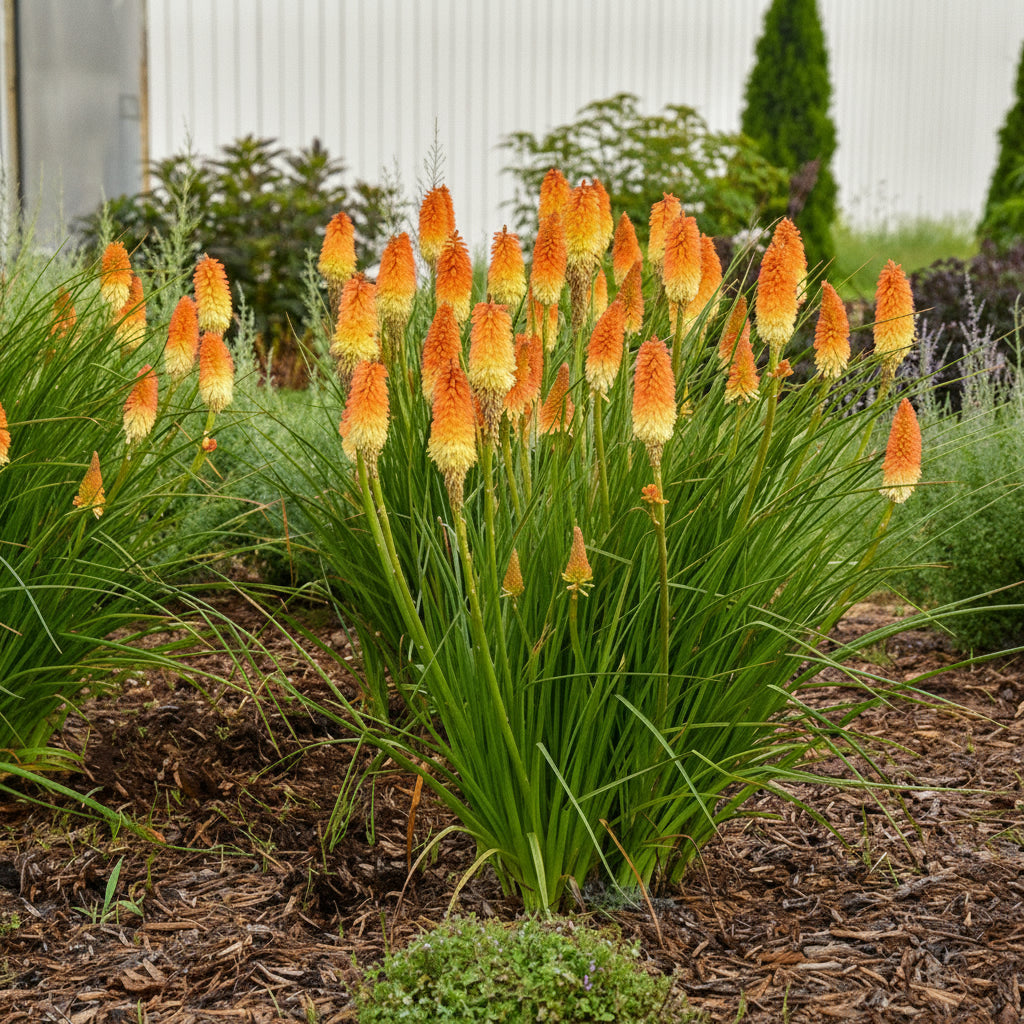
Royal Castle Hybrids — From Seed to a Border Full of Fire
A friendly guide to sowing, growing and enjoying Kniphofia in Hungary.
Come Into the Garden With Me…
Today, we're growing Red Hot Poker — Kniphofia ‘Royal Castle Hybrids’.
This is one of those plants that can change the shape of a border before it even flowers. First comes a strong fan of long, strap-like leaves. Then, when summer arrives, tall stems rise above the foliage and finish in glowing flower spikes.
Red at the top, orange through the middle, yellow or amber lower down — the flowers can look as though someone has lit a torch in the garden.
For a Hungarian garden, that combination of strong structure, summer heat tolerance and perennial life makes Kniphofia particularly interesting.
It is not a plant for a dark, damp corner. It wants sun, drainage and room to make a substantial clump.
And unlike many of the annual flowers in this series, this is a plant we hope to keep. If we establish it well, it can return year after year and become more impressive with age.
The seed-grown ‘Royal Castle Hybrids’ are especially enjoyable because they are a mixture. Individual plants may lean more toward red, orange, amber or yellow.
So we begin with a packet of seed, but we are really planting the beginnings of a long-term perennial display.
We will sow, wait, pot on, plant carefully, learn how much water a young Kniphofia needs, and then talk about the most important Hungarian winter question: how do we keep the crown from sitting wet and cold?
There is no need to rush. Red Hot Poker is not an instant-flower annual. It rewards patience.
By the end, you will know how to take this dramatic South African perennial from seed to a permanent place in your garden.
Ready? Let's grow a little fire in the border.
1. Meet Red Hot Poker
The botanical name is Kniphofia. You may also see the plant called Torch Lily or Tritoma.
Despite the word ‘lily’ in one of its common names, it is not a true lily. Kniphofia belongs to the Asphodelaceae family and comes originally from Africa, with many garden forms derived from South African species.
The plant grows from a perennial crown and forms a fountain-like clump of narrow leaves.
Then come the flower spikes — dense cylinders of tubular flowers opening progressively along the spike.
‘Royal Castle Hybrids’ are grown for their warm mixture of red, orange and yellow tones and their strong vertical presence in the garden.
Why does it look like a torch?
The individual tubular flowers are packed closely together. Because buds and open flowers can differ in colour as the spike develops, a single stem often shows several shades at once.
That colour transition creates the glowing, flame-like effect that gives Red Hot Poker its common name.
Perennial, not annual
Kniphofia is a perennial. In a suitable Hungarian position, a well-established clump can return for many years. The important words there are ‘suitable position’: winter drainage matters just as much as summer sunshine.
|
GOOD TO KNOW Red Hot Poker is a true perennial. In Hungary, the question is usually not whether it likes our summer — it does — but whether the crown has enough drainage to come through winter well. |
2. Finding the Right Place
Before sowing, decide where the mature plant might eventually live. This is not a tiny edging flower.
‘Royal Castle Hybrids’ are commonly listed at around 80–100 cm in flower, sometimes taller in especially good conditions. Give them enough room to be seen and enough surrounding space for the foliage.
Full sun is ideal. A bright south- or west-facing border is often excellent, provided the soil does not remain waterlogged.
Hungarian summers generally suit Kniphofia well. Heat and sunshine encourage strong growth and flowering once the plant is established.
The difficult season is more often winter. Cold alone is less worrying than a crown sitting in heavy, saturated soil through repeated freezes and thaws.
Choose a position where excess water can escape. On heavy clay, consider planting slightly raised and improving the surrounding soil structure rather than creating a wet planting pocket.
What kind of soil?
Aim for fertile but freely draining soil. Kniphofia appreciates moisture while actively growing, but the roots should never be left in stagnant winter wetness.
|
A COMMON MISTAKE Planting Kniphofia in the wettest part of the garden because it looks like a lush, moisture-loving plant. It appreciates water while growing, but stagnant winter wet can be far more damaging than summer dryness. |
3. The Red Hot Poker We Grow With You
At Holland Kertészet, the variety in this book is ‘Royal Castle Hybrids’.
It is a seed-grown mixture, so think of it as a family rather than a row of identical clones.
Some plants may flower more red-orange, others more amber-yellow, and the exact height and shape can vary a little from plant to plant.
Why choose Royal Castle Hybrids?
The appeal is simple: tall flower spikes, warm colour, perennial structure and a bold presence that still mixes naturally with grasses and other summer perennials.
A plant for the middle or back of the border
Use it where vertical flowers can rise above lower plants. The leaves form a strong base, while the flower stems create punctuation marks through the planting.
One isolated plant can look architectural. Three or five planted with breathing room can create a much stronger repeated rhythm.
Because the colours are warm, they combine beautifully with purple salvia, blue nepeta, echinacea, ornamental grasses, sedum and late-summer daisies.
A useful pollinator plant
The tubular flowers offer nectar and can attract bees and other visiting insects during the flowering season.
That makes Red Hot Poker more than a dramatic ornamental. In a mixed border, it can contribute both structure and summer food for pollinators.
|
GROW WITH US ‘Royal Castle Hybrids’ is the Red Hot Poker in the Holland Kertészet range. Seed-grown plants can vary slightly, which is part of the pleasure: a small group may give you a warm blend of red, orange, amber and yellow. |
4. Let's Sow
This is where patience begins. Kniphofia is straightforward from seed, but it is not a plant we expect to flower a few weeks after sowing.
Sow indoors from late winter through spring, or make a second sowing in early autumn if you can protect the young plants.
Use a fine, free-draining seed compost. Moisten it first so the tiny seed is not washed into a corner after sowing.
Surface sow or cover only very lightly. Light helps germination, so do not bury the seed deeply.
Keep the compost consistently moist rather than wet. A temperature around 18–24°C is suitable for germination.
Once seedlings appear, move them into bright light and slightly cooler conditions so they develop sturdy leaves rather than soft, stretched growth.
|
DON'T PANIC Germination can be uneven. Keep the seed tray consistently moist, bright and warm, and give slower seeds time rather than discarding the tray too quickly. |
5. From Seedling to Young Plant
The first seedlings will not look remotely like a mature Red Hot Poker. At first they are simply fine green leaves.
As they become large enough to handle, move them carefully into individual small pots or modules. Give the roots space without jumping immediately into an enormous container.
Keep young plants growing steadily. Do not let the compost swing repeatedly from bone dry to saturated.
When spring weather settles, begin hardening the plants off. Introduce them gradually to outdoor wind, sunlight and cooler nights.
In most Hungarian gardens, permanent planting is safest after the danger of severe spring frost has eased and the soil has warmed.
Space plants generously — roughly 45–60 cm apart is a useful starting point for a long-term border planting.
|
WHAT I WOULD DO If you are growing Red Hot Poker from seed for the first time, plant the young plants in a sunny nursery area or their final border with enough space to develop. Label them. Perennials have a habit of looking very ordinary before they suddenly become magnificent. |
6. The First Summer
A seed-grown Kniphofia may spend its first season building leaves, roots and crown rather than producing a full display of flowers.
That is not failure. Perennials often invest first in the underground structure that will support future flowering.
Water young plants during dry periods while they establish. Deep, occasional watering is better than keeping the surface permanently damp.
A modest spring feed or a little compost around established plants is usually enough. Avoid excessive nitrogen, which can encourage soft leafy growth.
Keep the crown clear of thick, wet mulch. Mulch around the plant if useful, but do not bury the centre of the clump.
By late summer, the plant should feel sturdier and more permanent — exactly what we want before winter arrives.
7. When Something Goes Wrong
Red Hot Poker is generally robust, but most problems tell us something about the growing conditions.
Leaves are pale and weak? Check light first. A shady position can produce softer growth and fewer flowers.
Brown leaf tips? Some older leaves naturally age, but prolonged drought, wind or irregular watering can exaggerate the damage.
The crown is soft or collapsing? Think immediately about drainage. Cold, wet soil can cause serious crown and root problems.
No flowers yet? If the plant is young, give it time. If it is mature, check sun, overcrowding and excessive feeding.
Slugs and snails may damage tender young leaves, especially while seedlings are small. Protect the young plants until the foliage becomes tougher.
|
A COMMON MISTAKE Cutting away all the leaves immediately after flowering. Remove the spent flower stem, yes — but leave healthy green foliage to keep feeding the crown for next year. |
8. And Then the Torches Light Up
This is the moment we have been waiting for.
A sturdy stem rises from the centre of the leaf fan. The flower head forms, colours begin to show, and then the tubular flowers start opening.
From a distance the spike looks like a flame. Up close, it is a surprisingly intricate structure made from dozens of individual flowers.
Cut spent flower stems back once the display is finished if you prefer a tidy garden. Leave the healthy foliage in place because it continues feeding the crown.
Flowering stems can also be cut for bold arrangements. Use a clean, sharp knife or secateurs and place the stem into water promptly.
In the garden, the vertical spikes are particularly effective repeated among softer, rounded flowers and moving grasses.
|
TRY THIS Plant Red Hot Poker among airy grasses and rounded flowers such as echinacea, salvia or sedum. The contrast makes the vertical torch-like spikes look even more dramatic without making the border feel stiff. |
9. Getting Through a Hungarian Winter
Autumn is when our attention shifts from flowers to survival.
Do not cut all the foliage down while it is still green. The leaves help feed and protect the crown.
The key winter job is drainage. If your garden tends to hold water, make sure autumn rain cannot collect around the centre of the plant.
In colder or exposed gardens, a light protective mulch around — not over — the crown can help buffer temperature swings.
In spring, remove damaged outer leaves and tidy the clump once new growth starts. Established plants can be divided every few years if they become congested.
10. Your Red Hot Poker Cheat Sheet
1. Choose ‘Royal Castle Hybrids’ for warm red, orange and yellow flower spikes.
2. Sow indoors from late winter through spring, or again in early autumn under protection.
3. Use fine, free-draining seed compost.
4. Surface sow or cover only very lightly.
5. Aim for roughly 18–24°C for germination.
6. Keep seed compost moist, never saturated.
7. Give seedlings excellent light as soon as they emerge.
8. Pot on when the roots need more room.
9. Harden young plants off gradually.
10. Plant in full sun.
11. Prioritise drainage, especially for winter.
12. Space plants about 45–60 cm apart.
13. Water young plants during establishment.
14. Established plants tolerate short dry periods better than seedlings.
15. Feed lightly rather than heavily.
16. Do not bury the crown under wet mulch.
17. Expect seed-grown plants to take time before their best flowering.
18. Remove spent flower stems when the display is over.
19. Leave healthy foliage to feed the plant.
20. Check winter drainage before the coldest weather arrives.
If You Remember Only Five Things…
1. Sunshine matters
Give Red Hot Poker a bright, open position if you want strong flowering stems.
2. Drainage is the winter insurance policy
A cold plant in well-drained soil is usually safer than a slightly warmer plant sitting wet.
3. Seed-grown perennials ask for patience
The first year may be mostly leaves and roots. The long-term reward is a clump that returns.
4. Water while establishing, then step back
Young plants need help. Mature clumps are far more resilient once their roots are established.
5. The foliage is part of the plant, not a nuisance
Those long leaves feed the crown and create the architectural base beneath the flowers.
One Last Walk Around the Garden
We started with seed so small that it gave no hint of the plant it would become.
We sowed it lightly, kept it moist, waited for fine green leaves and slowly built a young perennial rather than chasing instant flowers.
We found a sunny, well-drained place and gave the roots room to become permanent.
Then, when the plant was ready, a flower stem rose above the leaves and turned the border into something altogether more dramatic.
That is the pleasure of Red Hot Poker. It is not only a flower. It is shape, height, movement, colour and structure all at once.
In a Hungarian garden, the summer part is usually easy to understand: give it sun, sensible moisture and room to grow.
The real gardening skill comes in winter, when we remember that the crown wants protection from stagnant wetness more than it wants pampering.
If you get that balance right, ‘Royal Castle Hybrids’ can become one of those plants you stop thinking of as something you planted and start thinking of as part of the garden itself.
And each year, the first glowing flower spike will feel like the garden has struck a match.
Enjoy the colour. Enjoy the height. Enjoy the bees that come to investigate.
And when you're ready to grow something else…
Come into the garden with me.


