

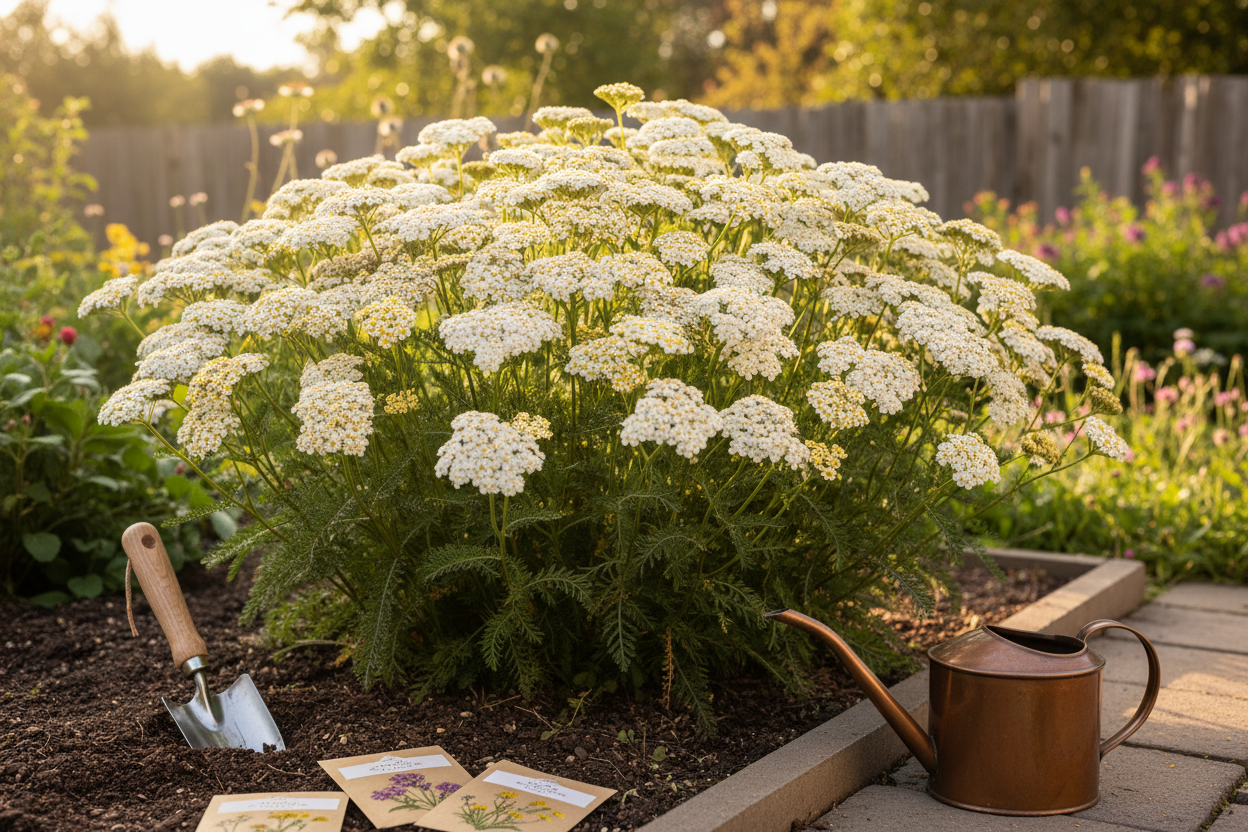
Yarrow (Achillea millefolium) is one of those rare plants that earns its place in the garden on almost every count. A hardy perennial herb historically prized for its delicate fern-like foliage, flat-topped flower heads, and near-indestructible nature, it rewards even the most distracted gardener with months of colour, a magnet for pollinators, and a wealth of traditional herbal uses. To grow yarrow successfully, the basic process involves sowing seeds at the surface (never buried deep), establishing them in well-drained soil with full sun, harvesting flower heads at peak bloom, and staying alert to the handful of fungal problems that can creep in under wet conditions.
Whether you are planting out a cottage border, building a pollinator patch, or creating a low-maintenance herbal corner, this guide covers every step, from sowing the first seed to protecting overwintering crowns in the coldest months.
Key Takeaways
-
Sow on the surface: Yarrow seeds need light to germinate, so it is essential to sow them on the soil surface, burying them kills germination rates. Start indoors 6-8 weeks before the last frost.
-
Drainage is everything: Yarrow is highly adaptable to various soil textures, but excellent drainage is paramount, the plant will not tolerate constantly saturated conditions, which quickly leads to root rot. If your soil holds water, amend with grit before planting.
-
Harvest in the morning: Harvest yarrow on a warm, sunny day when the plants are in full bloom, and wait until the dew has dried but before the plants' essential oils have dissipated in the heat of the day.
-
Avoid overfeeding: Yarrow does not require heavy fertilisation, in fact, excessive fertilisation can lead to weak, leggy growth and fewer flowers. A thin layer of compost in spring is usually sufficient.
-
Divide regularly: Yarrow is a true herbaceous perennial that dies back to the crown each winter and regrows from the base every spring. With good care, a yarrow plant can live for around 10 years, however, individual clumps often begin to decline after 3-5 years if they are not divided.
Quick-Start Prioritisation Framework
| Task | Best For | Effort Level | Time to Results |
|---|---|---|---|
| Sow indoors from seed | Beginners, maximum variety choice | Low | 10-14 days to germination |
| Direct sow outdoors | Large beds, low fuss | Low | 20-45 days to germination |
| Division of existing clumps | Propagating free plants, rejuvenating old patches | Medium | Blooms same season |
| Stem cuttings | Preserving a specific cultivar | Medium | 4-6 weeks to root |
| Container growing | Small gardens, patios | Medium | Blooms first year if started early |
Start here if you are:
-
A complete beginner: Sow indoors 6-8 weeks before last frost, fastest, most controlled path to healthy transplants.
-
Working with an existing garden bed: Division of a neighbour's established clump gives you free, already-rooted plants that bloom the same season.
-
Short on space: Container growing with a minimum 30 cm pot and gritty compost lets you manage spread and keep yarrow tidy.
Step 1: Sowing Yarrow Seeds Correctly
Timing Your Sow
Start Achillea seeds indoors 6-8 weeks before the last frost. In most of central and northern Europe, that means sowing from late January through to March. Seeds can also be started indoors or direct-sown outdoors in early spring once temperatures are reliably above 15°C.
Cold Stratification
Yarrow seeds benefit from a period of cold stratification. Though not required for germination, cold stratifying your yarrow seeds for one to two weeks prior to sowing will help improve the overall germination rate. To do this, wrap moist seeds in a damp paper towel, seal in a plastic bag, and place in the refrigerator for two weeks before sowing.
The Sowing Method
Sow the tiny seed atop moist seed-starting mix, barely pressing them in. Resist the urge to cover them with compost. Light is required for germination. Cover seeds with a thin layer of vermiculite to retain moisture and hold seeds in place, then bottom-water or mist lightly to avoid covering the seed.
At room temperature, seeds should germinate in 10 to 14 days. Keep the tray in a bright spot or under grow lights positioned about 15 cm above the seedlings.
Pro Tip: According to Seeds growing information, 3-5 weeks at 13-18°C in full light are ideal conditions for seedling development after germination. A cool, bright windowsill or an unheated greenhouse is perfect, avoid placing seedlings somewhere warm and dim, or they will stretch and become weak.
Transplanting and Spacing
When the yarrow seedlings have grown their second set of true leaves, they are ready to be transplanted into individual pots or into your garden. Weed out weaker plants until the remaining plants are 15 to 25 cm apart as they grow larger or as they are transplanted into the garden from indoors. Good spacing is not cosmetic; it creates the airflow that prevents fungal disease later in the season.
Step 2: Growing Yarrow Well
Soil and Sun
The most significant factor in cultivating healthy yarrow is ensuring it receives sufficient sunlight, meaning at least six hours of direct sun daily. Full sunlight encourages compact growth and abundant flowering, plants in partial shade tend to become elongated and floppy.
Yarrow thrives in poor or lean soil, which keeps the growth habit dense and upright. Planting in overly rich soil or heavily amending the site is discouraged because it promotes weak stems and leggy growth, often requiring staking. If your soil is heavy clay, work in horticultural grit before planting. According to Biology Insights' complete yarrow care guide, the focus should remain on facilitating rapid water drainage above all other soil considerations.
Watering
During the first growing season frequent watering is needed until the root system has fully developed. Once established, yarrow rarely needs supplemental irrigation and prefers its soil to dry out completely between watering sessions. Overwatering is the single greatest threat, increasing the risk of root rot and powdery mildew.
In practice yarrow plants need at least 25 mm of water per week until established, after which established plants are drought tolerant and should only be watered during droughts. Use drip irrigation or water at the base of the plant to keep the foliage dry.
Feeding
Yarrow needs very little feeding. A light layer of compost in spring is sufficient. Avoid heavy fertilising; it encourages foliage at the expense of flowers. If you do wish to feed, Plant Addicts' fertilising guide recommends applying a slow-release fertiliser once a year in the early spring when new growth emerges, and not again after that, as Plant Addicts' fertilising guide will not help the plants bloom more and will only encourage excess foliage growth that is weak and susceptible to disease and pests.
Deadheading and Pruning
Yarrow seeds benefit from a period encourages a new flush of bloom throughout the season. Cut back to the nearest set of healthy leaves after each flush. You should deadhead spent flowers throughout the summer to promote new growth and cut the foliage back to soil level after the first hard frost in winter.
Pro Tip: Avoid cutting the plant completely to the ground in late autumn. Leaving the basal rosette intact helps the plant survive extreme temperature fluctuations. This is particularly relevant in continental climates with hard frosts.
Division and Propagation
Divide yarrow every 3 to 5 years in early spring or fall to rejuvenate the centre of the clump and control its rhizomatous spread. Divide established yarrow clumps in the early spring or fall when the plant is dormant. Using a sharp spade, separate the clump into sections, ensuring each division has both roots and shoots, then replant the divisions in well-prepared soil, spacing them appropriately to allow for future growth.
For cuttings, Gardener's Path's growing guide explains that to propagate cuttings, take a sharp knife and cleanly cut a stem of soft spring growth off at the third or fourth leaf node down from the top, about six inches long, then remove the lower two leaves to reveal a bare stem.
Step 3: Harvesting Yarrow at Peak Potency
When to Cut
The most ideal time to cut yarrow is on a warm morning when the flowers are fully open, the dew has evaporated, and the leaves are completely green, not yellowing or browning. It is important to wait until the flowers have fully opened before harvesting. Cutting too early means lower concentrations of the plant's volatile oils and a shorter vase life for cut flowers.
Harvest yarrow leaves before the flowers start blooming for the most potency. Flowers should be harvested as soon as they bloom, at the peak of their freshness.
How Much to Cut
When harvesting herbs, only harvest about one-third of the plant at a time and do not cut the stems all the way to the ground. This will leave enough leaves for the plant to continue to thrive and will not cause too much stress to the plant. Frequent harvesting actually encourages more blooms. Therefore, a regular cutting routine, every few weeks during the flowering season, keeps the plant productive and looking its best.
Drying and Storing
Bundle stems together and hang them upside down in a dark, dry place. Once dried, store in airtight containers for future use. According to The Old Farmer's Almanac's yarrow guide, hang small bundles upside down in a dark, dry, well-ventilated area, alternatively, use a dehydrator on a low setting, and store dried flowers in airtight containers away from light.
Hang the bundles upside down in a dark, well-ventilated room and dry for 1-2 weeks. The flowers are ready when they feel crisp and break easily.

Step 4: Protecting Yarrow from Pests and Disease
Common Pests
Yarrow is a hardy, low-maintenance perennial and is generally resistant to pests and disease, making it a dependable choice for many gardens. However, problems can occasionally develop, especially in overly wet soil or crowded planting conditions.
The pests you are most likely to encounter are:
-
Aphids, which cluster on stems and flower heads and cause distorted growth
-
Spittlebugs, which leave foamy deposits on stems
-
Mealybugs, found occasionally on the fern-like foliage
The easiest way to deal with any of these bugs is to simply blast your yarrow with a strong stream of water (not so strong that you damage the leaves). The water should remove any aphids, mealybugs, or spittlebugs from the plant. Be sure to do this in the morning of a sunny day so the leaves can dry off. If a water blast proves insufficient, Gardener's Path's growing guide recommends insecticidal soap or neem oil as a follow-up treatment.
Fungal Diseases
Most commonly, plants will be affected by either botrytis mould or powdery mildew. These will both appear as a white powdery covering on the leaves.
-
Powdery mildew tends to appear later in the season, particularly after periods of humid weather. Pruning your plants often and watering them at ground level will help prevent powdery mildew from spreading.
-
Rust is a fungal disease that begins as rust-coloured spores on stems and leaves. Surrounding tissue can turn brown and in the case of a bad infection, growth can be stunted. Remove and dispose of infected material promptly, do not compost it.
-
Botrytis (grey mould) is best addressed by removing infected stems and sanitising your tools between cuts.
To reduce disease problems, thin out plants that become overcrowded and cut out any dead growth. Good air circulation is the single best preventative measure, which is exactly why proper spacing at planting time pays dividends for years.
Pro Tip: Yarrow is not particularly susceptible to pest or disease issues. Plants that are healthy are the least likely to have problems. Those that are stressed by less than optimal conditions may become vulnerable to infestation and infection. Prioritise drainage and airflow first, and chemical interventions become almost unnecessary.
Pet Safety
Even though yarrow is safe for humans, the same cannot be said for your furry friends. Both dogs and cats will experience adverse reactions if they ingest yarrow, as it is poisonous to both pets. Because yarrow is toxic to pets, it is unsafe to plant it in an area your pet has access to. Choose a raised bed, a walled border, or a separate section of garden if you share your home with animals.
Winter Protection
The main enemy of yarrow in the winter is poor drainage. If the soil is waterlogged during cold weather, the root ball will be starved of oxygen and rot. After a hard frost, cut back dead foliage. A light mulch after the ground freezes can help protect roots from freeze-thaw cycles. Container-grown plants need slightly more attention: yarrow growing in containers needs a bit more attention to its position and watering during the winter months, as plants in containers do not have the added benefit of insulation that a garden bed provides.
The Garden Benefits of Growing Yarrow
Yarrow earns double duty in any garden. This plant has extensive roots that draw nutrients from deep within the soil. It can bring potassium, calcium, magnesium, phosphorus, and copper to the surface, improving the soil quality for other plants when used as a mulch material or added to the compost pile.
One of the key benefits of yarrow is its ability to attract beneficial insects like lacewings and parasitic wasps, which prey on common pests like aphids and whiteflies. By attracting these predators, you are creating a balanced ecosystem where natural predators keep pest populations in check, reducing the need for pesticides. For any vegetable grower, planting yarrow along the border of the kitchen garden is one of the most effective, and lowest-effort, companion-planting choices available. Holland Kertészet carries a range of yarrow varieties suited to both ornamental and herbal use, making it straightforward to source exactly the colour and height you need for your planting scheme.
Frequently Asked Questions
How long does yarrow take to flower from seed?
The plants should start blooming their first year when started indoors early enough and transplanted out after the last frost. However, when started early, these perennial plants will actually produce blooms in their first year, which can then be used as cut flowers. Plants sown directly outdoors in late spring may not bloom until the following season.
How often should I water established yarrow?
Once established, yarrow is highly drought tolerant. Common yarrow is drought-tolerant once established, but if the garden gets less than 10 mm of rain in any given week, provide extra water to the plant. In practice, that means checking rainfall rather than watering on a fixed schedule. Overwatering does far more harm than underwatering with this plant.
Can yarrow be grown in a pot or container?
Yes, with a couple of important caveats. The container needs to have excellent drainage and be at least 30 cm in diameter, depending on how many other plants are included. Yarrow needs sharply drained soil and will not tolerate any standing water. The best soil to use for potting up yarrow is a pre-mixed, all-purpose potting soil that does not have fertiliser added. Yarrow really thrives in lean, loose soil, and potting soils with added fertiliser are generally too rich for a native plant like yarrow.
Is yarrow safe around children and pets?
Yarrow is considered safe for humans and has a long history of traditional medicinal use. However, avoid using yarrow if you have allergies to plants in the daisy family (Asteraceae), and pregnant individuals should avoid medicinal use. As noted above, yarrow is toxic to dogs and cats, so garden placement matters if you have pets.
How do I stop yarrow from taking over my garden?
Yarrow seeds benefit from a period through reseeding or via rhizomes, so dividing the plants every few years can facilitate the health of the plant and keep its footprint manageable. Deadhead spent flowers to encourage continuous blooming throughout the summer and to prevent self-seeding. If spread via rhizomes is a concern, growing yarrow inside a buried root barrier or in a container will contain the plant effectively.
Closing Note
Yarrow rewards a light touch. The more you resist the urge to feed, over-water, and fuss, the more compact, floriferous, and resilient the plant becomes. In my experience, the gardens where yarrow struggles most are those where the soil is too rich and the drainage too poor, conditions that encourage the soft, floppy growth that is most vulnerable to disease. Get the fundamentals right at sowing time, harvest little and often, and you will have a plant that gives back for a decade.
Sources
-
Yarrow Grow Guide, GrowVeg. Germination, sowing, and transplanting guidance. https://www.growveg.com/plants/us-and-canada/how-to-grow-yarrow/
-
How to Plant Yarrow Seeds, Eden Brothers. Stratification and outdoor sowing. Yarrow seeds benefit from a period
-
Planting Guide for Yarrow, Sow True Seed. Spacing, germination and harvest timing. https://sowtrueseed.com/pages/planting-guide-and-seed-saving-notes-for-yarrow
-
Yarrow Key Growing Information, Johnny's Selected Seeds. Temperature and light requirements. https://www.johnnyseeds.com/growers-library/flowers/yarrow/yarrow-key-growing-information.html
-
How to Grow Yarrow From Seeds, Gardening Plants and Flowers. Indoor seed starting method. https://gardening-plant.com/blogs/news/how-to-grow-yarrow-from-seeds
-
How to Forage, Harvest and Dry Yarrow, Oak Hill Homestead. Harvesting timing and technique. https://www.oakhillhomestead.com/2013/07/how-to-harvest-yarrow.html
-
How to Harvest and Dry Yarrow, Get Green Be Well. Cutting method and drying guidance. https://www.getgreenbewell.com/harvest-dry-yarrow-plant/
-
How to Dry Yarrow Flowers and Leaves, Homely Hens. Dehydrator and storage guidance. https://homelyhens.com/medicinal-herbal-remedies/how-to-dry-yarrow/
-
Growing, Harvesting, and Using Yarrow, Harvick Farms. Harvest and companion planting overview. https://harvickfarms.com/blogs/gardening/growing-harvesting-and-using-yarrow-natures-first-aid-herb
-
How to Grow and Take Care of Yarrow Plants, House Digest. Pests, diseases, and pet toxicity. https://www.housedigest.com/787766/how-to-grow-and-take-care-of-yarrow-plants/
-
Growing Yarrow Plant, Gardening Know How. Disease and care guidance. https://www.gardeningknowhow.com/edible/herbs/yarrow/growing-yarrow.htm
-
How to Grow and Care for Yarrow, Gardener's Path. Propagation, pests, and cultivation. https://gardenerspath.com/plants/flowers/grow-yarrow/
-
How to Plant, Grow and Care for Yarrow, Epic Gardening. Pest management and water treatment. https://www.epicgardening.com/yarrow-plant/
-
How to Grow Yarrow, The Old Farmer's Almanac. Comprehensive care, harvest, and division guide. https://www.almanac.com/plant/yarrow
-
How to Care for Yarrow: A Complete Guide, Biology Insights. Soil, water, and fertiliser guidance. https://biologyinsights.com/how-to-care-for-yarrow-a-complete-guide/
-
Yarrow Growing Guide, HOSS Tools. Water requirements and establishment. https://growhoss.com/blogs/growing-guides/yarrow
-
Fertilising Yarrow, Plant Addicts. Feeding schedule and soil pH. Plant Addicts' fertilising guide
-
Yarrow Winter Care, Plant Addicts. Overwintering, dormancy, and container care. yarrow growing in containers needs
-
Yarrow Care Guide, Gardeningin Steps. Lifespan and division timing. https://www.gardeninginsteps.com/article/yarrow-care-guide-7-common-questions-answered
-
How to Care for Yarrow, Greensoul Blog. Division, deadheading, and winter protection. https://greensoul.blog/how-to-care-for-yarrow-guide
-
The Many Uses and Benefits of Yarrow, Gardener's Path. Soil improvement and companion planting. https://gardenerspath.com/plants/herbs/yarrow-benefits-uses/
-
Attract Pollinators with Yarrow, Plant Grower World. Pollinator and beneficial insect attraction. https://plantgrowerworld.com/attract-pollinators-with-yarrow-a-comprehensive-guide/
-
Grow Yarrow, Florea Garden. Sowing indoors, compost feeding, and division. https://floreagarden.com/en/blogs/gardening-school/odla-rollika
-
Growing Yarrow: An Easy Pollinator and Medicinal Herb, Bell Garden Nashville. Harvest technique, drying, and medicinal cautions. https://bellgardentn.org/growing-yarrow-an-easy-pollinator-medicinal-herb/


