

From Curled Seeds to Golden Summer Flowers
A friendly guide to sowing, growing, cutting and enjoying calendula marigolds in Hungary.
Come Into the Garden With Me…
Today, we're growing marigolds. But before we put a single seed into the soil, we need to sort out one small gardening confusion: the word marigold can mean more than one plant.
The cheerful orange and yellow bedding plants many of us know as French or African marigolds belong to the genus Tagetes. They are wonderful plants, but they are not the main characters in this book.
Here we're growing Calendula officinalis - the pot marigold, the old-fashioned cottage-garden flower with soft green leaves and generous daisy-like blooms. This is the marigold behind varieties such as Touch of Red Buff, Radio Orange, Golden Emperor and Pacific Beauty in the Holland Kerteszet range.
And I think calendula deserves a whole little book of its own. It is one of those flowers that manages to be beautiful without being difficult. You can sow it directly into the garden. It grows quickly. It flowers generously. Bees and other pollinating insects visit it. The petals are edible when grown and handled appropriately. It makes a lovely cut flower. And if you let a few seedheads mature, it may even help with next year's garden by sowing itself.
In Hungary, calendula is especially useful because it enjoys the cooler edges of our growing season. It can flower beautifully through spring and early summer, sometimes pause when the hottest weather arrives, and return to form as conditions become kinder again. With a little planning, we can enjoy it for a surprisingly long time.
By the end, I want you to look at a handful of those funny curled calendula seeds and know exactly what comes next.
Ready? Come into the garden with me.
1. Meet the Marigold
Calendula officinalis has been grown in European gardens for generations. It is often called pot marigold, common marigold or simply calendula. In Hungary you may know it as koromvirag, and it has that lovely quality of feeling both familiar and newly fashionable at the same time.
A marigold - but not a Tagetes
This is worth remembering because garden centres and seed catalogues often use the word marigold for two quite different groups. Tagetes gives us the compact French marigolds and taller African marigolds with their strongly scented foliage. Calendula gives us softer, more open flowers on leafy stems and is the plant we are growing here.
What does calendula look like?
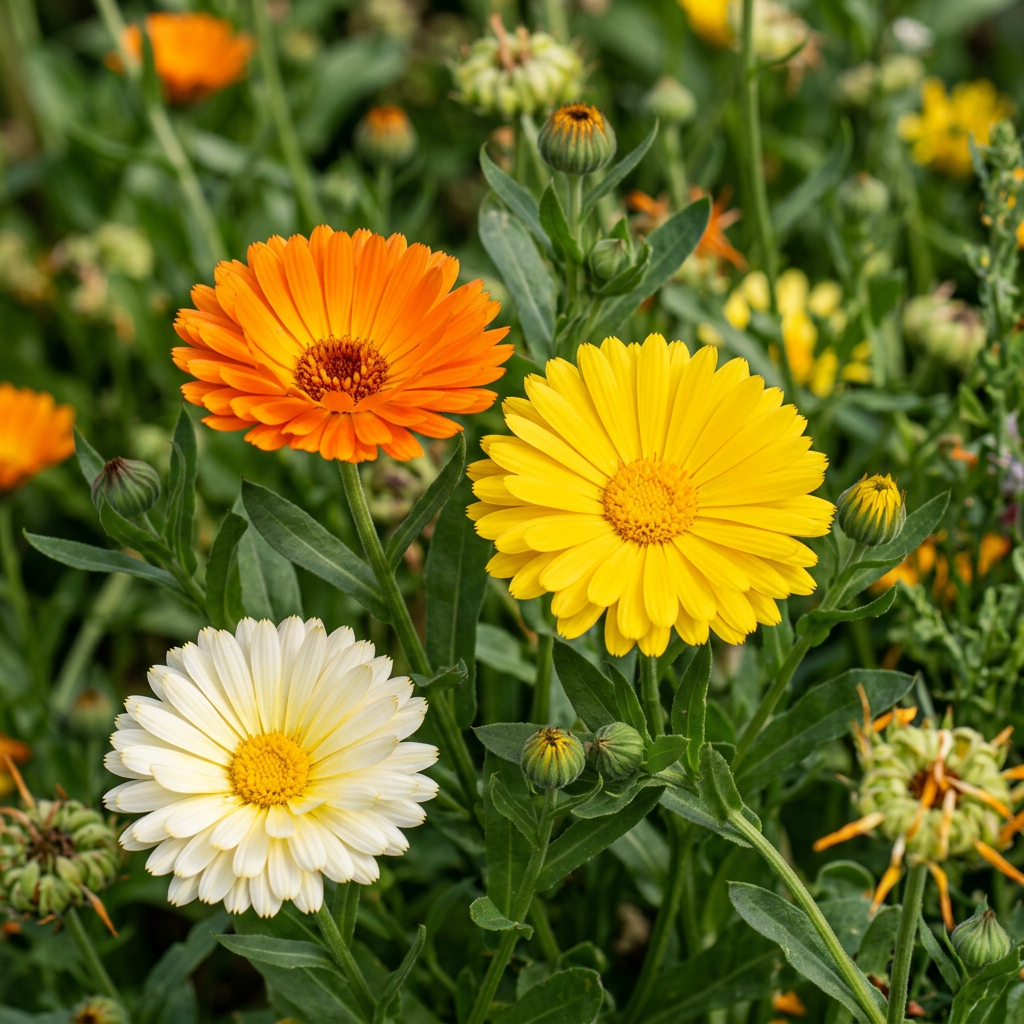
Calendula forms a bushy annual plant with slightly sticky, aromatic green leaves and upright stems carrying daisy-like flowers. Depending on the variety, the blooms may be single, semi-double or wonderfully full and ruffled.
The classic colours are orange and golden yellow, but modern varieties have given us cream, apricot, soft buff, bronze and flowers with red backs or darker centres. That broader palette is one reason calendula has returned so strongly to cutting gardens and naturalistic borders.
|
GOOD TO KNOW Calendula is an annual. It completes its life cycle in one growing season, but it is very good at producing seed. Leave a few mature heads and you may find new seedlings appearing the following year. |
2. Why Marigolds Work So Well in Hungary
Give it sun
Choose a bright, sunny position. Calendula can tolerate a little light shade, but the best flowering generally comes with plenty of sun. A vegetable garden edge, cutting patch, cottage border, sunny courtyard or large container can all work beautifully.
Ordinary soil is fine
Calendula is not a plant that demands perfect soil. Give it reasonably fertile, well-drained ground and it will usually be quite content. Very rich soil can create lots of leafy growth, so this is another occasion when we do not need to turn the flower bed into a luxury buffet.
If your soil is heavy clay, the main issue is drainage. Improve structure where necessary and avoid places where water sits around the roots after rain.
Cooler weather is its friend
This is where calendula differs from many classic summer bedding plants. It can be surprisingly happy in cool spring weather. That gives us the chance to sow relatively early and enjoy flowers before the hottest part of summer arrives.
|
A COMMON MISTAKE Waiting until late May to think about sowing. Calendula can be started much earlier. In Hungary, an early spring sowing often gives you a useful head start before serious summer heat arrives. |
3. The Marigolds We Grow With You
At Holland Kerteszet, the current marigold range includes some lovely Calendula officinalis varieties, and they each create a different feeling in the garden.
Touch of Red Buff
Touch of Red Buff is the one I would show to someone who says, 'I don't really like marigolds.' Its flowers move away from the traditional bright orange and into soft apricot, cream and buff tones, with warmer red colouring on the reverse of the petals. The result can feel almost antique.
The plants grow to around 50-60 cm and are useful for cutting. The flowers are also edible when grown without unsuitable chemical treatments and prepared correctly. In a bouquet, Touch of Red Buff is beautiful with cream, dusty pink, burgundy and soft blue flowers.
Radio Orange
Radio Orange brings us back toward classic calendula colour, but with more texture. Its rich orange flowers are wonderfully cheerful and have the sort of presence that makes a vegetable garden or cottage border look immediately more alive.
Golden Emperor
Golden Emperor is exactly what the name suggests: golden yellow, sunny and uncomplicated. It grows to around 50 cm and makes a useful cut flower as well as a bright garden plant.
Pacific Beauty
Pacific Beauty is a classic calendula mixture, usually giving us a range of warm yellow and orange shades. If you want the traditional cheerful cottage-garden feeling rather than a carefully controlled colour scheme, a mixture like this is very easy to love.
|
GROW WITH US Choose the variety that makes you want to sow it. Touch of Red Buff for soft, romantic bouquets; Radio Orange for rich orange energy; Golden Emperor for clear golden yellow; Pacific Beauty for a cheerful warm mixture. The best choice is the one you are excited to walk outside and see. |
4. Let’s Sow Some Marigolds
Open the packet and take a look at the seeds. Calendula seeds are wonderfully strange: pale brown, curved, ridged and sometimes almost like tiny dried caterpillars. They are large enough to handle easily, which makes this an excellent flower for first-time seed sowers and children.
When should we sow?
For Hungary, a spring sowing from around March onward works well, depending on weather and whether you are sowing under protection or directly outside. Holland Kerteszet's Touch of Red Buff is recommended for sowing from the end of March through May, while other calendula types can also be sown through spring.
Direct sowing
Calendula is one of those lovely flowers that makes direct sowing feel sensible. Prepare a fine patch of soil, remove large weeds and stones, and make a shallow drill about half a centimetre to one centimetre deep.
Place the seeds individually rather than pouring the entire packet into one small hole. Cover lightly with soil and water gently.
Starting in pots or modules
If spring weather is unreliable, sow one or two seeds per module in seed compost. Keep them bright and moderately cool once they germinate. Calendula does not need tropical conditions; in fact, strong, sturdy seedlings are more useful than soft, stretched ones raised in excessive warmth.
|
DON'T PANIC Calendula seeds do not all look identical. Some are tightly curled, some broader and some almost hooked. That variation is normal. Sow the healthy, firm seeds and let the plant do the rest. |
5. From Seedling to Strong Plant
Calendula usually germinates quite willingly, and the first seedlings are easy to recognise once you know them. Soon the plants begin forming broader leaves and start looking less like 'seedlings' and more like proper little marigolds.
Thinning
But crowded plants compete for light, water and airflow. Give your calendula room. For many taller cutting types, around 20-30 cm between plants is a useful home-garden guide. Smaller plants can be closer, but remember: we are spacing the plant it will become, not the seedling you see today.
Hardening off
Plants started indoors need a gradual introduction to Hungarian outdoor life. A warm windowsill has no wind, no sudden cold night and no strong midday sunshine.
Move seedlings outside for short periods in a sheltered place, then gradually increase their time outdoors over roughly a week. Once they are accustomed to real weather and the risk of severe frost has eased, they can stay outside.
Pinching - should we?
For taller calendula grown for cutting, pinching the growing tip when plants are young can encourage branching and produce more flowering stems. It is not compulsory, but it can create a bushier plant.
|
WHAT I WOULD DO Sow more than one small batch. A second sowing two or three weeks after the first can extend the season and gives you a useful backup if spring weather is unkind to the first seedlings. |
6. Keeping Marigolds Happy
Watering
Young plants need reliable moisture while their roots establish. Once they are growing well, water according to weather and soil conditions rather than by habit.
A calendula in open ground near Lake Balaton may need much less water than one growing in a terracotta pot on a sunny Budapest balcony. Push a finger into the soil. If it is still comfortably moist below the surface, leave the watering can alone.
Feeding
Calendula generally does not need heavy feeding in ordinary garden soil. In containers, an occasional balanced or flowering-plant feed can be useful because nutrients wash out more quickly.
Deadheading
This is the job that makes the biggest visible difference. Remove fading flowerheads regularly and the plant has a reason to keep producing more.
|
GOOD TO KNOW Calendula often slows down during very hot weather. Keep plants reasonably watered, continue deadheading, and don't be too quick to remove them. They may produce another flush when late-summer or early-autumn temperatures become kinder. |
7. When Something Goes Wrong
Aphids on the new growth
Aphids may gather on tender stems and buds. Check the growing tips during your normal garden wander. A small colony can often be rubbed off or washed away before it becomes a major problem.
Powdery mildew
A pale, floury coating on the leaves is often powdery mildew. It is more likely when plants are stressed, crowded or growing with poor airflow.
Seedlings disappeared overnight
Slugs and snails can be very interested in tender young calendula. Look around after rain or in the evening. Choose control methods suitable for your garden, pets and wildlife.
|
A COMMON MISTAKE Pulling plants out the moment hot weather slows flowering. In Hungary, calendula can sometimes regain enthusiasm when temperatures ease. Give a healthy plant a little time before deciding its season is finished. |
8. Flowers for the Garden, Vase and Kitchen
A calendula bud opens into one of those wonderfully uncomplicated flowers that makes a garden look happier immediately. Golden yellow catches the light. Orange glows. Touch of Red Buff brings something softer and almost vintage.
For the vase
Calendula makes a very useful cut flower, especially the taller varieties. Cut stems when the flowers are just opening or newly open, ideally in the cooler part of the day.
Use clean snips, strip foliage that would sit below the waterline and put the stems into clean water promptly. Mix them with cosmos, cornflowers, scabiosa, grasses, yarrow or other loose cottage-garden flowers.
Edible petals
Calendula petals are traditionally used as edible flower petals and can add colour to salads, butter, rice dishes and decorations. But there is one rule I want to make very clear: only eat flowers you have positively identified as edible and that have been grown without unsuitable pesticides or other treatments.
For pollinators
Single and more open calendula flowers can provide useful pollen and nectar for visiting insects. Let some flowers remain in the garden rather than cutting everything. A cutting garden can still be a living garden.
|
TRY THIS Grow one patch mainly for cutting and another where you allow flowers to stay longer for pollinators and seed. It removes the feeling that every beautiful flower has to choose between the vase and the garden. |
9. Seeds, Self-Sowing and the End of the Season
If you stop deadheading a flower and leave it alone, something wonderful happens. The petals fade, the centre dries and a ring of strange curled seeds begins to form.
Saving seed
Wait until the seedhead is dry and the seeds have turned firm and brown. Choose a dry day, cut the head and let it finish drying indoors somewhere airy if necessary.
Rub the seeds free, remove obvious plant debris and store them in a labelled paper envelope somewhere cool, dark and dry.
If you are saving from a named variety, remember that seedlings may not always come perfectly true, especially if different calendulas have been growing and pollinating nearby. I don't see that as a disaster. Sometimes next year's surprise is half the fun.
Letting it self-sow
Leave a few seedheads on the plants and let ripe seed fall. In a suitable position, calendula may produce volunteer seedlings later or the following season.
Autumn sowing
Calendula can also be sown in autumn in suitable conditions for earlier flowering the following year. In Hungary, success depends on location, winter severity and drainage. If you enjoy experimenting, try a small protected sowing rather than risking your entire seed supply.
|
GOOD TO KNOW Saving seed turns one packet into a continuing garden story. Label it with the variety and year. Next spring, you'll be very pleased you did. |
10. Your Marigold Cheat Sheet
We've gone from curled little seeds to armfuls of warm summer flowers. So let's put the whole process in one easy place.
1. Know which marigold you're growing. This book is about Calendula officinalis, the pot marigold - not Tagetes.
2. Choose a sunny, well-drained place.
3. Sow from early spring onward, depending on weather and whether you're starting under protection or directly outside.
4. Sow shallowly. Calendula does not need to be buried deeply.
5. Keep the seedbed moist while germination begins.
6. Thin seedlings so mature plants have room and airflow.
7. Harden off any plants raised indoors before permanent planting.
8. Water young plants while they establish.
9. Once established, water according to the soil and weather - not the calendar.
10. Don't overfeed. Rich leafy plants are not our goal; flowers are.
11. Deadhead regularly if you want a long flowering season.
12. Expect very hot Hungarian weather to slow the plants temporarily.
13. Watch for aphids, mildew, slugs and snails.
14. Cut flowers regularly for the house.
15. If using petals as food, grow and handle the flowers appropriately and avoid unsuitable chemical treatments.
16. Leave some flowers for insects.
17. Leave a few seedheads if you want to save seed.
18. Collect seed only when it is properly mature and dry.
19. Let a few plants self-sow if you enjoy surprises.
20. Next year, grow the colour you loved most - plus one you haven't tried yet.
If You Remember Only Five Things…
1. Calendula is the marigold we are growing here
It is Calendula officinalis, often called pot marigold. French and African marigolds belong to Tagetes and deserve their own book.
2. Start earlier than you think
Calendula enjoys cooler weather, so an early spring start in Hungary can give you flowers before the hottest weeks arrive.
3. Sunshine and drainage matter more than pampering
Good light, sensible watering and ordinary soil are usually enough. Don't overcomplicate it.
4. Keep picking or deadheading
The more consistently you remove finished blooms, the longer the plant has a reason to keep producing flowers.
5. Save some seed
Those strange curled seeds are next year's garden waiting in your hand.
One Last Walk Around the Garden
Do you remember what we started with? A handful of dry, curved seeds that hardly looked capable of becoming a flower garden.
We sowed them shallowly, watered gently and waited. Seedlings appeared, we gave them room, and before long the first warm-coloured flowers opened.
Perhaps Golden Emperor became your patch of sunshine. Maybe Radio Orange brought the strongest colour, Pacific Beauty gave you a cheerful mixture, or Touch of Red Buff completely changed what you thought a marigold could look like.
Along the way, you learned that an easy flower does not have to be an ordinary one. Calendula can live beside vegetables, fill a cottage border, feed visiting insects, brighten a vase and, when grown appropriately, even give us edible petals.
Next year you'll know when to sow, when to thin, when to deadhead and when to simply let a healthy plant wait out the hottest Hungarian weather. And when those strange curled seeds appear at the end of the season, you'll know they are next year's garden waiting in your hand.
So grow the orange ones if orange makes you happy. Grow the soft buff ones if you love romantic colours. Cut some, leave some for the insects, save some seed - and enjoy how easily one small packet can become a summer full of flowers.
When you're ready for the next plant…
Come into the garden with me.


