

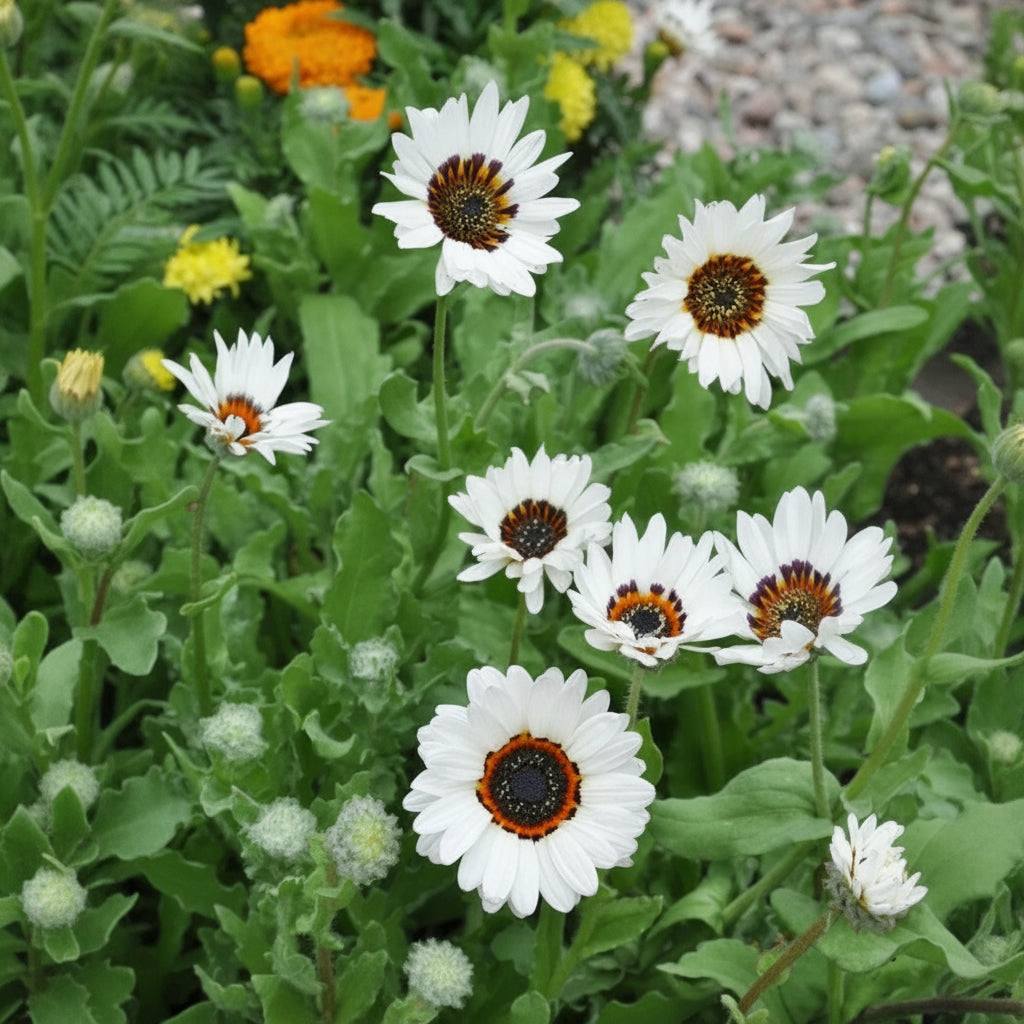
Arctotis fastuosa • White with Dark Ring
A friendly guide to sowing, growing, cutting and enjoying Venidium in Hungary.
Come Into the Garden With Me…
Today, we're growing Venidium - one of those flowers that looks as though someone painted a dramatic ring around a daisy with a very steady hand.
The packet in the Holland Kertészet range is Horti Tops Venidium. It is the white-flowered form with a dark ring around the centre, a striking annual that grows to about 60 cm and makes an excellent cut flower.
You may see two botanical names for it. The seed trade still commonly uses Venidium fastuosum, while current botanical references place the species in the genus Arctotis as Arctotis fastuosa. They are the same plant for our gardening purposes, so in this book I will use the familiar garden name Venidium while also giving you the accepted botanical name.
Its origins explain almost everything about how we should grow it. This is a South African annual from dry, sunny country. It wants light, warmth and free drainage. That makes it particularly interesting for Hungarian gardens where summer sun can be intense and rainfall unreliable.
We will start with the seed packet, learn when to sow, how to raise sturdy young plants, where to place them, how much water they actually need, how to keep flowers coming, and when to cut them for the vase.
|
GOOD TO KNOW |
1. Meet Venidium
Venidium belongs to the daisy family, Asteraceae. Like a sunflower or a true daisy, what looks like one flower is really a flower head made up of many tiny florets.
The form sold in our range has white ray petals surrounding a conspicuous dark ring and central disc. On a bright day the flowers open widely and can reach an impressive size for such an easy annual. Against silver-green foliage, the contrast is elegant rather than loud.
A South African sun lover
Arctotis fastuosa is native to the Cape Provinces of South Africa, where it grows as an annual in dry or semi-dry habitats. That background tells us not to pamper it with constantly wet soil or heavy feeding.
Annual in Hungary
In Hungary, treat Venidium as an annual. Sow it in spring, enjoy the flowers through summer, collect seed if you wish, and expect frost to finish the plants in autumn. There is no need to try to overwinter it outdoors.
2. The Venidium We Grow With You
Our Holland Kertészet packet is Horti Tops Venidium - 0.25 g, the white-flowered form with the characteristic dark ring.
• Botanical name: Arctotis fastuosa, still widely sold as Venidium fastuosum.
• Height: approximately 60 cm.
• Colour: white flowers with a dark ring and dark centre.
• Sowing: mid-March to mid-April under protection, or mid-April to the end of May outdoors.
• Transplanting: about 5-6 weeks after sowing.
• Best position: full sun.
• Use: borders, sunny beds, containers and cut flowers.
|
GROW WITH US |
3. Finding the Right Place
Venidium is not a plant for a gloomy corner. Give it as much sunshine as you reasonably can.
Full sun
Aim for six or more hours of direct sun. In the strongest Hungarian summer heat, established plants cope well provided their roots are not trapped in bone-dry containers, but shade will usually reduce flowering.
Drainage before richness
Choose soil that drains freely. Ordinary garden soil is fine, and lean soil is often better than heavily manured ground. Too much nitrogen can produce lush leaves and fewer flowers.
If your soil is heavy clay, improve the planting area with grit and organic matter that helps structure, or raise the planting level. A sunny raised bed or large container can be an excellent alternative.
|
A COMMON MISTAKE |
4. Let's Sow
The packet gives us two good sowing routes, and both work well in Hungary.
Protected sowing: mid-March to mid-April
Sow in trays or small pots under protection. Use a fine seed compost, moisten it before sowing, then space the seeds thinly and cover lightly. Keep the compost gently moist rather than saturated.
A bright position is important as soon as seedlings appear. Stretched seedlings usually mean too little light or too much warmth after germination.
Outdoor sowing: mid-April to the end of May
Once soil has warmed and conditions are reasonably settled, sow into a prepared seedbed outdoors. This is simple and avoids keeping trays indoors, but young seedlings must be protected from drying out while roots are still shallow.
Whichever route you choose, the packet recommends transplanting after about five to six weeks. Move seedlings carefully and avoid damaging the developing roots.
|
DON'T PANIC |
5. From Seedling to Garden
Once the young plants have several true leaves, they begin to look less like fragile seedlings and more like small grey-green daisies.
Harden them off
Plants raised under cover need a gradual introduction to outside wind, sun and cool nights. Put them outdoors for increasing periods over roughly a week before planting permanently.
Spacing
Allow around 25-30 cm between plants. Venidium needs enough air around the foliage, and the stems branch more attractively when they are not crushed together.
Planting out in Hungary
The packet allows planting after the young plants are ready, but in practice avoid exposing tender seedlings to a hard late frost. In many Hungarian gardens, late April into May is a comfortable period, depending on local weather.
Water well after planting. For the next couple of weeks, keep an eye on moisture while roots establish. After that, the plant becomes much more tolerant of dry spells.
6. Summer Care
Once Venidium settles in, it becomes one of those reassuring plants that does not require constant intervention.
Water deeply, not constantly
Established plants are reasonably drought tolerant, but they flower better if severe drought is broken by a thorough watering. Let the upper soil begin to dry between waterings rather than keeping the root zone permanently wet.
Containers need more attention
A plant in a pot has far less soil to search for water. During a hot Hungarian July, check containers frequently and water thoroughly when needed. Always let excess water escape through drainage holes.
Feeding
In ordinary garden soil, heavy feeding is unnecessary. Container plants may benefit from an occasional low-nitrogen flowering feed, but do not push soft leafy growth.
Deadheading
Remove faded flowers if you want the neatest appearance and a longer display. Leave a few later flower heads if you want to collect seed.
|
HUNGARIAN SUMMER NOTE |
7. Flowers, Pollinators and the Vase
The big white flowers are not only decorative for us. Their open daisy structure makes the central florets easy for visiting insects to access on sunny days.
For cutting, choose flowers that are newly open and stems that feel firm. Cut in the cool of the morning, strip leaves that would sit below the water line and place stems into clean water immediately.
A flower that follows the sun
Like many relatives from southern Africa, Venidium flowers respond strongly to light. Blooms may close or partly close in dull weather and open again when strong sunshine returns. That is normal behaviour, not a sign that the plant is failing.
|
TRY THIS |
8. When Something Goes Wrong
Lots of leaves, few flowers
Check sunshine first. Then think about feeding. Too much nitrogen and too little light are common reasons for leafy growth with disappointing flowering.
Plants collapse at the base
Wet, poorly drained soil can damage the roots and crown. Improve drainage and reduce watering frequency rather than adding more water automatically.
Seedlings become long and floppy
They need stronger light and often slightly cooler growing conditions after germination. Turn trays regularly if they lean toward a window.
Leaves wilt in afternoon heat
Check the soil before watering. A temporary afternoon droop can recover as temperatures fall. If the soil is genuinely dry several centimetres down, water deeply.
Aphids
Soft new growth may occasionally attract aphids. Small populations can often be washed away with water or left for ladybirds and hoverflies to control.
9. Pots and Garden Design
Venidium can be very successful in a large container, especially on a sunny terrace where its white flowers can be seen close up. Use a pot at least 25-30 cm deep with generous drainage holes and a free-draining compost.
Do not overcrowd the container. One strong plant in a medium pot or three in a broad trough will usually look better than many plants competing for the same small volume of soil.
Where it works in a border
At around 60 cm, this Venidium sits comfortably in the middle of a sunny border. The dark ring in the flowers is particularly effective beside burgundy foliage, deep purple flowers, blue flax, lavender, ornamental grasses and silver-leaved plants.
A dry-garden feeling
Because the plant enjoys sun and drainage, it fits naturally into gravel gardens and Mediterranean-style plantings. Combine it with other plants that appreciate similar conditions rather than placing it among thirsty moisture-lovers.
|
DESIGN IDEA |
10. Saving Seed
If you want to grow Venidium again next year, allow several of the healthiest late-season flowers to mature rather than deadheading everything.
Wait until the seed heads are fully dry. Collect them on a dry day, separate the seed from loose chaff and store it in a labelled paper envelope somewhere cool, dark and dry.
Seed saved from a named or selected form may show some variation in the next generation, especially if other compatible Arctotis forms are flowering nearby. That is part of the fun of seed saving.
11. A Simple Venidium Calendar for Hungary
• MARCH: Begin protected sowing from mid-month.
• APRIL: Continue protected sowing; from mid-month begin outdoor seedbed sowing when conditions allow.
• MAY: Continue outdoor sowing to the end of the month. Harden off and transplant earlier seedlings.
• JUNE: Plants establish and begin vigorous growth. Water deeply during dry spells.
• JULY: Main flowering period. Deadhead and cut flowers regularly.
• AUGUST: Keep deadheading; leave a few good flowers for seed if desired.
• SEPTEMBER: Flowering may continue in warm weather. Begin collecting dry seed heads.
• OCTOBER: First hard frosts usually finish the plants. Clear spent growth and save labelled seed.
|
THE RHYTHM OF THE PLANT |
12. Your Venidium Cheat Sheet
• Common name: Venidium / monarch-of-the-veld.
• Accepted botanical name: Arctotis fastuosa; Venidium fastuosum is a synonym still used in horticulture.
• Height: about 60 cm.
• Life cycle: annual.
• Position: full sun.
• Soil: well drained; avoid heavy feeding.
• Sowing under protection: mid-March to mid-April.
• Outdoor sowing: mid-April to end of May.
• Transplant: about 5-6 weeks after sowing.
• Watering: regular while young, deeper and less frequent once established.
• Best uses: sunny borders, dry-style planting, containers and cutting.
|
IF YOU REMEMBER ONLY FIVE THINGS |
And Then One Morning…
There is the first flower.
For weeks you have watched grey-green leaves and wondered whether the plant was doing very much at all. Then one stem lifts above the foliage and a white flower opens, neat and bright, with that extraordinary dark ring around its centre.
It is one of those flowers that looks designed rather than grown. Yet the plant itself asks for remarkably little: sunshine, drainage, a sensible drink when it is young, and enough space to show what it can do.
That is exactly why Venidium deserves a place in a Hungarian summer garden. It comes from a climate that understands strong sun. It does not need constant feeding. It can stand beside gravel, herbs and other drought-tolerant flowers without looking out of place.
And by the time autumn arrives, you may already have a paper envelope of seed ready for next spring.
Until then, enjoy the flowers. And whenever you're ready to grow something new…
Come into the garden with me.


