

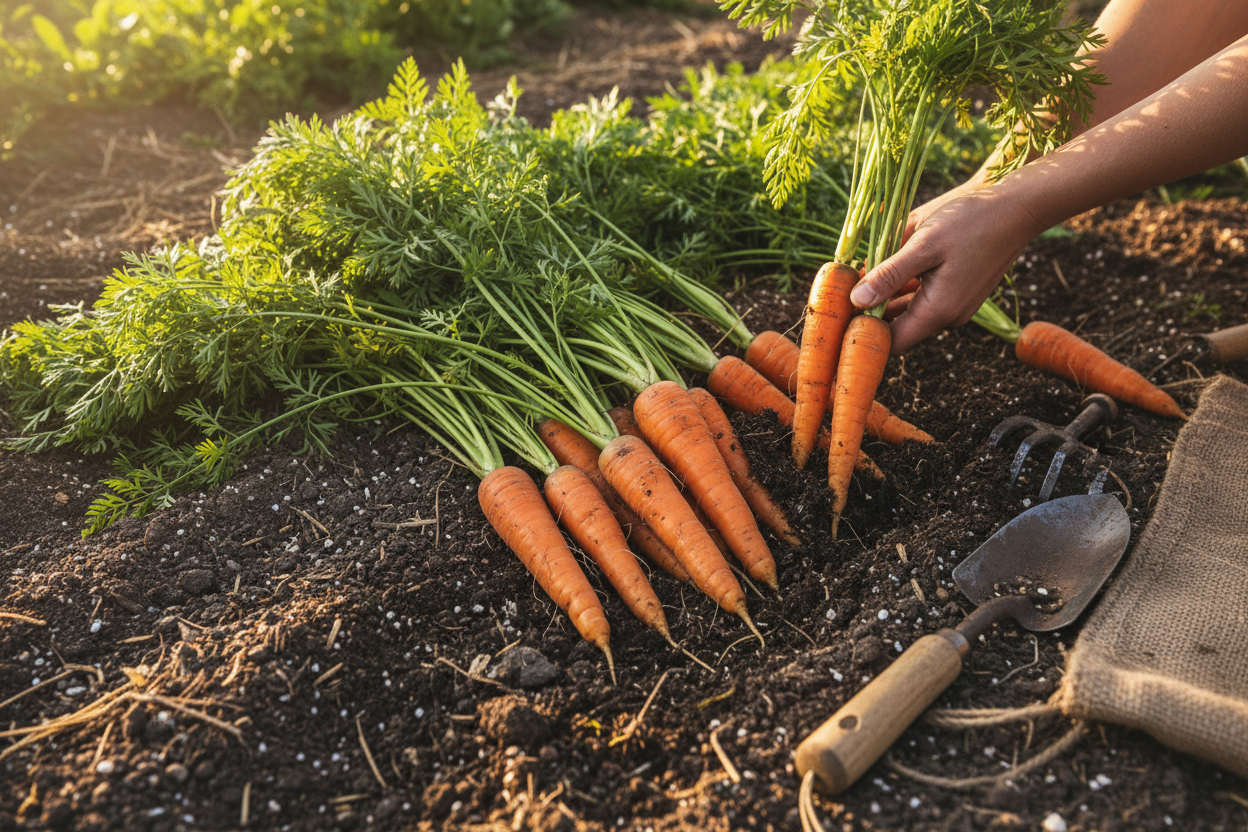
Growing your own carrots is one of the most rewarding things you can do in the garden. To grow carrots successfully, the basic process involves choosing the right variety for your soil, preparing a loose and stone-free bed, sowing seeds directly, thinning the seedlings, and harvesting at the right moment. Get any one of those steps right and you will notice the difference immediately.
Carrots grown in the garden taste more flourful, fresher, and juicier because the sugar that makes a carrot sweet begins to be replaced by fibre as it ages in grocery stores. That alone is reason enough to dedicate a bed to them. Carrots are a particularly good source of beta-carotene, fibre, vitamin K1, potassium, and antioxidants, making them as good for your body as they are satisfying to pull from the earth. This guide walks you through every stage, from choosing the right variety to spotting and managing the most common diseases.

Key Takeaways
-
Soil preparation is the single most important step: Carrots grow best on deep, loose well-drained mineral or organic soils with good water-holding capacity and few physical obstructions, such as stones. Before you sow a single seed, dig your bed to at least 25 cm.
-
Match the variety to your soil: Carrots thrive in various soil types but avoid compacted soil. Have heavy soil? Opt for short and thick varieties like Chantenay. For sandy soil, long and thin types like Amsterdamse Bak are your best bet. Choosing correctly saves enormous frustration.
-
Thinning is non-negotiable for quality roots: It is difficult and tedious, but do your best to leave only one carrot plant every 5-10 cm. Skipping this step produces forked, stunted roots every time.
-
Frost improves flavour: As cool-season root vegetables carrots like a little chill. In fact, carrots generally taste better after a frost or two since the cold weather alerts the carrots to store energy (aka sugars) in their roots. Delay your autumn harvest until after the first frost for the sweetest results.
-
Prevention beats cure for diseases: For fungal and bacterial diseases removing the affected plants and practising good crop rotation and garden hygiene for the following year are your best choices. Build healthy habits from the outset rather than reacting to problems.
Quick-Start Prioritisation Framework
| Strategy | Best For | Effort Level | Time to Results |
|---|---|---|---|
| Nantes variety in raised bed | Beginners, small gardens | Low | 60-70 days |
| Flakkee in heavy garden soil | Established plots, clay soil | Medium | 65-75 days |
| Parisian / round types in containers | Balconies, poor or shallow soil | Low | 50-60 days |
| Amsterdamse Bak in deep sandy beds | Juicing, larger plots | Medium | 75-85 days |
| Chantenay for long-term storage | Allotments, bulk growing | Medium | 70-80 days |
Start here if you are:
-
A complete beginner: Choose Nantes, Nantes is the best carrot variety to start with. These carrots are shorter and cylindrical with blunt ends, making them more forgiving to grow.
-
Working with containers or poor soil: Parisian carrots do not require deep soil, making them the best carrot variety for containers, grow bags, or gardens with poor soil.
-
Focused on storage: Berlikum carrots are one of the best for long-term storage because they have a lower moisture content.
Understanding the Different Kinds of Carrots
Choosing the right variety before you plant is one of the highest-leverage decisions you will make. There are so many more varieties to try, from Belgian Jaune du Doubs to Purple Sun to Parisian heirlooms that are round. They fall into five main groups, each suited to different conditions and culinary purposes.
The Four Main Carrot Types
Flakkee carrots are the long, slender roots most people picture from the supermarket. These carrots grow best in loose deep, sandy soil, where their roots can stretch without hitting resistance. Because they take 75 to 85 days to mature, they are a long-season crop, meaning they take more patience than some other varieties. If you want to juice your harvest, Imperator is an excellent choice.
Nantes types are the friendliest option for home growers. With a 60 to 70-day maturity time they grow faster than many other carrots, making them ideal for spring and autumn plantings. The flavour is sweet, crisp, and tender, which is why they are a favourite for fresh eating.
Chantenay carrots are the short, broad-shouldered workhorses of the vegetable garden. Chantenay is short, broad-topped, stores well, and ideal for heavy soils. Because of their shorter root structure, Chantenay carrots are also a great option for container gardening. However, one thing to watch out for is that if they grow too large, they can become woody and tough, so harvesting them at the right time is key.
Parisian (round) carrots are the fastest-maturing option. These carrots mature quickly in just 50 to 60 days, making them a great choice for fast harvests. The flavour is sweet, mild, and tender, making them a favourite for snacking or roasting.
Pro Tip: Growing a few varieties of carrots with different days to maturity enables you to have a staggered harvest instead of all at once. Sow two or three types at the same time and you will be pulling carrots from the garden over two months rather than scrambling to use them all in a fortnight.
How to Prepare the Soil and Sow Carrot Seeds
Soil preparation is where most carrot failures begin, or are prevented. In my experience, gardeners who rush this step and skip the deep loosening almost always end up with forked, stunted roots.
Preparing the Bed
The soil should be sandy, loose and well-drained so that the roots have enough room to grow downward without becoming stunted. The roots may become stunted or forked if your garden soil is shallow, stony, or heavy clay. The practical fix is to dig the bed to a depth of at least 25 cm, remove every stone and clump you find, and work in well-rotted compost. The soil should be sandy. If you are unsure of your pH (6-7), a basic soil testing kit takes only a few minutes and takes the guesswork out entirely.
If your garden is made of rugged clayey soil, grow carrots in containers or raised beds at least 20 - 30 cm high. Raised beds filled with a gritty, free-draining mix are an excellent solution and allow beginners to control the growing conditions far more precisely.
Sowing Seeds Correctly
Seeds germinate after the soil temperature is at least 4°C and germinate best at 13° to 18°C, not exceeding 24°C. That means early spring, once the worst frosts have passed, is the ideal sowing window for a summer crop. Sow seeds two to three weeks before the last frost date of spring, and follow up with a succession planting three weeks later. Alternatively or additionally, carrots may be planted 10 weeks before the first frost date for a autumn harvest.
Sow 0.6 centimeters deep, 5 to 7.5 centimeters apart in rows 30 centimeters apart Carrot seeds are tiny, and it is very easy to sow them far too thickly. An easy tip is to mix the seeds with fine sand to spread the seeds out. You can then sow pinches of your sand-seed mix instead.
Watering, Thinning, and Ongoing Care
Keep the soil moist with frequent shallow watering. For small carrot seeds to germinate, the soil must not form a hard crust on top; cover with a layer of fine sand, vermiculite, or compost to prevent a crust from forming.
Once seedlings are a few centimetres tall, thin them. Keep the soil moist until the seedlings are at least 2,5 cm high; then thin to 5 cm between plants.When carrots are halfway to maturity, up the water schedule to 50 mm per week. However, reduce watering when carrots reach three-quarters of their mature size to lessen the chance of splitting.
Pro Tip: Sow seeds two to three weeks fertiliser, which can cause excessive top growth at the expense of root growth. At the same time, also avoid excess phosphorus, which can cause roots to form side shoots or split roots. Use a low-nitrogen fertiliser and apply it sparingly.

How to Identify and Manage Common Carrot Diseases and Pests
Carrots are vulnerable to several diseases, primarily fungal and bacterial, which can significantly reduce their yield and quality. These diseases can affect both the root and the plant's foliage, and careful management is needed to maintain plant health and root quality. I have found that understanding the key threats early makes all the difference between a bumper crop and a disappointing one.
The Most Common Diseases
Aster yellows is one of the most troubling carrot diseases you are likely to encounter. Aster yellows is caused by a phytoplasma, similar in action to a virus, and this particular one causes foliage to turn yellow and grow twisted. The roots of affected plants may become overly hairy. There is no cure once a plant is infected, so remove affected plants immediately and focus on prevention. Aster leafhoppers can be prevented by managing weeds such as thistles, fleabane, chicory, and dandelion in and near your garden.
Black canker is a fungal disease that shows up at the crown. The soil should be sandy, loose shallow, reddish black to brown cankers on the crown and shoulders of carrots. You can prevent it by choosing fungus-resistant varieties, covering carrot shoulders with soil, and practising crop rotation.
Black rot is another serious threat. Carrots are vulnerable to several on the crown and roots. A greenish-black mould often develops on the taproot, leading to severe post-harvest losses. Crop rotation of up to 7 years and proper field sanitation are essential to prevent black rot.
Common Pests
Wireworms are damaging underground pests. The soil should be sandy, loose seedlings, and bore into roots and tubers. Use traps with germinating peas, beans, or corn as bait, sow seeds in warm soil for quick germination, and rotate crops to control wireworms.
Carrot rust fly is another persistent threat. The carrot rust fly lays eggs near the carrot plant, causing larvae to feed on the roots. Look for wilting or yellowing leaves and stunted growth as signs of infestation.
Prevention Strategies That Work
The three most effective cultural controls are choosing resistant varieties, reducing leaf wetness by watering in the morning, and avoiding overcrowding in rows, giving each plant adequate airflow dramatically lowers fungal pressure.
Companion planting can also help planting carrots alongside companion plants like onions or leeks can help deter pests and reduce the risk of disease. Additionally, floating row covers can be installed from the moment of germination to prevent pest access to plants.
Pro Tip: Healthy soil is the foundation of pest-free gardening. Regularly test your soil and amend it with organic matter to maintain balance. Beneficial microbes and predators thrive in rich, diverse soil environments, naturally keeping pest populations in check.
When and How to Harvest Carrots
Knowing when to pull your carrots is an art that improves quickly with practice. Many carrots are ready to harvest in about 60 to 80 days after seeding, with fast-growing varieties ready in as little as 50 days and slow, bulkier types taking over 100 days. Use the days-to-maturity figure on the seed packet as a starting point, but always confirm with the physical signs described below.
Reading the Signs of Maturity
The shoulder of the carrot is your clearest visual guide. When carrots are ready to harvest their tops should be lush and green, but they have not grown flower stalks. The root shoulder (the top of the root visible out of the soil) should be 2.5 to 4 centimeters in diameter. Picking them too early means thin, small carrots.
Leaves are one of the best visual cues that carrots are ready to harvest. The frilly, feathery greens should be full at peak growth. Mature leaf size is variety dependent, but is usually about 25 to 30 centimeters tall. If the tops are still short and sparse, give the roots another week or two.
The Harvesting Technique
Once you have decided your carrots are ready, water the garden well so the soil is nice and moist. Let the soil sit overnight. Come back out early in the morning. Use a hori hori or long trowel to dig around the base of the carrots to loosen the soil up a bit. This prevents the carrot tops from breaking off when you are pulling on them. Gently tug on the bottom of the stems to pull each carrot up.
Storing Your Harvest
Once harvested, proper storage extends the life of your crop significantly. Store unwashed carrots in a root cellar at 1°C with 90-95% humidity. Remove greens and layer carrots in sand or straw to prevent them from touching. Properly stored, carrots can last 4 to 5 months. If you lack a root cellar, you can chop or grate them and freeze without blanching, having them on hand is a real time-saver come winter.

Frequently Asked Questions
What is the easiest carrot variety to grow for a beginner?
If you are new to growing carrots Nantes is the best carrot variety to start with. These carrots are shorter and cylindrical with blunt ends, making them more forgiving to grow. They tolerate a range of soil types, mature relatively quickly, and have an excellent sweet flavour straight from the garden.
Why are my carrots forked or stunted?
Forked or stunted carrots almost always come down to the growing medium. The soil should be sandy, loose and well-drained so that the roots have enough room to grow downward without becoming stunted. The roots may become stunted or forked if your garden soil is shallow, stony, or heavy clay. Remove stones, loosen the bed deeply before sowing, and choose a shorter variety such as Chantenay or Parisian if your soil is heavy.
How do I know when my carrots are ready to harvest?
Carrots should be ready for harvest about 60-80 days after sowing seeds, depending on the variety. Confirm readiness by checking the shoulder: a good rule of thumb is that when the root is at least 1,5 cm thick, the carrot is ready to harvest. 2 cm is optimal, with 2.5 to 3.5 centimeters for larger storage types.
What are the most common carrot diseases and how do I prevent them?
The main threats are aster yellows (spread by leafhoppers), black canker (fungal), and black rot. Prevention centres on three actions: practise strict crop rotation so you never grow carrots in the same spot two years running; choose varieties with some amount of resistance, reduce water on leaves by watering in the morning or by employing drip irrigation, and strive for proper plant densities so you do not overcrowd rows.
Can I grow carrots in containers or pots?
Yes, compact varieties are particularly well suited to container growing. Compact varieties like Paris Market grow well in pots. The soil should be sandy, loose varieties in raised beds at least 20 to 30 centimeters high or containers filled with the ideal soil mixture. Use a deep pot, a gritty free-draining compost mix, and water consistently to prevent the mix drying out between sessions.
A Final Word
Growing carrots well is a skill that builds season on season. Start with soil preparation, match your variety to your conditions, keep an eye on the key disease threats, and harvest at the right moment. Just about 60 grams of raw carrots has 51% of the daily value of vitamin A, every carrot you pull from your own garden is genuinely worth the effort. Whether you are starting with a simple raised bed or expanding an established allotment, Holland Kertészet offers seeds, soil amendments, and growing tools to support every stage of the process.
Sources
-
Carrots: Planting, Growing, and Harvesting, The Old Farmer's Almanac. Comprehensive growing guide covering soil, sowing, and care. https://www.almanac.com/plant/carrots
-
How to Choose the Best Carrot Variety for Your Garden, The Beginner's Garden. Variety-by-variety comparison for home growers. https://journeywithjill.net/gardening/2025/03/11/how-to-choose-the-best-carrot-variety-for-your-garden/
-
Carrot Growing Guide, Grow Organic. Soil preparation, variety selection, and storage advice. https://www.groworganic.com/blogs/growing-guides/carrot-growing-guide
-
How to Grow Carrots, MSU Extension (Michigan State University). Academic growing guide covering insects, diseases, and harvest. https://www.canr.msu.edu/resources/how\\\_to\\\_grow\\\_carrots
-
How Do I Grow Carrots, Joe Gardener. Planting timing, watering, and fertiliser guidance. Sow seeds two to three weeks
-
How to Grow, Care for, and Preserve Carrots, Northern Homestead. Variety and storage guide. https://northernhomestead.com/growing-food-carrots/
-
Carrot Growing Guide, DripWorks. Pest and disease identification reference. The soil should be sandy, loose
-
Carrot Common Pests, Diseases and their Management, WikiFarmer. Fungal and bacterial disease guide. Carrots are vulnerable to several
-
How to Identify and Control Carrot Pests, Gardener's Path. Pest identification including aster leafhopper. https://gardenerspath.com/plants/vegetables/carrot-pests/
-
Natural Pest Control: Protecting Carrots from Common Threats, Grow Organic. Organic and biological control strategies. https://www.groworganic.com/blogs/articles/natural-pest-control-protecting-carrots-from-common-threats
-
5 Signs It's Time To Harvest Your Carrots, Epic Gardening. Harvest timing and shoulder-size guide. https://www.epicgardening.com/time-to-harvest-carrots/
-
When to Harvest Carrots, MIgardener. Harvest timing and seed packet guidance. https://migardener.com/blogs/blog/when-to-harvest-carrots
-
Carrots: Nutrition Facts and Health Benefits, Healthline. Beta-carotene, fibre, and antioxidant content. https://www.healthline.com/nutrition/foods/carrots
-
Are Carrots Good for You? 7 Benefits, Cleveland Clinic. Clinical perspective on vitamin A and eye health. https://health.clevelandclinic.org/reasons-why-carrots-of-all-colors-are-healthy-for-you
-
Carrot Pests and Diseases, Vegetable Garden Guru. Prevention strategies for organic growers. https://www.vegetablegardenguru.com/carrot-diseases.html
-
Carrot Pests and Diseases, Johnny's Selected Seeds. Cultural best-practice guide. https://www.johnnyseeds.com/growers-library/vegetables/carrots/carrot-pests-diseases.html


