

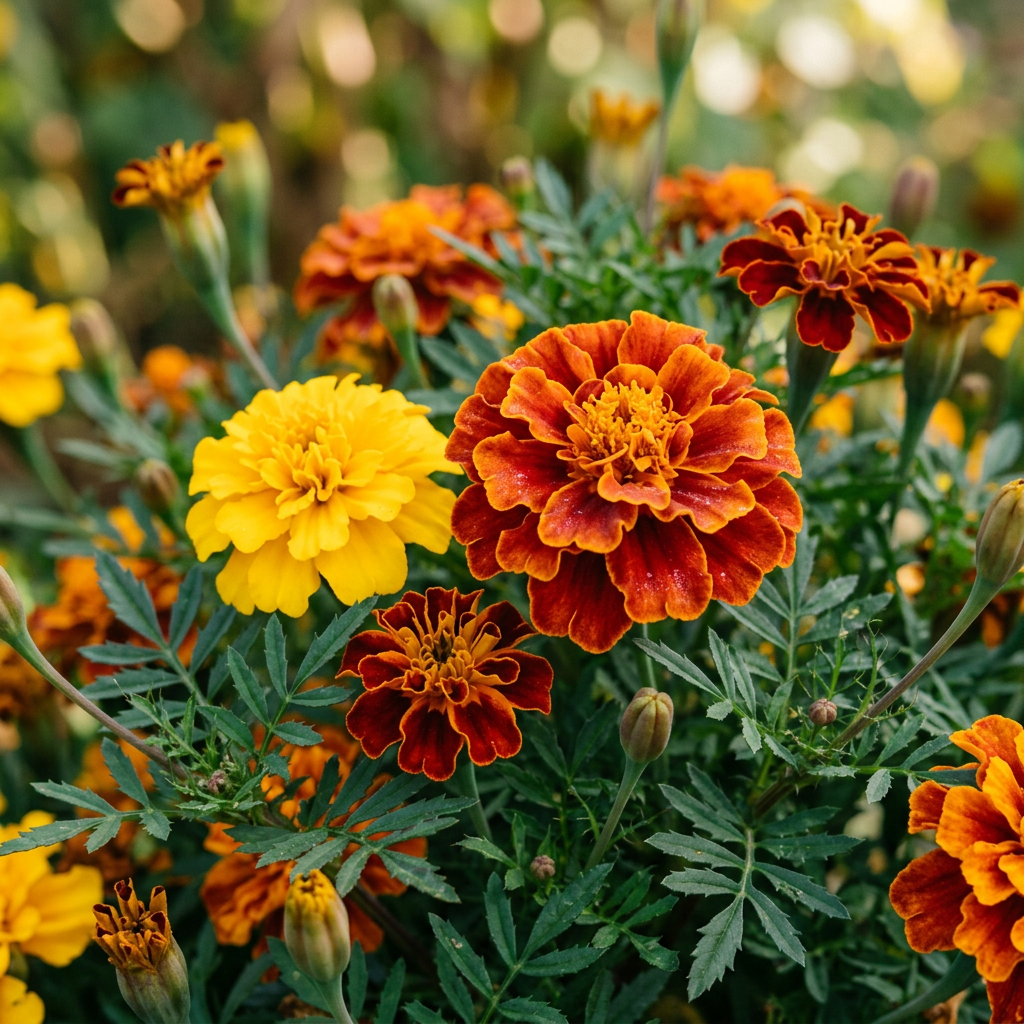
From Tiny Seeds to a Summer Full of Colour
A friendly guide to sowing, growing and enjoying French marigolds in Hungary.
Come Into the Garden With Me…
Today, we're growing French marigolds. And this time I want to start by untangling a name, because gardeners use the word marigold for several rather different flowers.
In our previous Marigold book we grew Calendula officinalis - the pot marigold, with softer leaves and open cottage-garden flowers. French marigold is different. Its botanical name is Tagetes patula, and it gives us those compact, bushy summer plants covered in yellow, orange, bronze, red and wonderfully striped flowers.
It is also different from the taller African marigold, Tagetes erecta. Same genus, different character. French marigolds are generally shorter, more spreading and especially useful along paths, around vegetable beds, at the front of borders and in pots.
And for Hungarian gardens, that compact toughness is very useful. French marigolds love warmth and sunshine, cope well with summer once established, and can keep flowering until autumn frost finally calls time on the season.
We'll begin with seed, move through sowing and pinching, learn how to keep plants neat and floriferous, talk honestly about their reputation as companion plants, solve the common problems, save seed and finish with what happens when the first cold nights arrive.
By the end, I want you to be able to look at a packet of French marigold seed and know exactly how to turn it into a cheerful little army of flowers.
Ready? Come into the garden with me.
1. Meet the French Marigold
French marigold is Tagetes patula, a bushy annual in the daisy family. Despite the name, the plant comes from the Americas rather than France. Garden names have a habit of carrying history more reliably than geography.
What does it look like?
The foliage is finely divided, deep green and strongly aromatic. Rub a leaf and you'll know immediately that you're dealing with Tagetes. Some gardeners love the scent. Others remain unconvinced. Either way, it is unmistakable.
The flowers may be single, semi-double or fully double. Colours run from lemon and gold through orange, mahogany-red, bronze and rich bicolours. Many French marigolds stay around 20-30 cm high, though some varieties can grow taller.
Annual, and happy about it
French marigolds complete their life cycle in one season. We sow them in spring, they flower through summer and autumn, and frost eventually finishes the plants. That may sound short-lived, but they flower so generously that they rarely feel temporary while they're with us.
|
GOOD TO KNOW French marigolds are not frost hardy. In Hungary, think of them as warm-season annuals: sow under protection in spring, plant out after frost danger has passed, and enjoy them until autumn cold arrives. |
2. Why French Marigolds Work So Well in Hungary
There are plants that spend July looking offended by Hungarian summer. French marigolds are not usually among them.
Sun, please
Give them full sun for the strongest, most compact plants and the best flower production. A bright Budapest balcony, a sunny border near Szeged or a warm vegetable garden on the Great Hungarian Plain can all suit them beautifully.
They can tolerate some light shade, but too little sun often means fewer flowers and stretchier growth.
Warmth suits them
Unlike ranunculus and anemones, which prefer the cool side of the season, French marigolds really get going once conditions become warm. That makes them a useful bridge in our series: this is a plant we are not trying to protect from summer; we're inviting it into summer.
Drainage still matters
They like moisture while establishing and during dry spells, but they do not need permanently wet soil. Moderately fertile, well-drained garden soil is ideal. In containers, make sure excess water can escape freely.
|
A COMMON MISTAKE Planting them outside after one warm April weekend. French marigolds dislike frost. In Hungary, wait until the risk of damaging late frost has genuinely passed, then harden young plants off before leaving them outside permanently. |
3. Choosing French Marigolds
This is where French marigolds become far more interesting than the old idea of 'little orange bedding plants.'
Single flowers
Single French marigolds have an open daisy-like centre and a lighter, simpler look. They can be excellent in pollinator-friendly planting because the flower centre is more accessible than in very full double forms.
Double and crested flowers
Double forms bring more petal and more visual impact. Some look almost pompon-like; others have a frilled or crested centre. These are especially effective in pots and formal edging where you want a dense block of colour.
The colour palette
Classic yellow and orange are only the beginning. Look for lemon yellow, deep gold, rusty orange, mahogany-red and combinations where red petals are edged in gold or golden petals carry dark blotches.
A row of one colour can look wonderfully tidy. A mixture gives a more relaxed, cottage-garden feeling. Neither is better; they simply tell different stories.
The French marigolds we grow with you
Holland Kertészet carries marigolds within its flower-seed range, including Tagetes in mixed edible-flower seed and a broader marigold category alongside our Calendula and African marigold selections. Because webshop ranges change during the season, I would rather you choose the French marigold that is actually available when you sow than pretend one variety is permanent.
When you browse our current range, look specifically for Tagetes patula if you want the compact French marigold described in this book. If the packet says Calendula officinalis, that belongs with our Pot Marigold book; if it says Tagetes erecta, that is the taller African marigold.
|
GROW WITH US The name on the packet matters more than the word 'marigold' on the front. For this book, look for Tagetes patula. Once you've found it, the growing method on the following pages is the one to use. |
4. Let’s Sow Some Seeds
French marigolds are satisfying to grow from seed because they are generally quick to get moving. The seed itself is rather distinctive: long, narrow and dark with a pale tip, like a tiny paintbrush someone forgot to finish.
When to sow in Hungary
For an early start, sow indoors or under protection in spring, roughly several weeks before you expect to plant outside. You can also sow directly outdoors once the soil has warmed and frost danger has passed, but starting under protection gives you flowers sooner.
How to sow
Fill trays or small pots with a good seed-starting compost. Moisten it first, sow the seeds thinly and cover lightly. Keep the compost gently moist and warm while germination begins.
Once seedlings appear, give them plenty of light. Warmth without enough light produces long, pale seedlings leaning desperately toward the window.
Potting on
When seedlings are large enough to handle comfortably and have developed true leaves, move them into individual modules or small pots if they are crowded. Handle by a leaf rather than squeezing the delicate stem.
|
DON’T PANIC French marigold seedlings usually grow quickly once they are happy. If yours are tall and floppy, the first thing to check is light. Move them somewhere brighter rather than immediately reaching for fertiliser. |
5. From Seedling to Garden Plant
Now our seedlings look like actual marigolds, the weather is improving, and every gardener begins asking the same question: can they go outside yet?
Harden them off
Not all at once. Plants raised indoors need time to adjust to wind, stronger sunshine and cooler nights. Put them outside in a sheltered place for a few hours, bring them back under protection, and gradually increase their outdoor time over a week or more.
Planting day
Choose a sunny position and space plants according to the eventual size of your variety. Compact French marigolds often look best planted close enough to form a generous mass without being so crowded that air cannot move between them.
Water thoroughly after planting. During the first couple of weeks, keep an eye on the soil while the roots establish. A newly planted marigold is much less drought tolerant than a mature one.
Pinching - do we need to?
Many compact varieties branch perfectly well without intervention. If a young plant becomes tall with one dominant growing tip, pinching that tip can encourage branching. But don't pinch simply because a gardening video told you every plant must be pinched. Look at the plant in front of you.
|
WHAT I WOULD DO Plant a little group near a path or terrace where you can see it often. French marigolds are small enough to disappear at the back of a border; they are much more enjoyable where their details are close to eye level. |
6. Summer Care Without Fuss
Once French marigolds settle in, they become wonderfully straightforward. This is the point where our job changes from raising babies to keeping good plants going.
Watering
Water during genuinely dry periods, especially in containers. A pot on a south-facing balcony may need attention far more often than a plant rooted into open ground.
Water well, then let excess drain away. Constant tiny splashes encourage shallow roots and make you feel busier than necessary.
Feeding
In ordinary garden soil, French marigolds do not need heroic amounts of fertiliser. Container plants may appreciate a modest flowering feed during the season. Too much nitrogen can give you lush foliage at the expense of flowers.
Deadheading
This is the useful job. Remove faded flowers regularly and the plant has every reason to keep producing new buds instead of putting all its energy into seed.
If you're growing a large group, deadheading one flower at a time can become a little obsessive. Give the plants a quick tidy during your garden walk and don't worry about perfection.
|
GOOD TO KNOW RHS recommends full sun, well-drained soil, watering during dry spells and regular deadheading to prolong flowering. That simple combination gets you most of the way there with Tagetes patula. |
7. Companion Planting: What Is True?
French marigolds have one of the biggest reputations in the vegetable garden. They are often described as magical protectors that repel every pest in sight.
I like marigolds very much. I also like being fair to them.
Useful, yes. Magic, no.
Tagetes roots produce compounds that can affect certain soil nematodes, and marigolds are studied and used in some cropping systems for that reason. But simply putting one little marigold beside a tomato does not create an invisible force field around the vegetable bed.
Their real garden value is broader and simpler: they add flowers, diversity and habitat; some forms attract visiting insects; and they fit neatly between vegetables because many French marigolds stay compact.
Tomatoes and marigolds
They are popular companions because both enjoy warmth and sun, and the compact marigolds can occupy the lower edge of a tomato bed without demanding much space.
Plant them because the combination works visually and horticulturally, not because you expect the marigold to solve every pest problem for you.
One warning
Some people find Tagetes foliage irritating to the skin. If you know you are sensitive, wear gloves when handling lots of foliage or removing old plants.
|
A COMMON MISTAKE Thinking 'companion plant' means 'pesticide.' A diverse garden can be healthier and more interesting, but marigolds are helpers, not superheroes. Keep watching your vegetables for pests just as you normally would. |
8. When Something Goes Wrong
French marigolds are generally robust, but even easy plants occasionally send us a message.
Hardly any flowers
Start with sunlight. Too much shade can reduce flowering. Then think about feeding: lots of nitrogen can give you leaves instead of blooms. Finally, check whether you have been leaving every faded flower to make seed.
The leaves are yellowing
A few old leaves are normal. Widespread yellowing can point toward overwatering, poor drainage, root stress or nutrient imbalance. Touch the soil before deciding what to do next.
The plant has collapsed after watering
If the soil is permanently saturated, the roots may be struggling. Improve drainage and reduce the frequency of watering. A thirsty plant and a waterlogged plant can both wilt, which is why checking the soil matters.
Slugs and snails
Tender young plants can be damaged, especially after damp weather. Check in the evening and use a control method suitable for your garden, pets and wildlife.
Spider mites or aphids
Hot, dry conditions can favour spider mites, while tender growth may attract aphids. Check the undersides of leaves and new shoots. Early detection makes any problem easier to manage.
|
DON’T PANIC One chewed leaf is not a failed crop. French marigolds grow quickly. Look for patterns: repeated damage, spreading yellowing, lots of insects or consistently wet soil. Treat the cause, not one imperfect leaf. |
9. Flowers, Seed and the End of Summer
By midsummer, a happy French marigold can feel like a little flowering machine. New buds appear behind old flowers, and the plant keeps going as long as warmth and your deadheading allow it.
Enjoy the flowers where they are
French marigolds are not primarily grown for long cutting stems. Their gift is colour close to the ground. Use them along paths, at the front of borders, in window boxes, around vegetables and in pots where their compact shape can do the work.
Saving seed
When you want seed, stop deadheading a few flowers and allow the heads to dry on the plant. Inside you'll find those long, narrow seeds packed together like tiny brushes.
Collect on a dry day, dry the seeds thoroughly and store them in a labelled paper envelope somewhere cool, dark and dry.
If you save seed from hybrids or from several varieties growing together, next year's plants may not look exactly like the parent. That can be either inconvenient or delightful, depending on your personality.
Then frost arrives
French marigolds are warm-season annuals. A serious autumn frost will end the show. There is no need to persuade them through a Hungarian winter outdoors.
Pull or compost healthy plants once the season is over, clear diseased material appropriately, and keep your saved seed for spring.
|
TRY THIS Leave three or four of your best flowers to make seed while you continue deadheading the rest. That way you keep the display going and still have something to sow next year. |
10. Your French Marigold Cheat Sheet
We've gone from strange little paintbrush seeds to months of bright summer colour. Here's the whole journey in one place.
1. Check the botanical name: French marigold is Tagetes patula.
2. Sow under protection in spring for an earlier start.
3. Cover seed lightly and keep the compost gently moist.
4. Give seedlings plenty of light.
5. Pot crowded seedlings on once they are easy to handle.
6. Harden plants off before permanent outdoor planting.
7. Wait until damaging frost risk has passed in your part of Hungary.
8. Choose full sun for the best flowering.
9. Use moderately fertile, well-drained soil.
10. Water young plants while they establish.
11. Water established plants during dry spells, especially in pots.
12. Do not overfeed with nitrogen.
13. Deadhead regularly for a longer flowering season.
14. Use compact plants at the front of beds and around vegetables.
15. Enjoy companion planting, but don't expect pest-control magic.
16. Check young plants for slug and snail damage.
17. Watch leaves for aphids, mites and signs of water stress.
18. Leave a few flowers to ripen seed if you want to save it.
19. Expect autumn frost to finish the plants.
20. Sow again next spring - perhaps in a colour you haven't tried yet.
If You Remember Only Five Things…
1. French marigold means Tagetes patula
Calendula and African marigolds are different plants. Read the botanical name and the mystery disappears.
2. Wait for warmth
French marigolds love summer but dislike frost. Don't rush them into the Hungarian spring garden.
3. Give them sunshine
The more sun they receive, the stronger and more floriferous they usually become.
4. Deadheading matters
Remove finished blooms and the plant keeps concentrating on new flowers rather than seed.
5. Companion planting is helpful, not magical
Grow marigolds among vegetables because they add diversity, colour and habitat - not because one plant can solve every pest problem.
One Last Walk Around the Garden
Do you remember where we began?
With a packet of strange, narrow seeds and one surprisingly complicated name.
We learned that French marigold is Tagetes patula. Not Calendula. Not the taller African marigold. A compact, warm-season annual with strongly scented leaves and cheerful flowers that seem built for summer.
We sowed the seeds. Gave the seedlings light. Waited for Hungary's late frosts to move on. Hardened the little plants off and finally put them outside.
Then summer arrived.
Perhaps yours lined the vegetable garden in yellow and mahogany, filled a balcony box in Budapest, or sat beside tomatoes as bright, useful neighbours.
You watered when the soil needed it, deadheaded as you walked past, and learned that more fertiliser is not always more flowers. And the flowers kept coming.
That is the charm of French marigolds. They don't need a greenhouse or years of patience. They simply ask for warmth, sun, ordinary care and somewhere you can enjoy them.
By autumn, you may have a paper envelope of seed for next year. Next spring, you'll know exactly what to do.
Because now you know the plant, not just the name.
Enjoy the colour, enjoy the heat of summer, and save a little seed if you like.
And when you're ready for the next plant…
Come into the garden with me.


