

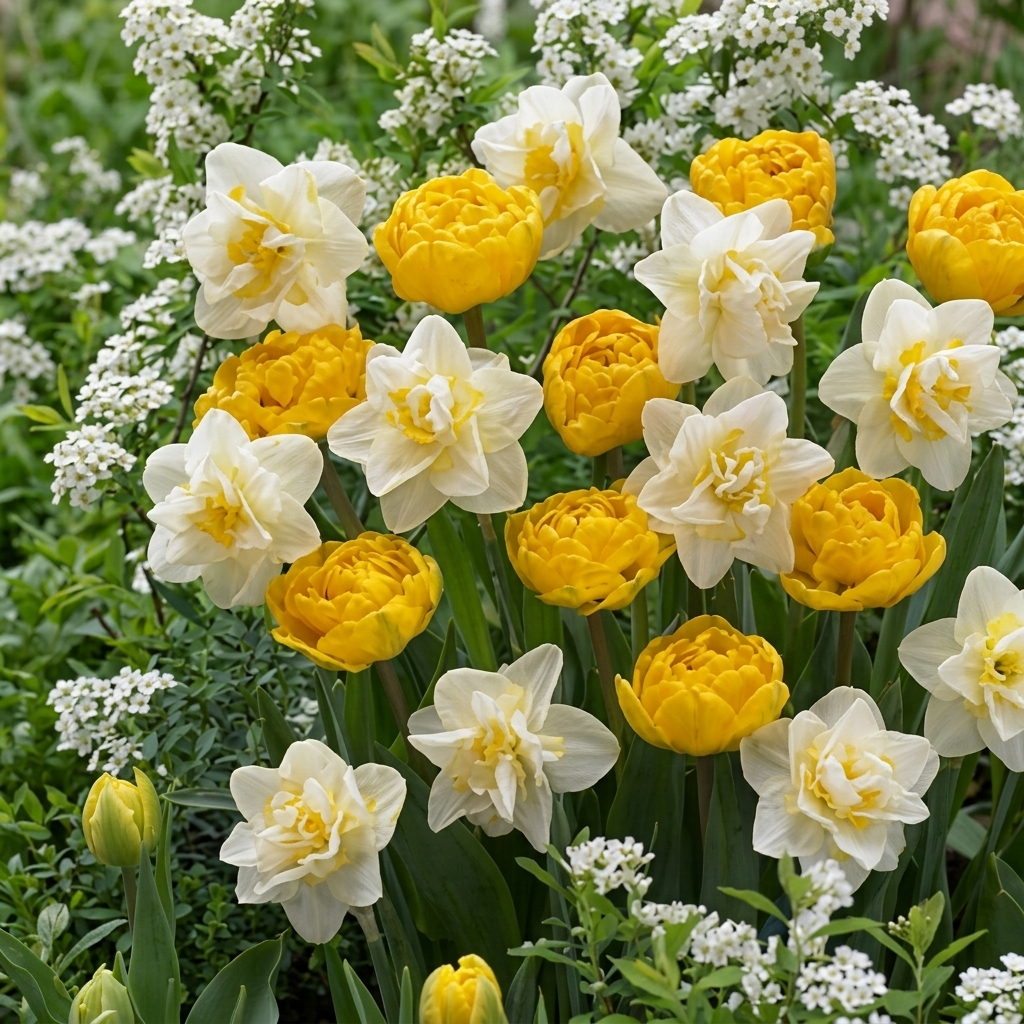
From Autumn Bulbs to Spring Sunshine
A friendly guide to choosing, planting, growing and enjoying daffodils in Hungary.
Come Into the Garden With Me…
Today, we're growing daffodils - one of the most dependable signs that winter is finally loosening its grip on the garden.
A daffodil begins not with a tiny seed but with a bulb: a compact storehouse already holding the promise of roots, leaves and a spring flower. We plant it in autumn, then let cold soil and winter weather do much of the quiet work for us.
For Hungary, daffodils are wonderfully well suited. They appreciate winter cold, cope with changeable spring weather and can return for years if we plant them deeply enough and allow the leaves to finish their job after flowering.
And daffodils are far more varied than the familiar yellow trumpet. There are miniature forms, doubles, fragrant jonquillas, cyclamineus types with swept-back petals, multi-flowered tazettas and bold traditional trumpets.
We'll begin with the bulb, learn when and how deeply to plant, what happens underground through winter, how to care for spring flowers, and what to do after flowering so the bulbs are ready for another year.
We'll also look at some of the daffodils currently in the Holland Kertészet range, so you can choose by height, flower form, fragrance and mood rather than simply buying 'a yellow one'.
Ready? Let's plant something now that spring will thank us for later.
1. Meet the Daffodil
Daffodils belong to the genus Narcissus in the amaryllis family, Amaryllidaceae. In everyday gardening we use 'daffodil' for many cultivated Narcissus forms grown from bulbs for spring colour.
One bulb, one whole spring plan
A healthy bulb already contains stored energy and the beginnings of next season's growth. In autumn it makes roots; through winter it rests in the cold; and as temperatures rise, leaves and flower stems emerge.
The familiar flower has six outer tepals surrounding a central cup or trumpet called the corona. Depending on the group, that corona may be long, short, frilled, split or surrounded by extra petals.
Perennial, not a one-season guest
Unlike many of our seed-grown annuals, daffodils are hardy perennials. Planted in a suitable place in Hungary, they can return year after year and gradually multiply into larger clumps.
|
GOOD TO KNOW Daffodils are hardy perennial bulbs. Plant them in autumn, enjoy them in spring, and leave the foliage until it yellows so the bulb can prepare next year's flower. |
2. Give Them Light, Drainage and Room to Stay
If daffodils could choose their own address, they would ask for a place that is bright in spring, drains freely after rain and can remain undisturbed while the foliage ripens.
Sun or light shade
Full sun gives strong flowering, but daffodils also grow well in light shade beneath deciduous trees because the branches are still relatively bare when the bulbs are active in early spring.
Borders, orchard edges, lawn margins and open spaces beneath shrubs can all work. The important part is that the leaves receive enough light after flowering to rebuild the bulb for next year.
Drainage matters
Daffodils dislike sitting in stagnant winter water. Ordinary garden soil is fine if it drains reasonably well. Heavy Hungarian clay benefits from improved structure and from avoiding low hollows where water gathers.
Very sandy soil can be improved with compost so it holds enough moisture during spring growth without staying waterlogged in winter.
Choose a place you can leave alone
The foliage must remain after the flowers fade. A position where yellowing leaves can quietly disappear among later perennials is often more practical than the very front edge of a formal border.
|
A COMMON MISTAKE Cutting or tying the leaves as soon as flowering finishes. Those green leaves are feeding the bulb for next spring. Let them yellow naturally before removing them. |
3. The Daffodils We Grow With You
The Holland Kertészet spring-flowering range currently includes eighteen daffodil selections, covering several Narcissus groups and flower styles.
Among them are Cyclamineus types such as 'Jetfire' and 'Elka', Tazetta 'Minnow', Jonquilla 'Verdin', Trumpet forms including 'California' and 'Dutch Sensation', plus characterful selections such as 'Rip van Winkle', 'Ice King' and double 'Obdam'.
Why the group matters
The group name gives useful clues. Trumpet daffodils make bold single blooms; cyclamineus types are often more compact with swept-back petals; jonquillas are valued for fragrance; tazettas often carry several flowers on one stem; doubles have a fuller centre.
For an early, compact display
Smaller cultivars such as 'Jetfire', 'Elka' or 'Minnow' work beautifully near paths, in pots and toward the front of borders where a very tall flower would feel out of scale.
For classic spring impact
Larger trumpet forms such as 'California' or 'Dutch Sensation' give the unmistakable daffodil silhouette and are excellent planted in generous groups.
For something less expected
A double such as 'Obdam' or the wonderfully shaggy 'Rip van Winkle' shows just how far daffodils can move beyond the simple yellow trumpet.
One collection, many springs
Mix early, mid and later flowering types and the daffodil season can feel much longer than a single variety planted alone.
|
GROW WITH US The Holland Kertészet range includes eighteen daffodil selections, from compact 'Jetfire', 'Elka' and 'Minnow' to bold trumpets, doubles and fragrant forms. Mix flowering times for a longer spring display. |
4. Let's Plant the Bulbs
Daffodil planting is one of the nicest autumn jobs because almost everything important happens before you can see it.
When to plant in Hungary
Plant in autumn, ideally from September through November while the soil is still workable. Earlier planting gives roots time to establish before winter, but healthy bulbs can still be planted later if the ground is not frozen or waterlogged.
How deep?
For most larger daffodils, place the base of the bulb about 15 cm below the soil surface. Smaller or dwarf forms can usually sit around 10 cm deep. A useful general rule is roughly two to three times the height of the bulb.
Plant with the pointed end upward. If you genuinely cannot tell which side is which, place the bulb on its side; the shoot will still find its way upward.
Spacing
Around 10-12 cm between larger bulbs makes a full display without forcing them together. For a natural look, plant in irregular groups rather than ruler-straight lines.
Water once if the soil is dry, then let autumn rain and winter weather take over. There is no need to dig them up to check - roots are already beginning their work below ground.
|
DON'T PANIC Nothing visible happens for months after autumn planting. That is normal. Roots are developing below the soil, and the shoot is waiting for the right spring conditions. |
5. Winter Below Ground, Spring Above It
Once planted, the garden becomes quiet, but the bulb has not stopped. Roots develop in cool soil while the flower shoot waits for winter cold and then rising spring temperatures.
Do not worry about winter cold
Daffodils are hardy and the cold period is part of their normal cycle. In Hungarian gardens, established bulbs are far more troubled by poor drainage than by ordinary winter frost.
What if leaves appear early?
A mild spell can bring green tips through the soil surprisingly early. Leave them alone. The foliage is tougher than it looks, and growth usually pauses again when colder weather returns.
The first spring shoots
As days lengthen, the leaves extend rapidly and flower buds rise from the centre. Water only during an unusually dry spell, especially in pots; spring soil often contains enough natural moisture.
Drought tolerance is not the issue here: good spring growth needs moisture, but bulbs should never sit in saturated soil.
|
WHAT I WOULD DO Plant some daffodils where you see them from the house in early spring, then add another group beneath deciduous shrubs or trees. You get colour in more than one part of the garden without adding much work. |
6. Spring Care: Flowers Without Fuss
Once daffodils are established, their spring care is refreshingly simple. Most of the important work is really about what not to do.
Feeding
In ordinary garden soil, a light bulb fertiliser or balanced feed as growth begins can help long-term flowering, especially in older clumps. Avoid heavy nitrogen feeding, which encourages leaves without improving the bulb's future.
Pots dry more quickly than open ground. Check moisture during active growth and make sure drainage holes remain open. A crowded pot may also need dividing or refreshing after several seasons.
Deadheading
Remove faded flower heads if you do not want seed. This stops the bulb spending energy on seed production and lets it direct resources back into itself.
Leave the leaves
The green foliage is making food for next year's flower. Leave it until it has yellowed and is coming away naturally, usually at least six weeks after flowering.
No tying or plaiting
Bundling the leaves into knots may make the border look tidier, but it reduces the leaf area receiving light. Let the foliage lie naturally and finish its work.
|
HUNGARIAN SPRING NOTE Hungarian winters provide the cold period daffodils need. Good drainage is usually more important than extra winter protection; water pots only when spring weather turns genuinely dry. |
7. When Something Goes Wrong
Daffodils are reliable bulbs, but disappointment usually has a reason - and the cause is often something we did the previous year rather than something happening today.
Lots of leaves, no flowers
This is often called daffodil blindness. Bulbs may be too shallow, overcrowded, shaded, repeatedly cut down too early, or simply in need of division and feeding.
Flowers are smaller each year
Crowding is a common cause. A clump that began with five bulbs can become a dense colony. Lift and divide after the foliage has died back, then replant the strongest bulbs at the correct depth.
Bulbs rot
Poor drainage is the first suspect. Avoid planting into waterlogged soil or containers without drainage holes, and discard bulbs that are soft or badly decayed.
Leaves have been damaged
A little cosmetic damage rarely matters. The important question is whether enough healthy green leaf remains to feed the bulb. Protect emerging shoots from heavy trampling and repeated cutting.
Pests and diseases
Narcissus bulb fly and fungal rots can occasionally cause problems. Buy firm healthy bulbs, maintain good drainage and remove clearly diseased bulbs rather than composting them.
|
DON'T PANIC A few early green tips during a mild winter spell are usually fine. Daffodil foliage is tougher than it looks. Leave it alone and let the plant respond naturally as temperatures change. |
8. Flowers for the Garden - and the Vase
Daffodils are at their best in generous groups, where the repeated shapes make the whole planting feel like spring rather than a collection of isolated bulbs.
In the garden
Plant in drifts through borders, beneath deciduous trees, along paths or in grass that can be left unmown until the foliage has ripened. Small cultivars are especially good in pots and near entrances.
For the vase
Cut when buds are showing colour or when the first flower has opened. Use clean tools and place stems into fresh water promptly.
Daffodil sap can shorten the vase life of some other cut flowers. If you want to combine them, condition the daffodils separately in water first and avoid recutting the stems immediately before mixing.
Think in layers
Daffodils combine beautifully with crocus, muscari, early tulips, hellebores, primroses and later-emerging perennials. The bulbs flower first; surrounding plants then hide the ripening foliage.
|
TRY THIS Plant one cultivar in a generous drift rather than scattering single bulbs. Repeat the same variety in another nearby group and the whole spring border immediately feels more intentional. |
9. After Flowering, Naturalising and Next Year
The petals fall, but this is the beginning of next year's flower rather than the end of this year's job.
Let the leaves ripen
Keep the foliage until it turns yellow and begins to collapse naturally. This is the single most important aftercare rule for reliable repeat flowering.
Deadhead the old flower, then wait. Continue watering only while plants are actively growing and the soil is genuinely dry.
When to divide
If flowering weakens or a clump becomes congested, lift it after the foliage has died back. Separate the bulbs gently, discard damaged ones and replant the healthy bulbs at proper depth.
Then summer arrives
Once the leaves have disappeared, the bulbs rest underground. Mark the area if you are likely to dig there later, and let summer perennials or annuals take over above them.
By autumn, you can add new varieties, extend the drift, or simply leave a successful clump exactly where it is.
In a suitable site, daffodils multiply slowly and can remain for many years, turning a small planting into a natural-looking spring colony.
|
A COMMON MISTAKE Treating the end of flowering as the end of the season. The six weeks after bloom are when the leaves recharge the bulb. Deadhead the flower, then be patient with the foliage. |
10. Your Daffodil Cheat Sheet
We've gone from a dry autumn bulb to a returning spring display. Here's the whole journey in one place.
1. Daffodils are Narcissus bulbs.
2. They are hardy perennials in Hungary.
3. Plant bulbs in autumn, ideally September-November.
4. Choose firm, healthy bulbs without soft rot.
5. Give them full sun or light spring shade.
6. Use soil that drains well in winter.
7. Plant larger bulbs about 15 cm deep.
8. Plant dwarf forms roughly 10 cm deep.
9. Space larger bulbs about 10-12 cm apart.
10. Plant in irregular groups for a natural effect.
11. Water after planting if the soil is dry.
12. Let winter cold do its normal work.
13. Water pots during dry spring weather.
14. Feed lightly as growth begins if needed.
15. Deadhead faded flowers if you do not want seed.
16. Never cut green foliage immediately after flowering.
17. Do not tie or plait the leaves.
18. Leave foliage for at least six weeks, until yellow.
19. Divide overcrowded clumps when flowering declines.
20. Let established bulbs multiply and return year after year.
If You Remember Only Five Things…
1. Plant them in autumn
September to November gives bulbs time to root before winter and prepares them for spring flowering.
2. Plant deeply enough
Around 15 cm for larger daffodils is a good working depth; shallow planting can weaken long-term performance.
3. Drainage matters more than winter cold
Daffodils are hardy, but bulbs sitting in stagnant wet soil are vulnerable to rot.
4. Leave the leaves alone
The green foliage is feeding next year's flower, so wait until it yellows naturally before removing it.
5. Think in years, not weeks
A good daffodil planting can multiply, naturalise and become more beautiful with time.
One Last Walk Around the Garden
Do you remember where we started?
With a dry bulb in our hand and a patch of autumn soil that did not look very exciting at all.
We planted the bulb deeply, pointed end up, and then we walked away. Through rain, cold mornings and the dark part of winter, the roots quietly established beneath the surface.
Then one day the first green tips appeared. A few weeks later there were buds, and suddenly the garden had yellow, cream, white or orange faces turning spring into something visible.
Daffodils taught us a different kind of gardening patience. We did the work months before the reward, and after flowering we had to resist tidying too quickly so the leaves could prepare the bulb for another year.
By next spring, that lesson becomes even better: the bulbs return. A small clump grows fuller. A favourite variety becomes familiar. The garden begins to remember what you planted.
So enjoy the flowers, leave the leaves to finish their work, and perhaps make a note of where there is room for five more bulbs this autumn.
And when you're ready for the next plant…
Come into the garden with me.


