

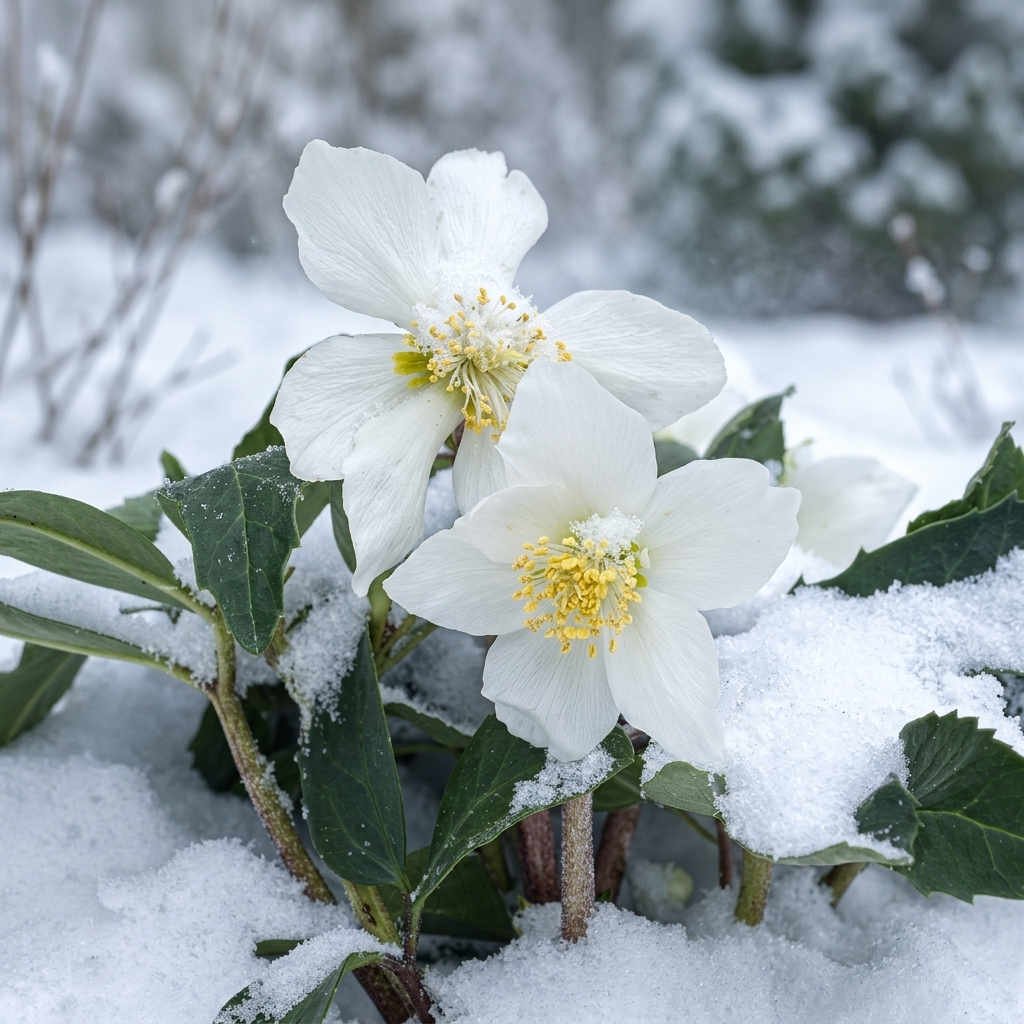
When the garden is quiet, the trees are bare and the coldest days of the year have arrived, one extraordinary little flower is preparing to do something almost unbelievable. Meet the Christmas rose — a beautiful winter-flowering perennial surrounded by legends, mystery and the promise of spring.
There is a particular kind of silence in the garden during winter.
Have you noticed it?
The bees have disappeared from the lavender.
The roses have finished their last flowers.
The vegetable beds are resting beneath their winter covering.
And the trees, which only a few months ago were filled with leaves and birdsong, now stand bare against the pale winter sky.
Sometimes there is frost on the grass.
Sometimes a thin layer of snow covers the flower beds.
And sometimes, especially here in Hungary, we have those cold, grey December mornings when the garden seems to have forgotten all about flowers.
But nature has a few surprises waiting for us.
Imagine walking through your garden on a quiet winter morning.
You pull your coat a little tighter around you.
The air is cold.
The soil is damp.
And beneath a deciduous shrub, close to the ground, you notice something unexpected.
A flower.
Not a dried flower left over from summer.
Not an artificial Christmas decoration.
A real, living flower.
Its petals appear almost white against the dark winter soil.
In the centre is a beautiful collection of golden-yellow stamens.
And around it, deep green leaves provide a little shelter from the cold.
You bend down to look more closely.
And there it is.
The Christmas rose.
A flower that seems to have decided that winter is no reason to stop being beautiful.
I think that is one of the most wonderful things about gardening.
Just when we believe we know what to expect from a season, a plant comes along and surprises us.
And the Christmas rose is particularly good at that.
So today, let's get to know this remarkable winter flower.
We'll explore the beautiful legends surrounding it, discover why it isn't really a rose, learn how it survives cold weather and, most importantly, find out how to grow it successfully in our Hungarian gardens.
Because once you have seen a Christmas rose flowering on a cold winter morning, I suspect you will want one in your own garden.
Make yourself a warm cup of tea, put on your gardening coat, and come into the garden with me.
There is something rather special waiting beneath the winter trees.
1. First of All, the Christmas Rose Isn't a Rose
Let's begin with a little botanical surprise.
Despite its beautiful name, the Christmas rose is not a rose at all.
Its botanical name is Helleborus niger.
It belongs to the buttercup family, Ranunculaceae, rather than the rose family, Rosaceae.
That means it is more closely related to plants such as buttercups, anemones and clematis than to the roses growing in our summer flower beds.
So why is it called a Christmas rose?
The answer is quite simple.
Its flowers resemble small, elegant, single roses, and in some climates and growing conditions, it can flower around Christmas.
However, there is something important I want every Hungarian gardener to understand.
A Christmas rose does not necessarily flower at Christmas.
In many Hungarian gardens, it may flower during January, February or even March.
Its flowering time depends on the variety, the weather, its growing position and how well established the plant is.
That doesn't make it any less beautiful.
It simply means we should allow nature to follow its own timetable.
What does the Christmas rose look like?
A mature Christmas rose forms a low clump of attractive, leathery, dark green leaves.
The leaves are divided into several broad segments.
During winter or early spring, sturdy flower stems rise above the foliage.
At the top appear elegant white flowers, often around 5–8 centimetres across, although size varies.
The flowers usually have five large, petal-like structures.
And here is another botanical surprise.
Those beautiful white structures are actually sepals, not true petals.
The true petals have been modified into small nectar-producing structures inside the flower.
The golden-yellow stamens in the centre create a wonderful contrast with the white sepals.
As the flowers age, they often develop soft pink, green or rosy tones.
Sometimes the flowers remain decorative for weeks.
It is a plant that changes gently rather than suddenly.
And I think that is part of its charm.
GOOD TO KNOW
The word niger means black in Latin.
It refers to the plant's dark roots, not its flowers.
So the botanical name Helleborus niger refers to a hellebore with dark roots, even though its flowers are usually white.

2. The Beautiful Christmas Legend of the Little Girl in the Snow
Every special Christmas plant seems to have a story.
The poinsettia has its Mexican Christmas legend.
Mistletoe has its ancient traditions and romantic customs.
And the Christmas rose has a particularly touching story.
According to a traditional Christian legend, a young girl was travelling to Bethlehem.
She wanted to bring a gift to the newborn Jesus.
But she was very poor.
She had no gold.
No precious ornaments.
No beautiful presents.
And when she saw the gifts that others were bringing, she became terribly sad.
What could she possibly offer?
She stepped outside into the cold winter night and began to cry.
Her tears fell onto the frozen ground.
And then something extraordinary happened.
Where her tears touched the earth, beautiful white flowers appeared.
Christmas roses.
The little girl gathered the flowers and carried them as her gift.
And although they were simple flowers, they were given with love.
That, according to the legend, made them precious.
What a lovely Christmas thought
I have always liked the message behind this story.
A gift doesn't need to be expensive to be meaningful.
Sometimes the smallest things are the most beautiful.
A flower.
A little kindness.
A moment of attention.
Or something made with our own hands.
Of course, this is a legend rather than a historical account of the plant's origin.
But legends often tell us something about the values people wished to preserve.
And this one reminds us that beauty and generosity can appear in the most unexpected places.
Even in the middle of winter.
3. A Flower With a Long European History
The Christmas rose is native to parts of mountainous Europe, particularly areas of the Alps and neighbouring regions.
In the wild, it grows in suitable woodland and mountain habitats.
Its natural environment helps explain many of its preferences in the garden.
It is accustomed to seasonal cold.
It often grows where there is some shelter from trees.
And it appreciates soil that drains well rather than remaining waterlogged.
The Christmas rose in European gardens
Hellebores have been known in Europe for centuries.
They appear in historical botanical writings and have long been cultivated as ornamental plants.
The Christmas rose became particularly valued because it could produce flowers when relatively few other garden plants were blooming.
In older European gardens, winter-flowering plants had a special importance.
They provided colour and interest during the darkest months.
A word about old medicinal traditions
Hellebores were also used historically in various medicinal practices.
However, this is not something we should imitate.
Helleborus niger is poisonous if eaten.
Historical medicinal use does not mean a plant is safe for home remedies.
Today, we should appreciate the Christmas rose as an ornamental garden plant, not as something to consume.
4. How Can a Flower Bloom When It Is So Cold?
Now we come to one of the most fascinating questions.
How can a plant produce flowers when temperatures are close to freezing?
Most of our familiar garden flowers prefer warmth.
Cosmos needs the growing season.
Zinnias dislike frost.
Dahlias disappear when freezing temperatures arrive.
But the Christmas rose follows a different rhythm.
A plant adapted to cold seasons
Helleborus niger has evolved in environments where cold weather is a normal part of the year.
Its evergreen leaves can remain functional during suitable winter conditions.
Its flower buds develop according to the plant's seasonal cycle.
And its tissues have adaptations that help it tolerate freezing temperatures.
However, this does not mean every flower is completely frost-proof.
Severe frost can damage open flowers, especially during sudden temperature changes.
The remarkable drooping flower
Have you noticed that Christmas rose flowers sometimes bend downward?
This can help protect their reproductive structures from rain and snow.
The plant's overall shape also keeps the flowers relatively close to the ground.
What happens during frost?
During freezing weather, hellebore flowers and leaves may appear limp or drooping.
This can be a temporary response to cold conditions.
When temperatures rise, the plant may recover its normal appearance.
However, prolonged or severe freezing can still cause damage.
GOOD TO KNOW
Don't immediately cut off Christmas rose flowers that appear droopy after a frosty night.
Wait until temperatures rise and see whether they recover.
You may be surprised how resilient they are.
5. Can Christmas Roses Grow Successfully in Hungary?
Yes.
And this is where our story becomes especially interesting for gardeners in Hungary.
Christmas roses can be excellent perennial plants in many Hungarian gardens.
They are generally hardy when planted in suitable conditions.
But there is an important difference between surviving winter and thriving throughout the entire year.
A Christmas rose must cope not only with our winters but also with our summers.
And Hungarian summers can be hot.
Very hot.
Sometimes dry for weeks.
This is often a greater challenge than the winter cold.
Understanding the Hungarian climate
In western Hungary, including the Győr region, gardens may experience cold winters, drying winds and hot summers.
Around Budapest, urban gardens may be somewhat warmer, but summer heat and dry soil can be serious challenges.
In the Great Hungarian Plain, prolonged summer drought and high temperatures may make careful plant placement especially important.
In cooler or more sheltered gardens, hellebores may find conditions easier.
The secret is the right location
If I could give you only one piece of advice about growing Christmas roses in Hungary, it would be this:
Choose a position that protects the plant from intense summer heat.
Winter cold is usually not the main problem.
Hot afternoon sunshine and excessively dry soil can be much more damaging.
A position beneath deciduous shrubs or trees can be ideal.
During summer, the leaves provide shade.
During winter, after the leaves have fallen, more light reaches the plant.
Nature has created a rather clever arrangement for us.
6. Where Should You Plant a Christmas Rose?
Let's imagine we have just brought home a beautiful Helleborus niger.
Where should we plant it?
Not necessarily in the sunniest flower bed.
And not in a place where the soil becomes waterlogged.
We want to create conditions that resemble its preferred natural habitat.
Light
Partial shade is often ideal in Hungary.
A little winter sunshine is welcome.
But protection from strong summer afternoon sun is important.
Soil
Christmas roses prefer:
-
Fertile soil.
-
Good drainage.
-
Plenty of organic matter.
-
A generally neutral to slightly alkaline soil reaction.
-
Reasonably consistent moisture without waterlogging.
This is good news for many Hungarian gardeners.
Unlike acid-loving plants such as rhododendrons, Christmas roses can be comfortable in suitable calcareous soils.
However, drainage is still essential.
Shelter
Choose a location protected from strong, drying winds.
A sheltered border near shrubs can be excellent.
Space
Allow approximately 30–45 centimetres between plants, depending on their eventual size.
They develop into attractive clumps over time.
A COMMON MISTAKE
Planting a Christmas rose in a hot, exposed south-facing border.
It may survive for a while, but summer heat and drought can weaken it.
Choose a cooler, sheltered position instead.

7. How to Plant Helleborus niger Step by Step
Let's get our hands into the soil.
Planting a Christmas rose is not difficult, but a little care at the beginning makes a big difference.
Step 1 — Choose the right season
Autumn and spring are generally good planting periods.
In Hungary, early autumn can be particularly suitable when the soil is still warm and rainfall becomes more regular.
Spring planting is also possible.
Avoid planting into frozen or waterlogged soil.
Step 2 — Prepare the planting area
Remove weeds.
Loosen the soil.
Incorporate well-rotted compost if the soil needs improvement.
If drainage is poor, consider a raised planting area or another location.
Step 3 — Dig the planting hole
Make the hole slightly wider than the root ball.
There is no need to dig an excessively deep hole.
Step 4 — Remove the plant carefully
Take the plant out of its pot.
If the roots are tightly circling the root ball, gently loosen the outer roots without excessive damage.
Step 5 — Position the plant
This is very important.
Plant the Christmas rose at approximately the same depth it was growing in its container.
Do not bury the crown deeply.
The crown is the area where the leaves and flower stems emerge.
If it is buried too deeply, flowering and plant health may suffer.
Step 6 — Fill the hole
Return the soil around the roots.
Firm gently.
Step 7 — Water thoroughly
Water the plant after planting to settle the soil around the roots.
Step 8 — Add a light mulch
Apply a thin layer of leaf mould or compost around the plant.
Keep the crown uncovered.
GROW WITH US
Plant three or five Christmas roses together rather than one isolated plant.
A small group creates a much stronger winter display.
And as the plants mature, the effect becomes more beautiful every year.

8. How Much Water Does a Christmas Rose Need?
This is an important question, especially in Hungary.
Christmas roses prefer soil that is reasonably moist but well drained.
They dislike prolonged waterlogging.
They also dislike becoming excessively dry during hot weather.
During spring
Water newly planted Christmas roses when the soil begins to dry.
Established plants may need less attention if rainfall is sufficient.
During summer
This is the season when we need to be particularly careful.
In hot Hungarian summers, the soil beneath shrubs can become surprisingly dry.
Even shaded areas may receive little rainfall if tree canopies intercept it.
Check the soil regularly.
Water deeply when needed rather than giving tiny amounts every day.
During autumn
As temperatures fall, watering requirements generally decrease.
However, avoid allowing newly planted hellebores to dry out completely.
During winter
Water only when necessary and when the soil is not frozen.
Avoid keeping the roots constantly wet.
A COMMON MISTAKE
Assuming a shade-loving plant never needs watering.
Shade reduces direct sunlight, but tree roots may compete strongly for moisture.
Always check the actual soil conditions.
9. Should You Fertilise Christmas Roses?
Christmas roses are not particularly demanding feeders.
They usually perform well in fertile garden soil enriched with organic matter.
What I recommend
Apply a modest layer of well-rotted compost or leaf mould around established plants.
This helps improve soil structure and supports healthy growth.
If the soil is poor, a suitable balanced fertiliser may be useful according to the manufacturer's instructions.
Avoid excessive nitrogen.
Too much fertiliser can encourage soft leafy growth without improving flowering.
When should you feed them?
Spring is generally a suitable time to support growth.
Autumn soil improvement may also be helpful.
But remember:
A Christmas rose planted in the wrong position will not become happy simply because we give it more fertiliser.
Location and drainage matter much more.
10. Why Isn't My Christmas Rose Flowering?
Now we come to one of the questions gardeners ask most often.
"I bought a Christmas rose, planted it carefully, and now it won't flower. What am I doing wrong?"
First of all, don't assume you have done something wrong.
There are several possible explanations.
Reason 1 — The plant is still young
Young plants may need time to establish before flowering reliably.
Reason 2 — It has been planted too deeply
A buried crown can interfere with healthy growth and flowering.
Check the planting depth.
Reason 3 — Too much summer heat
A plant weakened by prolonged heat or drought may produce fewer flowers.
Reason 4 — Poor drainage
Waterlogged soil can damage roots and reduce plant vigour.
Reason 5 — The plant has been disturbed
Hellebores generally prefer to remain in one place.
Frequent moving or dividing may delay flowering.
Reason 6 — The weather is affecting the timing
Not every Christmas rose flowers in December.
In some years, flowering may be delayed until late winter.
Reason 7 — The variety has a different flowering period
Different selections and cultivars may bloom at different times.
What should you do?
Be patient.
Check the growing conditions.
Avoid unnecessary disturbance.
And remember that a healthy, established Christmas rose may reward you with flowers for many years.
11. Can You Grow Christmas Roses in Pots?
Absolutely.
In fact, a beautiful Christmas rose in a decorative pot can make a wonderful winter display.
It is particularly attractive near an entrance, on a sheltered terrace or in a cool outdoor seating area.
But container growing requires a little extra attention.
Choose the right pot
Select a container with drainage holes.
Use a suitable, well-drained potting mix.
Avoid pots that are too small for the root system.
Position
Choose a cool, sheltered location.
Protect the plant from strong summer sunshine.
Watering
Container compost dries out faster than garden soil.
Check moisture regularly.
However, never leave the pot standing in water for long periods.
Winter protection
Although the plant itself is hardy, roots in containers are more exposed to freezing temperatures.
During severe cold, move the pot to a sheltered outdoor position or protect the container.
Can you keep it indoors?
Only temporarily, if you want to enjoy its flowers as a Christmas decoration.
Christmas roses are outdoor perennials.
They generally dislike prolonged periods in warm, centrally heated rooms.
If you bring one indoors for a short festive display, choose a cool, bright location away from radiators.
Then gradually return it to suitable outdoor conditions.
GOOD TO KNOW
A Christmas rose is not a houseplant in the same sense as a poinsettia.
It is best enjoyed as an outdoor perennial.
12. Christmas Roses and Snow — A Beautiful Winter Combination
There are few garden scenes more beautiful than white hellebore flowers surrounded by snow.
The flowers seem almost to belong to the winter landscape.
But is snow good or bad for the plant?
Snow can provide insulation
A layer of snow can help moderate temperature fluctuations around the soil and plant crown.
It may protect the plant from some extreme cold.
Heavy snow can cause damage
Wet, heavy snow may bend or damage leaves and flowers.
Avoid roughly pulling frozen foliage apart.
What should you do?
Usually, very little.
Allow the plant to recover naturally as temperatures rise.
If heavy snow is bending stems severely, remove it carefully when conditions allow.
Don't walk on frozen flower beds or compact the soil unnecessarily.
Sometimes the best winter gardening advice is simply to leave the plant alone.
13. Should You Cut Off the Leaves?
Helleborus niger is generally evergreen.
Its leaves may remain attractive throughout winter.
However, older foliage can become damaged, spotted or untidy.
When should you remove leaves?
Remove dead, badly damaged or diseased leaves when necessary.
Use clean secateurs.
Avoid removing healthy foliage unnecessarily.
Why are leaves important?
The leaves produce energy through photosynthesis.
They help support the plant's growth and future flowering.
What about diseases?
Hellebores can develop fungal leaf spots and other problems.
Good airflow, appropriate watering and removal of badly affected foliage may help.
Avoid overhead watering late in the day when practical.
Dispose of diseased leaves appropriately rather than leaving them around the plant.
A COMMON MISTAKE
Cutting away all the healthy evergreen leaves simply because the plant is flowering.
This may weaken the plant unnecessarily.
14. What Can Go Wrong? Common Christmas Rose Problems
Even beautiful winter flowers can experience difficulties.
Let's look at some common problems.
Yellowing leaves
Possible causes include:
-
Natural ageing.
-
Excessively wet soil.
-
Root damage.
-
Nutrient imbalance.
-
Environmental stress.
Check the soil before assuming fertiliser is needed.
Black or brown leaf spots
These may be caused by fungal diseases or other damage.
Remove badly affected leaves and improve growing conditions.
Drooping flowers
Cold weather can cause temporary drooping.
However, persistent wilting may indicate root or moisture problems.
No new growth
A newly planted Christmas rose may be establishing its roots.
Give it time.
Crown rot
This can occur when the crown remains excessively wet or buried too deeply.
Prevention is easier than treatment.
Plant at the correct depth in well-drained soil.
Slugs and snails
Young growth can occasionally be damaged by slugs or snails.
Check plants during mild, damp weather.
Hellebore black death
Hellebores can occasionally develop a serious viral disease associated with black streaking and distorted growth.
It is different from ordinary fungal leaf spotting.
Severely affected plants should be assessed carefully, and suspected infected plants are generally removed rather than treated.
There is no simple home cure for a viral infection.
GOOD TO KNOW
Not every brown mark is a disease.
Winter weather, frost, ageing and physical damage can all change the appearance of leaves.
Observe the entire plant before deciding what action is necessary.

15. Can You Grow Christmas Roses From Seed?
Yes.
But this is where patience becomes particularly important.
Helleborus niger can be grown from seed, although germination may be slow and irregular.
Fresh seed is often preferable.
Hellebore seeds may have complex dormancy requirements involving seasonal temperature changes.
How does it work?
After flowering, the plant may produce seed pods.
When mature, the seeds can be collected.
In suitable conditions, fresh seed may be sown outdoors or in containers where it experiences natural seasonal changes.
Germination may take many months.
Some seeds may not germinate until after one or more seasonal cycles.
Why is it worth trying?
Because growing a perennial from seed is a wonderful experience.
You watch a tiny seedling appear.
You care for it.
You wait.
And eventually, perhaps after several years, it produces its first flower.
A little warning
Seedlings may not be identical to the parent plant, particularly when hybrid or selected garden plants are involved.
If you want a particular named variety, purchasing a correctly labelled plant is more reliable.
My advice for beginners
Start with an established potted Christmas rose.
Enjoy its flowers.
Learn what conditions it prefers.
Then, if you feel adventurous, try growing a few seedlings.
16. Should You Divide Christmas Roses?
Helleborus niger generally dislikes unnecessary root disturbance.
Unlike some perennials that benefit from frequent division, Christmas roses are often happiest when left to establish undisturbed.
When might division be necessary?
If an established clump has become too large or you need to move it, division may be possible.
However, it can temporarily reduce flowering.
How to approach it
Choose a suitable cool, moist period outside severe weather.
Lift the plant carefully.
Keep as much of the root system intact as possible.
Divide only if necessary, ensuring each section has healthy roots and growing points.
Replant promptly.
Water carefully.
My preference
Unless there is a good reason to move or divide the plant, I would leave it alone.
Sometimes the secret to a beautiful garden is knowing when not to interfere.
17. Christmas Roses and Wildlife
Winter-flowering plants can be valuable to wildlife.
During mild periods, some insects may become active even in winter.
A Christmas rose can provide pollen and nectar when conditions permit.
However, insect activity depends strongly on temperature and local weather.
On freezing days, there may be no pollinators visiting at all.
A wildlife-friendly planting combination
Try combining Christmas roses with:
-
Winter heath.
-
Early crocuses.
-
Snowdrops.
-
Winter aconites.
-
Suitable winter-flowering shrubs.
These plants can extend the period when flowers are available during late winter and early spring.
Don't tidy everything away
Leave some natural leaf litter in suitable areas.
Avoid excessive soil disturbance.
Provide shelter for beneficial insects.
A garden that looks slightly less tidy during winter can often be a more welcoming place for wildlife.

18. Beautiful Planting Combinations With Christmas Roses
Now let's have some fun.
Because Helleborus niger is not only beautiful on its own.
It can become part of a wonderful winter garden composition.
Combination 1 — The White Winter Garden
Plant Christmas roses with snowdrops and white crocuses.
Add dark evergreen foliage for contrast.
The effect is elegant and peaceful.
Combination 2 — The Woodland Garden
Combine Christmas roses with ferns, suitable woodland perennials and spring bulbs.
A sheltered position beneath deciduous shrubs can create a natural-looking planting.
Combination 3 — The Romantic Winter Border
Plant Christmas roses near winter-flowering viburnum.
Add a few early bulbs.
The pale flowers and delicate fragrance create a lovely atmosphere.
Combination 4 — The Small Garden Winter Corner
Use three Christmas roses, a compact evergreen and a few crocus bulbs.
This works beautifully in a small sheltered border.
Combination 5 — The Christmas Entrance
Place a potted Christmas rose near the front door.
Add a natural evergreen wreath and a few simple winter decorations.
Keep the plant cool and protected from severe weather.
A little design secret
White flowers often look particularly beautiful against dark green foliage.
Place Christmas roses where the background makes their flowers stand out.
And remember that their flowers are relatively low.
Plant them where you can enjoy them close up.
19. The Difference Between Christmas Roses and Lenten Roses
This is a question that often causes confusion.
Garden centres may sell several types of hellebores.
They are all beautiful, but they are not necessarily the same plant.
Christmas rose
Helleborus niger
Usually produces white flowers that may develop pink or green tones with age.
Can flower during winter or early spring.
Lenten rose
Helleborus orientalis and many related garden hybrids, often sold as Helleborus × hybridus.
Usually flowers later, commonly from late winter into spring.
Available in a wonderful range of colours, including pink, purple, cream, green and almost black.
Which is better?
Neither is necessarily better.
They simply offer different possibilities.
If you want the traditional white Christmas rose, choose Helleborus niger.
If you want a larger range of flower colours, explore the Lenten rose hybrids.
GOOD TO KNOW
Always check the botanical name when purchasing hellebores.
Common names can be confusing, especially when plants are sold in several languages.
20. The Christmas Rose as a Christmas Gift
A flowering Christmas rose makes a beautiful seasonal present.
It is elegant.
Natural.
And much more lasting than a bouquet of cut flowers.
How to present it
Choose a healthy potted plant.
Place the nursery pot inside a decorative container.
Add a simple ribbon.
Include a handwritten care card.
A lovely message
May this little Christmas rose remind you that even in the coldest season, beautiful things can bloom.
What should the recipient know?
Explain that the Christmas rose is primarily an outdoor perennial.
It should not remain for weeks in a hot living room.
After the festive season, it can be moved to a suitable cool, sheltered position and eventually planted in the garden when conditions allow.
A thoughtful detail
If the recipient has no garden, consider whether they have a suitable balcony or terrace.
A Christmas rose can grow in a container, but it still needs appropriate outdoor conditions.

21. The Christmas Rose Calendar for Hungarian Gardeners
Let's look at the year through the eyes of a Christmas rose.
January
Depending on the weather and variety, flowers may be opening.
Protect container plants during severe cold.
Enjoy the winter display.
February
Many Christmas roses may be flowering.
Remove damaged leaves if necessary.
Watch for early pollinators on mild days.
March
Flowering may continue.
Apply a little compost if needed.
Check the soil and remove weeds carefully.
April
The plant begins active spring growth.
Water if conditions are dry.
Avoid disturbing the roots.
May
Healthy foliage develops.
Maintain soil moisture during dry periods.
June
Protect the plant from intense afternoon sunshine.
Mulch lightly if needed.
July
This can be one of the most challenging months in Hungary.
Check soil moisture regularly.
Water deeply during prolonged dry periods.
August
Continue protecting the plant from heat and drought.
Avoid unnecessary transplanting during extreme weather.
September
A good period for planting when temperatures become milder.
Prepare suitable soil.
October
Autumn planting can continue while conditions are favourable.
Check drainage.
November
Flower buds may be developing.
Keep the crown clear of excessive mulch and wet debris.
December
Watch for the first flowers.
Enjoy the beauty of a plant that refuses to follow the ordinary gardening calendar.
22. Ten Things Every Christmas Rose Grower Should Remember
-
The Christmas rose is not a true rose. It belongs to the buttercup family.
-
It may not flower at Christmas. In Hungary, flowering often occurs later in winter.
-
Partial shade is usually ideal. Protection from hot summer sunshine is particularly important.
-
Good drainage is essential. Avoid waterlogged soil.
-
Don't bury the crown. Plant at approximately the same depth as in the nursery pot.
-
Avoid unnecessary disturbance. Established plants often prefer to remain in one place.
-
Water during summer drought. Hungarian summer heat can be more challenging than winter cold.
-
Don't remove healthy evergreen leaves unnecessarily. They help support the plant.
-
Be patient with young plants. Reliable flowering may take time.
-
Remember that hellebores are poisonous. Wear gloves when handling them and keep them away from children and pets that may eat plants.
23. Frequently Asked Questions About Christmas Roses
Is the Christmas rose hardy in Hungary?
Yes. Helleborus niger is generally hardy in many Hungarian gardens when grown in suitable, well-drained soil and protected from excessive summer heat.
Does the Christmas rose really flower at Christmas?
Sometimes, but not always. Flowering depends on the variety, weather and growing conditions. In Hungary, flowers may appear from winter into early spring.
Does the Christmas rose need sun or shade?
Partial shade is often ideal, especially where summer sunshine is intense.
Can I grow a Christmas rose in a pot?
Yes. Use a container with drainage holes and protect the roots during severe frost and summer heat.
Can I keep a Christmas rose indoors?
Only for a short period in a cool, bright location. It is primarily an outdoor perennial.
Why are my Christmas rose leaves turning yellow?
Possible causes include natural ageing, waterlogging, drought stress or root problems.
Why isn't my Christmas rose flowering?
It may be young, planted too deeply, stressed by summer conditions or simply following a later flowering schedule.
Should I cut back my Christmas rose?
Remove dead, damaged or diseased foliage as needed, but avoid cutting away healthy evergreen leaves unnecessarily.
Can Christmas roses grow under trees?
Yes, beneath suitable deciduous trees or shrubs can be an excellent location, provided the soil does not become excessively dry.
Is Helleborus niger poisonous?
Yes. All parts of the plant should be considered toxic if eaten, and the sap may irritate skin.
Can I grow Christmas roses from seed?
Yes, but germination can be slow and seedlings may take several years to flower.
What is the Hungarian name for Christmas rose?
Helleborus niger is commonly known as fekete hunyor. The name refers to the plant's dark roots rather than its white flowers.
Come Into the Garden With Me — A Christmas Thought
I think the Christmas rose has something rather lovely to teach us.
We spend much of our gardening year waiting for the right moment.
Waiting for the soil to warm.
Waiting for the last frost.
Waiting for seeds to germinate.
Waiting for flowers to open.
And we become accustomed to the idea that beautiful things belong to certain seasons.
Tulips belong to spring.
Roses belong to summer.
Chrysanthemums belong to autumn.
And winter?
Well, winter is supposed to be quiet.
But then along comes the Christmas rose.
A little plant that doesn't seem particularly interested in following our expectations.
While the garden is resting, it prepares its flowers.
While the days are short, it quietly continues growing.
And when the conditions are right, it opens its beautiful white blooms.
Not because the calendar says it should.
But because that is simply its nature.
Perhaps that is why I find it such a wonderful Christmas flower.
It reminds us that beauty can appear when we least expect it.
That patience is often rewarded.
And that even during the coldest, darkest months of the year, life continues.
This Christmas, perhaps you could find a little sheltered corner in your garden for a Christmas rose.
Somewhere beneath a deciduous shrub.
Somewhere you can see it from a window.
Somewhere you might notice its flowers on a quiet January morning.
Plant it carefully.
Give it time.
And let it become part of your garden's winter story.
Then, one cold morning, when the garden seems to be sleeping, you may look outside and discover a little white flower waiting for you.
And perhaps you will smile.
Because you will know that spring is not the only season capable of surprises.
Sometimes the most beautiful flowers are the ones brave enough to bloom when the world is cold.
Wishing you a peaceful Christmas, a beautiful winter garden and many wonderful moments among your plants.
And remember — come into the garden with me again soon.
With warm Christmas wishes from Holland Kertészet.


