

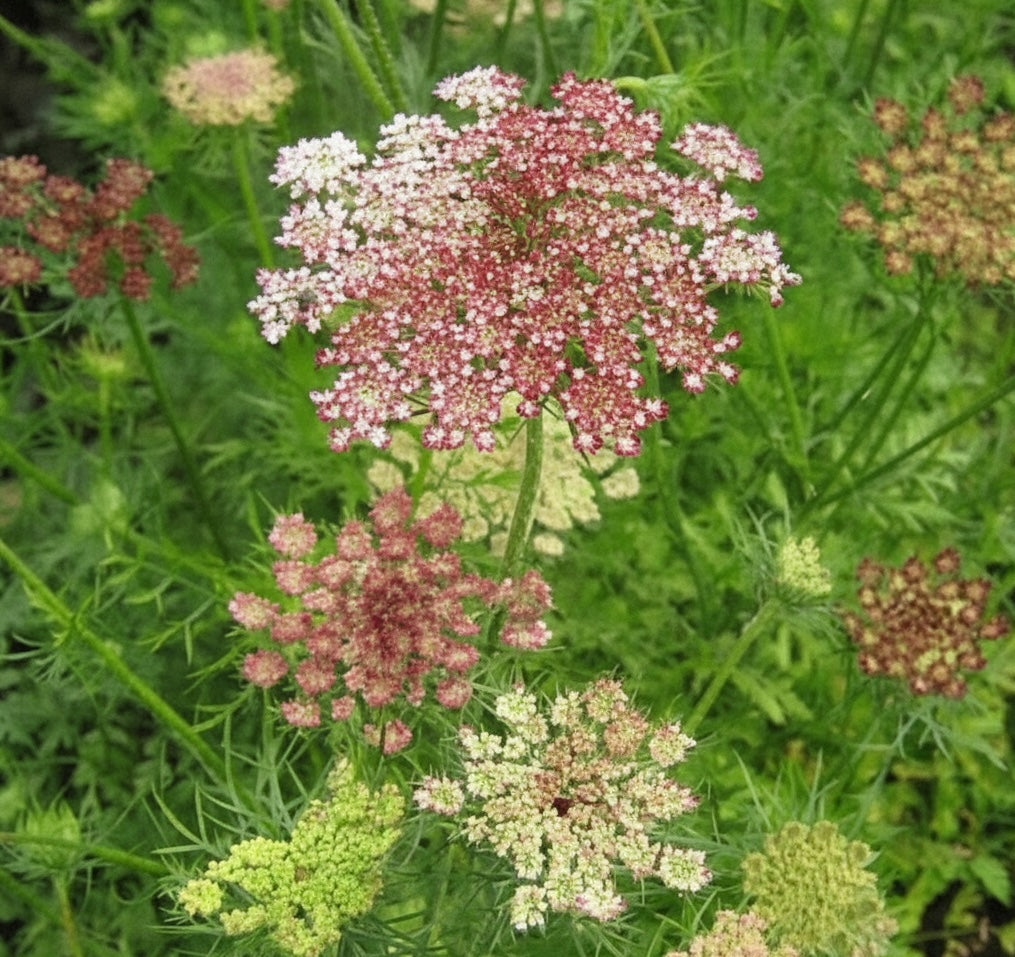
Dara — From Tiny Seed to a Cloud of Wine-Coloured Umbels
A friendly guide to sowing, growing and enjoying Daucus carota “Dara” in Hungary.
Come Into the Garden With Me…
Today, we're growing a carrot — but not the sort we are planting for dinner.
This is Red Ornamental Carrot ‘Dara’, Daucus carota, a beautiful flowering form of the same species as the wild carrot and the familiar kitchen carrot.
Instead of concentrating on a large root, ‘Dara’ sends up tall, branching stems topped with delicate umbrella-shaped flower heads in shades that can move from blush pink through dusty rose, wine-red and deep aubergine.
From a distance the flowers look soft and hazy. Up close, each umbel is made from dozens of tiny flowers, and as the seed head matures it slowly curls inward until it can look almost like a little bird's nest.
It is one of those plants that makes a garden look more natural without making it look untidy.
And there is something else beginners should know immediately: ‘Dara’ behaves very differently from many annual flowers.
It is usually grown as a biennial. We sow in late summer or autumn, the young plant establishes a low rosette, it waits through winter, and then it rises and flowers the following summer.
That means this is a plant for gardeners who enjoy the rhythm of seasons rather than instant results.
For Hungary, that rhythm works beautifully. Sow while the soil is still warm in late summer or early autumn, let the young plants establish before hard winter weather, then watch them return with purpose in spring.
The reward is a tall, airy plant that works wonderfully in cottage borders, naturalistic planting and cutting gardens.
We will learn why direct sowing is best, how to protect the young rosette, how to handle Hungarian winter and spring weather, when to cut the flowers, and how to let a few seed heads remain for next year.
Ready? Let's grow something that looks as though it wandered in from a meadow and decided to stay.
1. Meet Red Ornamental Carrot “Dara”
The botanical name is Daucus carota ‘Dara’. Daucus carota is the wild carrot species, a member of the Apiaceae family — the same broad family that includes parsley, fennel, dill and many other plants with umbrella-shaped flower heads.
The flower structure is called an umbel. Many small flower stalks spread from one point, creating the familiar flat or slightly domed umbrella shape.
‘Dara’ is selected for colour. Instead of the mostly white flowers we associate with wild carrot, its umbels develop a remarkable range of pink, burgundy, wine and aubergine tones.
Not every flower head will be identical. That variation is part of the charm.
The plant typically reaches somewhere around 60–100 cm in ordinary garden conditions, though especially happy plants can grow taller.
Why does the flower change colour?
The umbels can open relatively pale and deepen as they mature. On one plant you may see several stages at once, so the overall effect is far richer than a single flat colour.
This makes ‘Dara’ particularly useful in bouquets because it can bridge soft pinks, creams, burgundies and deep purple flowers in one arrangement.
Biennial — what does that mean?
A biennial usually completes its life over two growing seasons. In the first season it concentrates on leaves and roots. After experiencing winter, it produces flowering stems in the second season, sets seed and then finishes its life cycle.
|
GOOD TO KNOW ‘Dara’ is an ornamental flowering form of Daucus carota. We grow it for its beautiful umbels and seed heads, not because we expect a large kitchen carrot underground. |
2. Finding the Right Place
Choose the final position before you sow, because ‘Dara’ does not appreciate being moved once its taproot begins developing.
A sunny position is ideal. Light partial shade can be tolerated, but full sun generally gives the strongest stems and best flowering.
The soil should be reasonably loose and well drained. It does not need to be excessively rich.
In fact, very rich soil can encourage too much soft leafy growth and make tall stems more likely to flop.
Hungarian autumns are often ideal for establishing young Daucus plants. The soil still holds warmth after summer, while cooler air and autumn rain reduce stress on newly germinated seedlings.
Avoid low places where winter water stands for long periods. A young rosette can tolerate cold far better than cold combined with stagnant wet soil.
Think like a cut-flower gardener
Because ‘Dara’ is tall and airy, it works beautifully through the middle of a border, in a dedicated cutting patch, or repeated between stronger perennials where the umbels can float above neighbouring foliage.
|
A COMMON MISTAKE Starting the seed in small pots and planning to transplant later. Daucus develops a taproot and dislikes disturbance, so direct sowing into the final position is the simplest route to strong plants. |
3. The Red Ornamental Carrot We Grow With You
At Holland Kertészet, the variety in this book is Red Ornamental Carrot ‘Dara’ — 0.1 g.
It is grown primarily for its flowers, not for harvesting a large edible root.
The flower heads range from pale pink to rich wine and aubergine, and the mature umbels can curl inward into the characteristic bird's-nest shape.
Why choose Dara?
Few flowers create this much softness without disappearing into the background. ‘Dara’ has enough height to be noticed, but the fine branching and open umbels keep it transparent and light.
For fresh and dried arrangements
Cut stems while the umbels are fresh and well coloured for loose garden bouquets. For dried work, allow selected heads to mature further and hang them upside down in a dry, airy place.
The seed heads are attractive enough that many gardeners leave some standing in the garden long after flowering.
Good for insects too
The many tiny flowers in each umbel are accessible to a wide range of beneficial insects, including bees, hoverflies and other small pollinators.
That makes ‘Dara’ especially useful in a garden where ornamental value and wildlife value are meant to overlap.
|
GROW WITH US The Holland Kertészet packet in this book is Red Ornamental Carrot ‘Dara’. Expect airy umbels ranging from pale pink to deep wine and aubergine rather than one completely uniform colour. |
4. Let's Sow
This is the most important chapter in the book because sowing technique determines how easy the rest of the plant's life will be.
The packet guidance is to sow directly outdoors from August to October.
For most Hungarian gardens, September is an excellent month. The worst summer heat is usually easing, but the soil is still warm enough for germination and root development.
Prepare the bed first. Remove weeds, loosen the top layer of soil and rake the surface fairly fine.
Sow thinly where you want the plants to remain. Cover only very lightly and keep the surface gently moist while germination begins.
Do not sow a thick line and plan to move everything later. Daucus develops a taproot and resents transplanting.
If seedlings come up too densely, thin them carefully while still small, leaving the strongest plants with roughly 20–30 cm of space around them.
|
DON'T PANIC If autumn seedlings seem to stop growing as winter approaches, that is normal. A compact rosette is exactly what we want. The tall flowering stems arrive after winter, not before it. |
5. The First Autumn
At first, the seedlings make small divided leaves close to the ground rather than tall flower stems.
This low leafy rosette is exactly what we want before winter.
Keep the area weed-free while the plants are small so they are not smothered by faster autumn weeds.
Water during prolonged dry spells, but do not keep the soil permanently wet.
Once established, the young plants become surprisingly resilient.
As winter approaches, resist the urge to feed heavily. We want compact, sturdy plants going into cold weather, not lush soft growth.
|
WHAT I WOULD DO Sow two small patches a couple of weeks apart in September. It spreads the risk if the weather turns unexpectedly hot or dry and can give a slightly longer flowering period the following summer. |
6. Winter — Mostly Leave It Alone
The first winter can feel strange because the plant seems to be doing almost nothing.
That is normal. The important work is happening in the crown and root system.
In most of Hungary, an established young rosette can tolerate ordinary winter cold. The bigger concern is waterlogged ground, especially where freezing and thawing repeat around the crown.
Do not smother the plants with a thick, wet mulch. If you use winter protection in a very exposed garden, keep it light and breathable.
Mark the row or planting area. Small overwintering rosettes are easy to mistake for weeds during an enthusiastic early-spring clean-up.
Then wait for spring.
7. Spring — Suddenly It Starts Growing
As daylight lengthens and temperatures rise, the quiet little rosette changes character.
Fresh leaves appear, the centre strengthens, and eventually tall flowering stems begin to rise.
This is when ‘Dara’ begins to need more moisture than it did through winter. Water deeply during prolonged dry spring weather, especially on light soil.
If your soil is very poor, a light application of balanced fertiliser or a little compost in spring is enough. Avoid pushing the plant with too much nitrogen.
Tall plants in an exposed, windy position may appreciate discreet support, especially if heavy rain arrives just as the flower heads become large.
|
A COMMON MISTAKE Cutting every flower head for the vase. Leave a few of the strongest umbels on the plant. The curled seed heads are beautiful, and they also give you seed for the next generation. |
8. When Something Goes Wrong
Most problems with ‘Dara’ are easier to prevent than to cure.
Poor germination? The seedbed may have dried out during the first weeks, the seed may have been buried too deeply, or autumn sowing may have been followed by unusually severe weather before the seedlings established.
Seedlings disappearing? Slugs and snails can damage small autumn rosettes. Check at dusk and protect young plants if necessary.
Plants are tall but floppy? Very rich soil, too much nitrogen, too much shade or strong wind can all contribute.
No flowers in the first autumn? That is correct. Remember: ‘Dara’ is generally grown as a biennial. The first season is for establishment; flowering comes after winter.
Leaves showing carrot-family pests or disease? Remove badly affected material, improve air movement and avoid repeatedly growing closely related Apiaceae in exactly the same patch year after year.
|
TRY THIS Use ‘Dara’ as a transparent layer rather than a solid block. Plant it among roses, phlox, grasses or dahlias so the wine-coloured umbels seem to float through the border. |
9. And Then the Umbels Open
This is when the waiting suddenly makes sense.
The first umbels begin to open pale, then deepen through smoky pink, berry, burgundy and aubergine shades.
The plant becomes taller and more branched, and because you can see through it, neighbouring flowers remain visible behind the fine stems.
For cutting, harvest when most of the tiny flowers in an umbel are open and the stem feels firm.
Place the cut stems into clean water promptly. They combine beautifully with phlox, cosmos, zinnias, dahlias, grasses and soft-coloured roses.
If you want dried seed heads or self-sown plants, leave several umbels on the plant and allow them to mature fully.
10. Letting Dara Come Back
When the flower head finishes, it gradually contracts inward and forms the characteristic nest-like seed head.
Leave selected heads until they are dry if you want to collect seed.
Cut the dry heads into a paper bag and allow them to finish drying before rubbing the seeds free.
Store completely dry seed somewhere cool, dark and dry until the next sowing period.
Alternatively, allow a few seed heads to remain in the garden. ‘Dara’ can self-seed where conditions suit it.
Self-sown seedlings will not always appear exactly where you would have chosen, but that is part of the naturalistic charm.
11. Designing With Red Ornamental Carrot
‘Dara’ is a wonderful linking plant. It does not create a solid wall of colour; it creates a veil.
Use it between stronger shapes — roses, echinacea, dahlias, salvias, ornamental grasses or tall phlox — and let the fine umbels soften the transitions.
For a romantic palette, combine it with dusty pink, cream, white and soft mauve flowers.
For something richer, pair the deepest wine-coloured umbels with burgundy dahlias, purple basil, dark-leaved plants or copper grasses.
In a cutting garden, sow a generous but well-spaced patch so you can harvest stems without emptying the border.
In a naturalistic garden, scatter small groups through a sunny bed rather than creating one rigid block.
12. Your Red Ornamental Carrot Cheat Sheet
1. Choose Daucus carota “Dara” for pink, wine and aubergine umbels.
2. Treat it as a biennial.
3. Sow directly outdoors from August to October.
4. September is an excellent practical sowing month in much of Hungary.
5. Choose sun or light partial shade.
6. Use well-drained, reasonably loose soil.
7. Sow where the plants are meant to stay.
8. Avoid transplanting because Daucus dislikes root disturbance.
9. Keep the seedbed gently moist during germination.
10. Thin seedlings while young if they are too crowded.
11. Aim for roughly 20–30 cm between plants.
12. Expect only a leafy rosette in the first season.
13. Protect young plants from slugs if necessary.
14. Do not overfeed.
15. Prioritise winter drainage.
16. Water during prolonged dry spring weather.
17. Support tall stems only if the site is very exposed.
18. Cut fresh umbels when most tiny flowers are open.
19. Leave some heads to dry for seed or winter interest.
20. Save seed or allow gentle self-seeding for the next generation.
If You Remember Only Five Things…
1. Sow it where it will flower — Daucus develops a taproot and dislikes being moved.
2. Autumn sowing is the secret — August to October sowing gives the plant time to establish before winter.
3. Do not expect flowers immediately — leaves first, winter second, flowers the following summer.
4. Moderate fertility is enough — full sun and sensible feeding help keep stems strong.
5. Leave some seed heads — they are beautiful, useful for dried arrangements and may give you the next generation.
One Last Walk Around the Garden
We began with a tiny seed sown directly into warm late-summer soil. It spent its first season quietly building a rosette and root, then waited through winter before rising into a cloud of blush, wine, burgundy and aubergine umbels.
That is the pleasure of ‘Dara’: it does not shout. It softens, connects and brings a little meadow feeling into the garden. Cut a few stems for the table, leave a few for pollinators, and let several curl into their beautiful bird's-nest seed heads.
When the dry seeds finally rattle into your hand, you already have the beginning of next year's story. Enjoy the umbels, enjoy the colour, and when you're ready to grow something else…
Come into the garden with me.


