

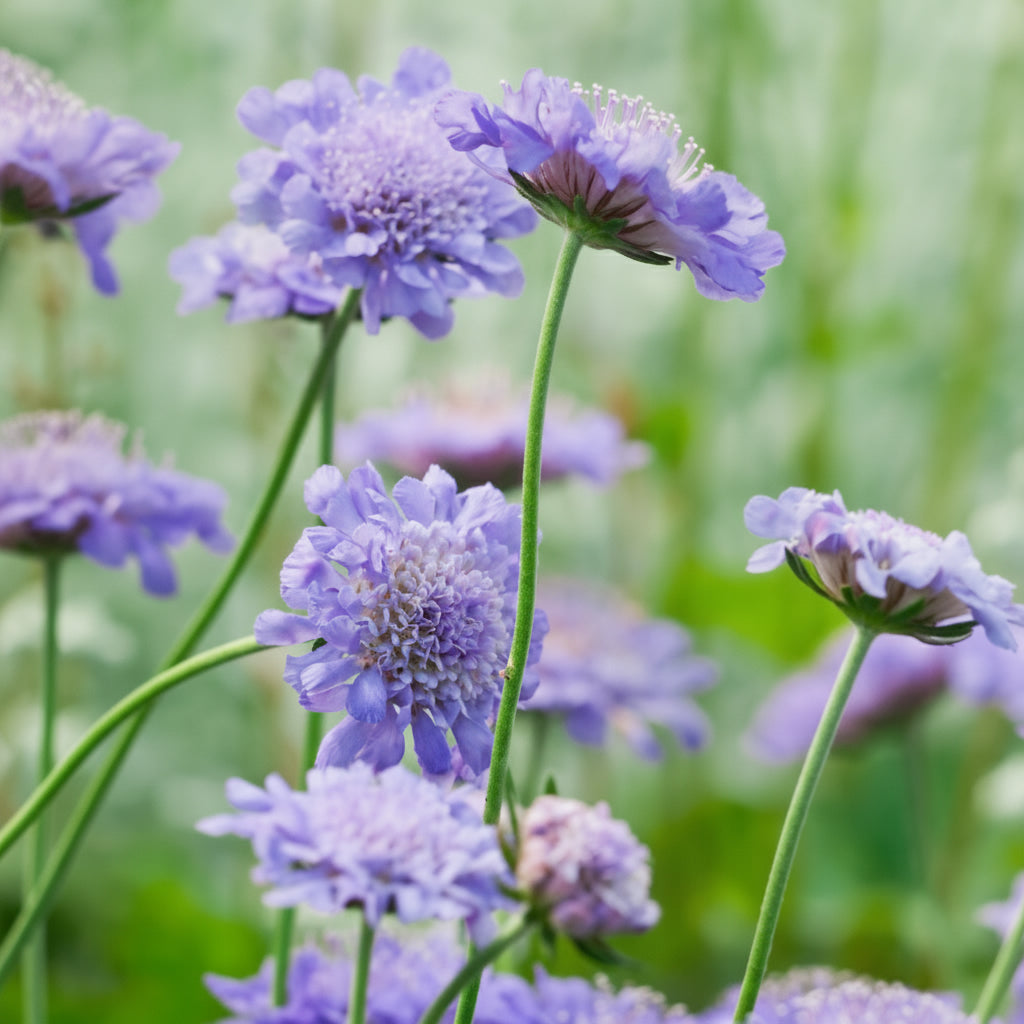
From Tiny Seeds to Pincushions Full of Summer Colour
A friendly guide to sowing, growing and enjoying Scabiosa in Hungary.
Come Into the Garden With Me…
Today, we're growing Scabiosa - one of those flowers that looks delicate from a distance and wonderfully intricate when you lean in close.
The common name 'pincushion flower' makes perfect sense once the blooms open. Each rounded flower head is made up of many tiny florets, with little pin-like stamens standing above the centre. The effect is soft, old-fashioned and slightly wild, yet the long stems make Scabiosa equally at home in a cutting garden.
This is a particularly useful flower for Hungarian gardens. It enjoys full sun and well-drained soil, attracts butterflies and bees, and keeps producing when faded blooms are removed regularly. The flowers also carry a light sweet fragrance and last beautifully in a vase.
We will start with seed, learn how to raise sturdy seedlings, decide whether to sow under protection or outdoors, plant them into a sunny border, keep them flowering through a hot Hungarian summer and finally save seed for another year.
Ready? Let's grow a flower that looks like a little pincushion floating above the border.
1. Meet Scabiosa
Scabiosa belongs to the honeysuckle family, Caprifoliaceae. The annual garden forms are usually Scabiosa atropurpurea, native to the Mediterranean region and long grown for their colourful flowers and excellent cutting stems.
Why is it called pincushion flower?
Look closely at a mature bloom and you will see why. The centre is packed with small florets and projecting stamens that resemble pins pushed into a cushion. Around the edge, larger outer florets give the flower a soft ruffled outline.
Annual or perennial?
There are perennial Scabiosa species, but Scabiosa atropurpurea is normally grown as an annual in our gardens. Sow it, enjoy a long season of flowers, allow some seed to ripen if you wish, and begin again the following year.
How tall?
The Special Edition form is a tall Scabiosa, reaching roughly 90 cm in good conditions. The stems are slender rather than bulky, so the plant adds height without creating a heavy wall of foliage.
|
GOOD TO KNOW Scabiosa is one of those plants that rewards close inspection. From across the garden it gives colour and movement; from nearby, every flower is a tiny piece of botanical architecture. |
2. The Scabiosa We Grow With You
At Holland Kerteszet, the Scabiosa currently highlighted in the flower-seed range is Scabiosa 'Special Edition'. This is the plant we follow through the book.
• Botanical name: Scabiosa atropurpurea
• Common names: Scabiosa, pincushion flower
• Height: about 90 cm
• Life cycle: annual
• Best position: full sun
• Main flowering period: July to September
• Uses: borders, cutting gardens, wildflower-style planting
• Wildlife value: attractive to butterflies and bees
|
WHY GROW IT? One packet gives you three gardens in one: a beautiful border plant, a first-class cut flower and a nectar source for summer pollinators. |
3. Finding the Right Place
Scabiosa grows best when we give it the conditions it would choose for itself: sunshine, air movement and soil that does not stay wet around the roots.
Full sun
Aim for at least six hours of direct sunlight. In Hungary, morning sun with good light through the rest of the day is excellent. Too much shade produces softer stems and fewer flowers.
Well-drained soil
Scabiosa is not particularly demanding about soil fertility, but drainage matters. Heavy clay can be improved with organic matter and drainage material, or you can plant on a slight rise where winter and storm water drains away quickly.
A little shelter helps
Tall flower stems appreciate protection from the strongest winds. An open sunny border is ideal, but a site exposed to repeated summer storms may benefit from discreet support.
|
HUNGARIAN GARDEN NOTE Do not place Scabiosa in the lowest, wettest corner of a clay garden. A sunny raised bed or slightly elevated border is often a much better home. |
4. When and How to Sow
The Horti Tops Special Edition instructions allow us to start early under protection, which is useful when we want a long flowering season.
Early sowing under protection
• Sow from January to March in trays, modules or small pots under glass or indoors.
• Use a fine, free-draining seed compost.
• Sow thinly so seedlings are easy to separate later.
• Cover the seed lightly with compost or vermiculite.
• Keep the compost evenly moist, not saturated.
• Give seedlings strong light as soon as they emerge.
Outdoor sowing
Scabiosa can also be sown in spring once the soil begins to warm, usually from April into May in Hungary. Sow in a prepared seedbed or directly where you want plants to grow, then thin or transplant while seedlings are still small.
Succession sowing
If you enjoy cutting flowers, make a second sowing a few weeks after the first. The plants do not all need to peak together; staggered sowing can extend the useful flowering window.
|
A COMMON MISTAKE Do not bury the seed deeply. A light covering is enough. Deep sowing slows emergence and increases the risk of seed rotting in wet compost. |
5. Raising Strong Seedlings
Light before warmth
After germination, bright light is more important than keeping seedlings excessively warm. Too much warmth with too little light produces long, weak growth.
Pricking out
When seedlings have developed true leaves and are large enough to handle, move them into individual cells or small pots. Hold each seedling by a leaf rather than squeezing the stem.
Pinching? Usually not necessary
Scabiosa naturally branches as it develops. You can pinch very young plants if they become leggy, but good light, sensible spacing and regular cutting later usually give enough branching without extra work.
Hardening off
Before planting outside, gradually expose young plants to wind, stronger sun and cooler nights over about a week. This reduces transplant shock.
|
BEGINNER TIP A sturdy short seedling is better than a tall impressive-looking one. Compact young plants usually establish faster once they reach the garden. |
6. Planting Out in Hungary
By spring, the young Scabiosa plants are ready to move into the border once the weather has settled.
When?
Plant out from late April into May, depending on your local conditions. Scabiosa tolerates cool weather reasonably well, but small greenhouse-raised seedlings still appreciate a gentle transition rather than a sudden cold night.
Spacing
Allow about 25-30 cm between plants. This gives each plant room to branch and also keeps air moving through the foliage - useful in warm, humid weather.
Planting depth
Plant at roughly the same depth as the seedlings were growing in their pots. Firm gently and water thoroughly after planting.
|
A USEFUL RULE Do not crowd Scabiosa just because the seedlings look small. By midsummer each plant will have branched into a much larger flowering shape. |
7. Summer Care
Watering
Established Scabiosa can cope with short dry periods, but continuous drought reduces flower production. During a Hungarian heatwave, water deeply at the root zone and then allow the upper soil to begin drying before watering again.
Feeding
In ordinary garden soil, heavy feeding is unnecessary. A little compost before planting or a light balanced feed is enough. Too much nitrogen gives you lush leaves and softer stems instead of more flowers.
Supporting tall plants
The stems are usually self-supporting in a sheltered border. If your garden is windy, place twiggy supports or a low plant ring early, before the stems begin to lean.
Deadheading is the secret
Cut faded flowers regularly. Each removed flower encourages the plant to keep sending up new stems rather than directing all its energy into seed.
|
TRY THIS Take a small bucket into the garden twice a week. Cut fresh Scabiosa for the house and remove faded heads at the same time. The more regularly you harvest, the longer the plants usually stay productive. |
8. Scabiosa for Bees and Butterflies
Scabiosa is not only decorative. The open flower heads provide an accessible feeding platform for a wide range of insects.
Butterflies
Butterflies are particularly fond of Scabiosa. The broad flower heads give them somewhere to land while they feed, which makes the plant easy to observe from a nearby path or terrace.
Bees and hoverflies
Bees and hoverflies also visit the flowers. A succession of blooms from midsummer into September helps bridge the gap between early-summer flowers and later autumn nectar sources.
Garden without broad sprays
If pollinators are part of the reason you grow Scabiosa, avoid broad-spectrum insecticides on open flowers. A few imperfect leaves are a small price for a living garden.
|
POLLINATOR PARTNERS Plant Scabiosa with lavender, yarrow, catmint, echinacea, cosmos and late asters to create a long summer buffet for bees and butterflies. |
9. Cutting Scabiosa for the Vase
Long stems are one of the great strengths of annual Scabiosa. The flowers bring a soft garden look indoors and combine beautifully with both bold and delicate companions.
When to cut
Harvest when the flower is open but still fresh and firm. Cut early in the morning or in the cool of the evening, before the plant is stressed by midday heat.
Condition the stems
Use clean snips, remove leaves that would sit below the waterline and place the stems into clean water promptly. Recutting the stems before arranging can improve water uptake.
What to combine it with
Scabiosa works particularly well with cosmos, zinnias, phlox, ammi, ornamental grasses and airy herbs. The rounded pincushion shape contrasts beautifully with daisies and spikes.
|
CUT-FLOWER GARDEN Plant a little more Scabiosa than you think you need. Once you start cutting these stems for small kitchen-table arrangements, it is surprisingly difficult to stop. |
10. Design Ideas for the Garden
Cottage borders
Let Scabiosa rise among roses, catmint, delphiniums and annual fillers. Its slender stems soften the border rather than dominating it.
Meadow-style planting
Mix it with annual poppies, cornflowers, nigella and grasses for a looser, more natural look. The dark flowers are especially effective against pale pink, white and silvery foliage.
A dark accent
Deep-purple Scabiosa is useful when a border needs contrast. Repeat a few plants through the bed rather than placing them all in one block, so the dark colour moves through the planting.
Containers
Tall Scabiosa can grow in a large container, but choose a deep, stable pot and combine it with lower plants around the edge. Containers need more regular watering than the same plants in open ground.
|
DESIGN SECRET Dark flowers become more visible when they have something pale behind them. Try deep-purple Scabiosa with white cosmos, cream yarrow or silver-leaved plants. |
11. Problems - and What to Do
Long, floppy stems
The usual causes are too little light, too much nitrogen or exposure to strong wind. Improve support, reduce rich feeding and choose a sunnier position next season.
Powdery mildew
Powdery mildew can appear late in the season, especially when plants are crowded or roots are dry while the air is humid. Give plants space and water deeply during prolonged drought.
Aphids
Tender stems can occasionally attract aphids. Small colonies can often be washed away, while ladybirds and hoverflies help keep them under control naturally.
Few flowers
Check the basics: sunshine, drainage, feeding and deadheading. Too much shade or too much nitrogen usually produces more leaves than flowers.
Plants stop after the first flush
If every faded bloom was left to make seed, the plant may decide its job is finished. Cut old heads back and water during dry weather to encourage another round.
|
A COMMON MISTAKE Do not diagnose a summer slowdown as disease immediately. During extreme Hungarian heat, many flowering plants reduce production until temperatures become kinder again. |
12. Seed Heads and Saving Seed
If you stop deadheading selected flowers, the pincushion blooms gradually turn into decorative dry seed heads. These can be attractive in the garden and useful for seed saving.
How to collect
• Choose healthy plants with flowers you particularly like.
• Leave several late blooms untouched until the heads become dry and papery.
• Cut the heads on a dry day into a paper bag.
• Let them dry fully indoors before separating the seed.
• Store seed labelled with the plant name and year in a cool, dry place.
Will seedlings look identical?
Seed-raised annual Scabiosa can show some variation, especially if several colours or strains are growing nearby. That is part of the pleasure of saving open-pollinated flower seed.
|
SAVE SOME, LEAVE SOME Collect a few heads for labelled seed and leave a few in the garden. Birds and insects may use the dry heads, and an occasional self-sown seedling is a welcome surprise. |
13. A Simple Scabiosa Calendar for Hungary
JANUARY Begin an early protected sowing if you want the longest season. Give seedlings strong light.
FEBRUARY Continue sowing under protection. Keep compost moist but never saturated.
MARCH Main protected sowing period; prick out early seedlings as they develop true leaves.
APRIL Harden off strong plants and begin outdoor sowing when conditions are suitable.
MAY Plant out at about 25-30 cm spacing and continue a later sowing if you want succession.
JUNE Plants branch and prepare to flower. Water deeply during dry periods.
JULY Main flowering begins. Cut for the vase and deadhead regularly.
AUGUST Keep harvesting flowers, support tall stems if necessary and watch watering during heatwaves.
SEPTEMBER Flowering continues. Begin leaving selected heads for seed.
OCTOBER Remove tired annual plants after seed collection, or leave some dry heads for wildlife.
NOVEMBER-DECEMBER Clean and label saved seed, then plan next year's sowing positions.
|
THE RHYTHM OF THE PLANT Scabiosa begins quietly, then spends summer producing one long stem after another. Keep cutting and deadheading, and the plant keeps answering with more flowers. |
14. Your Scabiosa Cheat Sheet
• Grow the Special Edition as Scabiosa atropurpurea.
• Expect a tall annual, around 90 cm in good conditions.
• Start seed under protection from January to March, or sow outdoors in spring.
• Cover seed only lightly.
• Give seedlings bright light and good airflow.
• Harden off before planting outside.
• Choose full sun and well-drained soil.
• Space plants roughly 25-30 cm apart.
• Water deeply during prolonged drought, but avoid soggy soil.
• Feed lightly rather than heavily.
• Cut flowers and deadhead regularly for a longer display.
• Use the long stems in fresh arrangements.
• Leave selected late heads if you want to save seed.
|
IF YOU REMEMBER ONLY FIVE THINGS Sun. Drainage. Lightly covered seed. Keep cutting. Leave a few heads for seed. |
15. One Last Walk Around the Garden
We began with a packet of seed and ended with dark pincushion flowers balancing on long, slender stems.
Along the way we learned that Scabiosa is generous without being demanding. Give it sun, drainage, sensible watering and regular cutting, and it will keep sending flowers through the heart of summer.
We also discovered that the plant belongs to more than the gardener. Butterflies settle on the blooms, bees move from flower to flower, and the same stems that brighten a border can be carried indoors for the vase.
Now you know how to sow it, raise it, plant it in Hungarian conditions, keep it flowering through heat, deal with the common problems and save seed when autumn arrives.
Your own garden will teach you the details no book can: which companions make the dark flowers glow, where butterflies visit first, how long your plants continue in autumn and how many stems you can cut before you decide you really should have sown another row.
Until then, enjoy every pincushion flower. And whenever you're ready to grow something new…
Come into the garden with me.


