

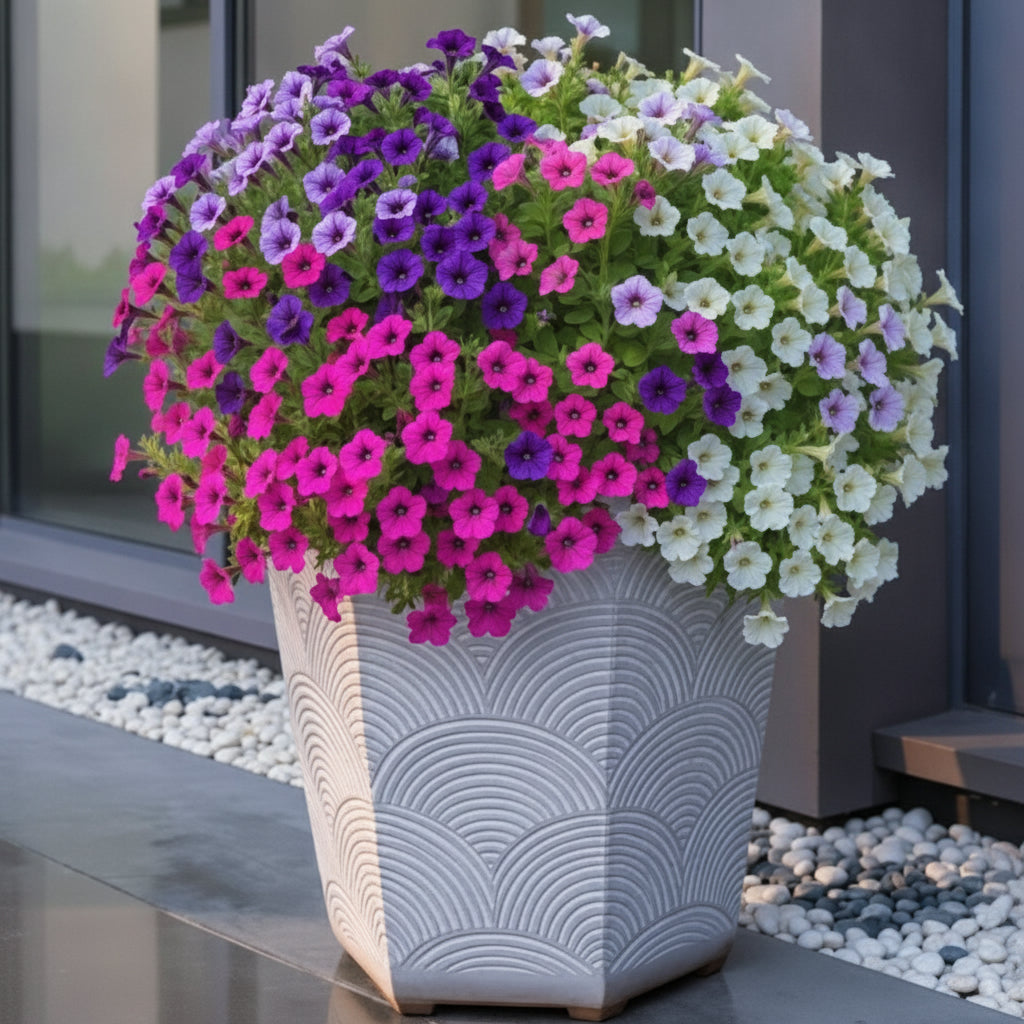
From Tiny Seeds to Cascades of Summer Colour
A friendly guide to sowing, growing and enjoying Petunias in Hungary.
Come Into the Garden With Me…
Today, we're growing petunias - the flowers that can turn one ordinary balcony box into a whole summer of colour.
Petunias are generous plants. Give them warmth, sunshine, regular water and a little food, and they keep producing trumpets in pink, purple, red, white and mixed colours for months. Some sit neatly in a border. Others spill over baskets and window boxes in long flowering trails.
They are also one of those plants that look deceptively simple. We see them everywhere, so it is easy to assume they must be effortless. In reality, the best petunias are the result of a few small habits: sowing those tiny seeds carefully, giving seedlings enough light, waiting until frost has truly passed, feeding container plants consistently and trimming tired growth before it becomes straggly.
For Hungarian gardens, petunias are especially useful because they love summer warmth. The challenge is not usually heat itself. The challenge is keeping containers evenly watered through hot, dry weeks without leaving roots permanently wet.
In the Holland Kerteszet range we grow several types with you, including Multiflora, Pendula, Cascade F1 and a Giant-Flowered Frilled colour mix. They all belong to the same petunia family, but they behave a little differently in baskets, borders and pots.
So we will start with seed that looks almost impossibly small, raise the seedlings, choose the right type for the right place, learn how to keep flowers coming through a Hungarian summer and rescue a plant that has become long, sticky and tired by August.
Ready? Let's grow a summer waterfall of colour.
1. Meet the Petunia
Garden petunias are tender ornamental plants in the nightshade family, Solanaceae. Most modern forms are hybrids descended from South American species, and in Hungary we normally grow them as annuals.
The flowers are trumpet-shaped and can range from small and abundant to huge, ruffled and dramatic. Some varieties grow as compact mounds. Others trail outward and downward, which is why petunias are so closely associated with hanging baskets and balcony boxes.
Their leaves and stems can feel slightly sticky. That is normal. Petunias have glandular hairs on the foliage and stems, and this texture becomes especially noticeable when you pinch or prune them.
Annual in our climate
Petunias are frost tender. Once autumn frost arrives, outdoor plants usually finish. That is why we treat them as annuals in Hungarian gardens, even though some petunias can behave as short-lived perennials in frost-free climates.
Why they flower for so long
A healthy petunia keeps making new shoots, buds and flowers as long as warmth, light and nutrition remain available. The secret is to keep the plant actively growing rather than allowing it to exhaust itself producing seed and long bare stems.
|
GOOD TO KNOW Petunias are not all the same shape. Choose compact forms for beds and bowls, trailing forms for baskets and window boxes, and large-flowered forms where you want individual blooms to be noticed. |
2. The Petunias We Grow With You
At Holland Kerteszet, petunia appears in several useful forms. This book teaches the shared growing method, but each type has its own personality.
Petunia - Multiflora
• A Garafarm annual listed at around 40 cm.
• Best suited to hanging baskets and trailing displays.
• The packet recommends sowing from late winter to early spring at about 20°C, or under frames in early to mid-spring.
• Plant out in early summer once frost danger has passed.
• Trailing stems can reach about 40 cm.
Petunia - Pendula
Pendula is another trailing petunia in the Horti Tops range. Think baskets, raised containers and window boxes where the stems are allowed to spill rather than being forced to stand upright.
Petunia - Cascade F1
Cascade F1 is a seed-count hybrid in the Horti Tops range. F1 plants are bred for uniform performance, so expect the plants from the packet to be more consistent than an open-pollinated mixture. If you save seed from F1 plants, the next generation may not look or behave exactly like the original.
Giant-Flowered Frilled
This Garafarm mixture is the showpiece type: large, frilled flowers in a colour mix. The flowers are spectacular, but large blooms can be more easily marked by heavy rain than small multiflora flowers, so a sheltered patio or container can be a very good home.
|
WHICH ONE SHOULD I CHOOSE? For a hanging basket, start with Multiflora, Pendula or Cascade F1. For a pot where you want to admire individual dramatic blooms, choose the Giant-Flowered Frilled mix. |
3. The Right Place
Petunias love light. If you want a plant covered in flowers rather than a soft green mound with a few blooms, start with sunshine.
Full sun
Aim for at least six hours of direct sun. In very hot Hungarian locations, a little late-afternoon shelter can reduce stress in containers, but too much shade usually means fewer flowers and softer growth.
Good drainage
Petunias appreciate regular moisture, but they do not like roots sitting permanently in water. Garden soil should drain freely, and every pot or basket must have open drainage holes.
Shelter helps large flowers
Small-flowered and multiflora petunias cope relatively well with summer weather. Giant-flowered forms can look battered after heavy rain or hail. If you have a sheltered terrace or roof overhang, that is an excellent place for the biggest-flowered varieties.
|
HUNGARIAN SUMMER NOTE Petunias enjoy warmth, but a black plastic pot in full afternoon sun can become extremely hot. Keep roots watered and consider a larger or lighter outer container if pots overheat repeatedly. |
4. Let's Sow Those Tiny Seeds
Petunia seed is tiny. Very tiny. This is the stage where beginners often think they need to bury the seed. Resist that instinct.
When to sow
For an early display, sow indoors from late winter into early spring. The Multiflora packet in our range recommends about 20°C. Because seedlings need time to become sturdy, starting in February or March is very practical if you have bright indoor conditions.
Surface sow
• Fill a tray with fine seed compost and firm the surface gently.
• Water before sowing so the seed is not washed away afterwards.
• Scatter seed thinly over the surface.
• Press very gently so the seed has contact with the compost.
• Do not bury deeply. A very fine dusting of vermiculite is enough if you use one at all.
• Keep warm, bright and evenly moist.
Pelleted seed
Some modern petunia seed is pelleted so it is easier to handle. If your seed looks like small pale beads rather than dust, that coating still needs to remain moist so it can dissolve around the seed.
|
A COMMON MISTAKE Covering petunia seed with a thick layer of compost. These tiny seeds germinate best close to the surface with light available. |
5. The First Seedlings
Petunia seedlings begin life as tiny green dots. At this stage, the two greatest dangers are too little light and too much water.
Light, light, light
As soon as seedlings appear, give them the brightest position you can manage without scorching them. Weak light creates thin seedlings that stretch and fall over.
Water from below when possible
A heavy stream of water can flatten tiny seedlings. Bottom watering or a very fine spray is much safer. Keep compost evenly moist, never swampy.
Pricking out
Once seedlings have several true leaves and are large enough to handle, move them into individual cells or small pots. Hold seedlings by a leaf rather than squeezing the delicate stem.
Pinch for branching
When young plants are established and growing strongly, pinching the central tip can encourage side shoots and a fuller plant. Do not pinch a weak seedling that is still struggling to establish.
|
DON’T PANIC Petunia seedlings can look absurdly small compared with the basket you hope to fill. Once warmth and long days arrive, their growth accelerates dramatically. |
6. Moving Outdoors in Hungary
Petunias dislike frost. A sunny April day is not enough reason to plant them permanently outside.
Harden off
• Put plants outside for a few hours on a mild day.
• Begin in a sheltered spot out of strong wind.
• Increase the time outside gradually for about a week.
• Bring plants back under cover if nights turn cold.
• Plant out once frost risk has passed and nights are reliably mild.
When is that in Hungary?
For most gardens, early to mid-May is a much safer target than April. In colder pockets or higher locations, wait a little longer. Petunias recover slowly from cold shock, so patience gives you a faster plant in the end.
Spacing
In beds, allow roughly 20 to 30 cm between compact plants. Trailing types in baskets are usually planted more closely because the aim is for several plants to merge into one flowering display.
|
A USEFUL RULE Do not judge planting-out time only by daytime temperature. Night temperature matters enormously for tender summer flowers. |
7. Petunias in Pots, Baskets and Window Boxes
This is where petunias really earn their place in the garden. They can turn a balcony, doorway or terrace into a flower display without needing a square metre of open soil.
Use enough compost
Tiny hanging baskets dry out very quickly in July. A larger basket or trough holds more compost, more moisture and more nutrients, and therefore supports more flowers for longer.
Drainage holes are essential
Water must be able to escape freely. Decorative outer pots are fine, but empty standing water after heavy rain.
Trailing types
Multiflora, Pendula and Cascade F1 are especially useful where stems can hang naturally. Let the shoots spill over the edge rather than constantly tying them upright.
Feed container plants
Petunias in pots are hungry because every flower is built from nutrients contained in a limited volume of compost. Once flowering begins, a regular liquid feed formulated for flowering plants can make a dramatic difference.
|
BALCONY TIP On a hot west-facing balcony, check baskets daily. A flowering petunia can go from cheerful to wilted surprisingly quickly when a small container dries out. |
8. The Summer Routine
By June, the difficult seedling stage is behind you. Now the job becomes very simple: water, feed, tidy and enjoy.
Water deeply
Water until excess runs from the drainage holes, then allow the upper compost to begin drying before watering again. Constantly wet compost is not healthier than dry compost.
Feed regularly
Container petunias flower more heavily with consistent feeding. Follow the product instructions rather than doubling the dose; more fertiliser does not mean twice as many flowers.
Deadhead where useful
Traditional petunias benefit from removing faded flowers together with the little swelling seed capsule behind them. Some modern hybrids are more self-cleaning, but even these appreciate occasional tidying.
Trim tired stems
If a plant becomes long and bare in the middle, cut some stems back by about one-third. It may look less impressive for a week, then fresh side shoots usually appear and flowering improves again.
|
THE JULY HAIRCUT Do not be afraid to shorten a straggly petunia in midsummer. A modest trim, followed by water and feed, can give you a much better plant for August and September. |
9. Flowering Through Heat and Rain
Petunias love summer, but different flower sizes react differently to weather.
During heatwaves
Plants in the ground usually cope if their roots are established and soil moisture is reasonable. Baskets are much more vulnerable. Water in the morning where possible and check again later if temperatures are extreme.
After heavy rain
Large flowers may collapse or stick together. Remove badly damaged blooms and allow the plant to make fresh ones. Small multiflora flowers usually recover more quickly because the plant carries many more of them.
Wind
Trailing baskets can become heavy sails. Hang them securely and protect them from the strongest exposed wind, especially on upper-floor balconies.
|
GOOD TO KNOW One ruined flower is not a ruined petunia. The plant is a flower factory. Remove damaged blooms and look for the buds already waiting behind them. |
10. Problems - and How to Solve Them
Lots of leaves, few flowers
Too much shade or too much nitrogen is the usual cause. Increase light if possible and use a balanced flowering feed rather than a high-nitrogen product.
Sticky plant
Petunia stems and leaves naturally feel sticky because of glandular hairs. This alone is not a pest problem.
Aphids
Check tender tips and flower buds. Small colonies can often be washed off with water or controlled by encouraging ladybirds and hoverflies.
Whitefly
On sheltered balconies or greenhouse-grown plants, tiny white insects may fly up when leaves are disturbed. Improve airflow and inspect leaf undersides regularly.
Yellow leaves
Check watering first. Both drought and waterlogged roots can cause yellowing. In long-term container culture, nutrient deficiency may also contribute, especially if the plant has not been fed for weeks.
Powdery or grey mould
Crowded wet foliage and poor airflow encourage fungal trouble. Space plants reasonably, water the compost rather than repeatedly soaking the leaves, and remove decaying flowers.
|
A COMMON MISTAKE Responding to every yellow leaf with more water. Put a finger into the compost first. Petunias can yellow because they are too wet as well as too dry. |
11. Designing With Petunias
One-colour baskets
A basket planted in one colour often looks more luxurious than a random mix. Pink, white or deep purple repeated around a terrace gives a calm, intentional effect.
Mixed balcony boxes
Combine trailing petunias with upright plants such as geraniums, ornamental tobacco or compact grasses. Let the petunia soften the edge of the container while taller companions give structure.
In the border
Multiflora and compact petunias work well at the front of sunny borders. Their long flowering season helps fill the gap between early summer perennials and autumn colour.
With silver foliage
Petunia colours look beautiful beside silver plants such as dusty miller or silver-leaved herbs. White and pink petunias become softer; purple petunias look deeper and richer.
|
DESIGN IDEA Repeat the same petunia colour in three separate pots rather than putting every colour into one container. Repetition makes a terrace look larger and more connected. |
12. Saving Seed - and the F1 Question
If you grow an open-pollinated petunia and allow a faded flower to form a seed capsule, you can collect seed once the capsule becomes dry and begins to split.
How to collect
• Leave a few flowers un-deadheaded late in the season.
• Wait until seed capsules are dry and papery.
• Collect them before they split completely.
• Dry the seed thoroughly indoors.
• Store cool, dry and labelled.
What about Cascade F1?
Cascade F1 is a first-generation hybrid. Seed saved from it may germinate, but the next generation can vary widely and may not repeat the colour, habit or performance of the original packet. If you want the same result, buy fresh F1 seed.
|
SEED-SAVING NOTE Saving seed is a lovely experiment, but with hybrids the surprise is part of the process. Grow saved F1 seed for curiosity, not for guaranteed uniformity. |
13. A Simple Petunia Calendar for Hungary
FEBRUARY Begin indoor sowing if you have strong light and warm conditions.
MARCH Main indoor sowing month. Keep tiny seedlings bright and evenly moist.
APRIL Pot on young plants and begin gentle hardening on mild days.
MAY After frost risk has passed, plant into beds, baskets and balcony boxes.
JUNE Growth accelerates. Begin regular feeding once plants are established and flowering.
JULY Water carefully during heat. Deadhead and trim straggly growth if needed.
AUGUST Keep feeding and watering. A midsummer haircut can renew tired plants.
SEPTEMBER Enjoy the late flush of flowers and begin leaving a few capsules if saving seed.
OCTOBER Flowering can continue until cold weather. Collect dry seed capsules.
NOVEMBER-JANUARY Clean containers, store seed and plan next year's colours.
|
THE RHYTHM OF THE PLANT Petunia asks for the most patience at the seedling stage. Once summer arrives, the routine becomes simple: sun, water, food and an occasional haircut. |
14. Your Petunia Cheat Sheet
• Sow tiny seed on or very near the surface.
• Use warmth around 20°C for germination.
• Give seedlings excellent light.
• Wait until frost danger has passed before planting out.
• Choose trailing varieties for baskets and window boxes.
• Use large enough containers with excellent drainage.
• Water thoroughly, but do not keep roots permanently wet.
• Feed container plants regularly once flowering begins.
• Remove faded flowers where needed.
• Trim long, tired stems in midsummer to renew the plant.
• Protect giant flowers from the worst heavy rain if possible.
• Remember that saved F1 seed may not come true.
|
IF YOU REMEMBER ONLY FIVE THINGS Surface sow. Bright light. No frost. Feed baskets. Trim tired growth. |
15. And Then One Morning…
There are flowers everywhere.
The tiny seeds that once looked like dust have become a basket full of trumpets. Some flowers hang over the rim, some turn upward toward the light, and every few days there seem to be more buds than before.
That is the pleasure of petunias. They do not ask us to wait years for maturity. They reward one season of attention with months of colour.
We began with seed, warmth and patience. We learned which petunias trail, which ones show off with giant frilled flowers, how to move tender plants safely into a Hungarian spring, and how to keep containers performing through the long dry weeks of summer.
Your own garden will teach you the rest: which balcony corner gets too hot, which basket dries fastest, whether you prefer a calm single colour or a riot of mixed flowers, and which petunia you absolutely have to grow again next year.
Until then, enjoy the flowers. And whenever you're ready to grow something new… Come into the garden with me.
We're growing Petunias.


