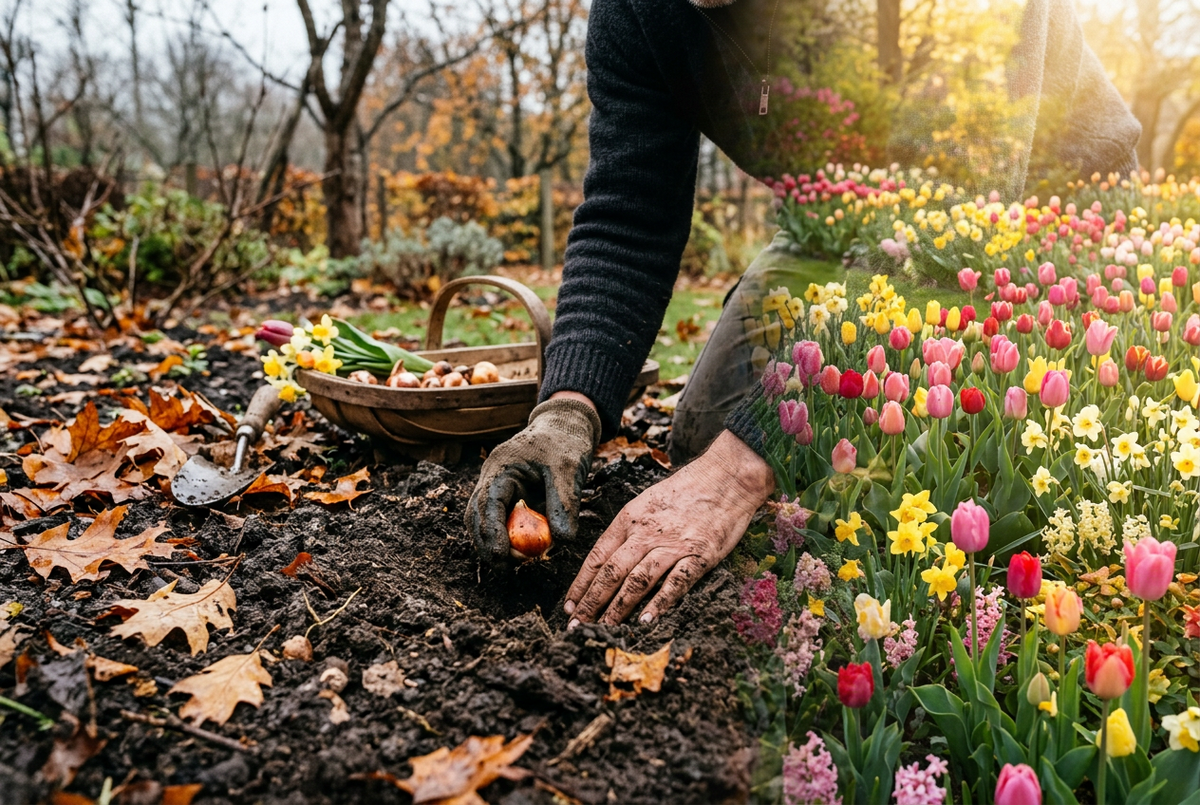
Who says the gardening season is over? November may be chilly, but there are still wonderful things you can plant today that will reward you with flowers, fresh vegetables and beautiful greenery next year.
There is a particular feeling that comes over us gardeners in November.
The mornings are getting colder, the trees are losing their leaves, and the last colourful flowers are slowly disappearing from our gardens. The vegetable beds look rather empty, the garden furniture has been put away, and the watering can has finally earned a well-deserved rest.
We look outside and think, Well, that's gardening finished for another year.
But wait a minute!
Before you put your gardening gloves in the cupboard and settle down with a warm cup of tea, I have some rather good news.
November is not the end of the planting season.
In fact, for certain plants, it can be one of the most useful times of the year.
While the air becomes cooler, the soil often retains enough warmth for roots to establish. Autumn rain can help newly planted trees and shrubs settle in, and many spring-flowering bulbs need the cool months ahead to prepare for their spectacular display.
Some vegetables even benefit from being planted before winter.
And perhaps the nicest part of all?
Most of these plants will quietly get on with their work while you enjoy the winter holidays.
By the time spring arrives, your garden may already be full of new life.
Of course, gardening in Hungary brings its own challenges. November in the mild, sheltered areas around Lake Balaton can feel quite different from November in the colder northeastern regions. Even two gardens in the same village may have very different conditions.
So today, we're going to look at fifteen wonderful things you can still plant in November, how to plant them successfully, and what you can realistically expect next year.
Put on a warm jacket, find your gardening gloves, and come into the garden with me.
We still have a little planting to do!
Before We Begin — The Three Golden Rules of November Planting
Before rushing outside with a basket full of bulbs and plants, let's remember three important things.
1. The soil must be workable
This is probably the most important rule.
If the soil is frozen solid, don't try to force your way through it with a spade.
If it is soaking wet and sticky, wait for better conditions.
Planting in waterlogged soil can damage its structure and cause bulbs or roots to rot.
Ideally, the soil should be moist but reasonably crumbly.
2. Choose plants that tolerate winter
Not every plant belongs in the November garden.
Tender annual flowers, tomatoes, peppers and many Mediterranean plants should not be planted outdoors now.
Our choices need to be suitable for cold weather, winter dormancy or protected cultivation.
3. Remember that Hungary has different growing conditions
In western Hungary, around Győr and Sopron, November may still offer relatively mild planting days.
The Great Hungarian Plain can experience sharp temperature changes, while northeastern regions and higher elevations may have colder conditions.
So don't follow the calendar blindly.
Look at your soil, observe the weather and choose the right moment.
GOOD TO KNOW
A plant doesn't know whether the calendar says November 5 or November 25. It responds to temperature, moisture, daylight and the conditions around its roots.
That is why a little observation is often more valuable than a fixed planting date.
Part One — Spring Flowers That Begin Their Journey in November
1. Tulips — Plant Now for a Spectacular Spring

If there is one flower that proves November gardening is worthwhile, it is the tulip.
Imagine your garden in April.
The trees are beginning to show fresh green leaves, the sun is finally warming the terrace, and suddenly your flower beds are filled with brilliant red, pink, yellow, purple and white tulips.
What a wonderful reward for a little work in November!
Tulips are particularly well suited to autumn planting because they need a period of cool conditions for normal spring development.
In much of Hungary, November can still be an excellent time to plant them, provided the soil is not frozen or waterlogged.
How to plant tulips
Choose a sunny location with well-drained soil.
As a general rule, plant tulip bulbs at a depth of approximately two to three times their height, often around 10–15 cm deep depending on bulb size and soil conditions.
Space them approximately 8–12 cm apart for a full display, adjusting for variety and desired effect.
Place the pointed end upwards, cover with soil and water lightly if the ground is dry.
Tulips dislike sitting in constantly wet soil, particularly during winter.
If you have heavy clay soil, improve drainage and avoid planting in places where water collects.
A little design secret
Instead of planting tulips in a perfectly straight line, try planting them in generous groups.
Twenty-five tulips together will usually create a stronger visual impression than twenty-five scattered across a large garden.
Combine early, mid-season and late-flowering varieties to extend the display.
When will they flower? Usually from March to May, depending on the variety and weather.
GROW WITH US: Tulips are also wonderful in large containers. Use pots with drainage holes and protect them from prolonged waterlogging and extreme exposure.
2. Daffodils — The Cheerful Messengers of Spring
There is something wonderfully optimistic about daffodils.
Their bright yellow and white flowers seem to announce that winter has finally lost its grip.
And once established in a suitable location, many daffodils can return year after year.
Daffodils generally prefer to be planted earlier in autumn than tulips, because they benefit from having time to develop roots before winter.
However, if you still have firm, healthy bulbs in November, planting them promptly into suitable soil is usually better than leaving them in storage until spring.
Late planting may reduce first-year flowering performance.
How to plant daffodils
Choose a sunny or lightly shaded position.
Plant at approximately two to three times the bulb's height, commonly around 10–15 cm deep for many garden varieties.
Allow approximately 10–15 cm between bulbs, depending on size.
Daffodils look especially beautiful beneath deciduous trees, along garden paths or in natural-looking groups.
An important little detail
After flowering, don't cut the green leaves off immediately.
The foliage needs time to produce and store energy for the following year.
Wait until it has naturally yellowed and died back.
When will they flower? Usually March to April, with some varieties earlier or later.
A COMMON MISTAKE: Planting daffodils in permanently wet ground can cause bulb problems. Good drainage is essential.
3. Crocuses — Tiny Flowers With Enormous Charm
Crocuses may be small, but they have a remarkable ability to make us smile.
Sometimes they appear when the garden still looks completely asleep.
A few purple, white or yellow flowers suddenly open in the sunshine, and spring feels just a little closer.
Many spring-flowering crocuses are excellent for naturalising in lawns, beneath deciduous trees or at the front of flower borders.
Ideally, they are planted earlier in autumn, but healthy corms can still be planted in November if the soil remains suitable.
How to plant crocuses
Choose a sunny or lightly shaded location.
Plant the corms approximately 5–10 cm deep, depending on their size and the species.
Space them around 5–8 cm apart.
For a natural appearance, scatter the corms gently over the planting area and plant them where they fall.
Avoid places where the ground remains wet throughout winter.
Crocuses in the lawn
A lawn filled with crocuses can be absolutely beautiful.
But remember not to mow the foliage immediately after flowering.
Allow it to die back naturally so the corms can replenish their reserves.
When will they flower? Many varieties bloom from February to March.
GOOD TO KNOW: Spring-flowering crocuses and autumn-flowering saffron crocuses are not interchangeable. Always check the species and flowering season when purchasing.
4. Hyacinths — Spring Flowers With an Unforgettable Fragrance
Some flowers are beautiful.
Others are fragrant.
And then there are hyacinths, which manage to be both.
Their dense flower spikes come in wonderful shades of blue, pink, white, purple and occasionally yellow.
But their fragrance is what makes them truly special.
A few hyacinths near a garden path can fill the air with a delicious spring scent.
How to plant hyacinths
Choose a sunny or lightly shaded position with well-drained soil.
Plant the bulbs approximately 10–15 cm deep, depending on their size.
Space them around 10–15 cm apart.
Hyacinths work beautifully in formal flower beds, containers and small groups near terraces.
Can you grow them indoors for Christmas?
Yes, but there is an important detail.
Hyacinths intended for Christmas flowering generally require specially prepared bulbs and a carefully managed forcing process.
Ordinary garden bulbs planted in November should not be expected to flower by Christmas.
For garden planting, November can still be suitable when conditions allow.
When will they flower outdoors? Usually March to April.
A COMMON MISTAKE: Planting hyacinths in poorly drained containers without adequate drainage holes.
5. Ornamental Alliums — Spring and Early Summer Fireworks
If you love unusual flowers, ornamental alliums deserve a place in your garden.
Their round flower heads look like colourful fireworks suspended above the flower beds.
Some varieties produce small, delicate spheres.
Others develop enormous purple globes that can become a real talking point.
And the best part?
Many varieties retain attractive dried seed heads after flowering.
That means they can also contribute to the winter garden we discussed in our previous article.
How to plant ornamental alliums
Most large-flowered ornamental alliums prefer full sun and well-drained soil.
Plant the bulbs at approximately two to three times their height.
Spacing varies considerably between species and varieties.
Smaller alliums may be planted relatively close together, while large varieties need more room.
A beautiful combination
Try planting purple alliums among ornamental grasses, catmint or hardy geraniums.
The rounded flower heads contrast beautifully with softer foliage.
When will they flower? Depending on the species, from late spring into summer.
GROW WITH US: Ornamental alliums can be excellent choices for sunny Hungarian gardens, particularly where drainage is good.
Part Two — Vegetables You Can Still Plant in November
6. Garlic — One of the Best November Planting Choices

Now let's move into the vegetable garden.
And we'll begin with one of the most useful crops of all.
Garlic!
If you enjoy cooking, growing your own garlic is incredibly satisfying.
And autumn planting can produce excellent results in Hungary.
Garlic benefits from a period of cool weather, and autumn-planted varieties generally establish roots before winter and resume growth in spring.
How to plant garlic
Choose healthy, disease-free planting cloves from a reliable supplier.
Use varieties suitable for autumn planting.
Separate the cloves shortly before planting, keeping their protective skins intact.
Plant each clove with the pointed end upwards.
A practical starting point is approximately 5–8 cm deep, measured to the base of the clove, with the top covered by several centimetres of soil. Adjust for local soil and winter conditions.
Space cloves approximately 10–15 cm apart, with 20–30 cm between rows.
Garlic prefers a sunny position and reasonably fertile, well-drained soil.
Avoid adding fresh manure immediately before planting.
What happens during winter?
The cloves begin developing roots when conditions are suitable.
Some may produce green shoots before winter.
This is not automatically a problem.
Cold-hardy varieties can usually tolerate normal winter conditions, although severe exposure or waterlogging may cause damage.
When can you harvest?
Autumn-planted garlic is commonly harvested in late spring or summer, often around June or July in Hungary, depending on variety and weather.
A COMMON MISTAKE: Planting ordinary supermarket garlic without knowing whether it is suitable for local growing conditions. Certified planting stock is a safer choice.
7. Broad Beans — An Early Start for Next Year's Harvest
Broad beans are a wonderful crop, but November sowing requires a little more care.
In milder climates, certain hardy broad bean varieties can be sown in autumn to overwinter.
In Hungary, however, winter conditions can be too severe for reliable outdoor overwintering, particularly in exposed gardens.
So this is an option for gardeners who enjoy experimenting, rather than a guaranteed November crop.
How to sow broad beans
Choose a variety specifically described as suitable for autumn sowing.
Select a sheltered, sunny position with good drainage.
Sow seeds approximately 5–8 cm deep, with spacing according to the variety.
Protect young plants from severe weather when necessary.
In colder regions, spring sowing is generally more reliable.
Why grow broad beans?
They are nutritious, versatile and can be harvested relatively early compared with many summer vegetables.
Like other legumes, they can form associations with nitrogen-fixing bacteria.
However, this does not mean that they automatically fertilise every neighbouring plant.
When will they be ready? Successful autumn-sown crops may produce an earlier harvest than spring-sown ones, but timing and survival depend heavily on winter conditions.
GOOD TO KNOW: In much of Hungary, March sowing is the safer choice. Treat November sowing as an experiment using hardy varieties and suitable protection.
8. Winter Spinach — Fresh Green Leaves in the Cold Months
Spinach is one of those vegetables that appreciates cool weather.
In fact, it generally performs much better in cool conditions than during the hottest weeks of summer.
But there is a difference between growing spinach in autumn and sowing it in November.
By November, shorter days and colder soil can make germination and growth very slow.
Can you still sow spinach?
Yes, in suitable conditions, particularly in a greenhouse, cold frame or protected bed.
Choose a cold-tolerant variety.
Sow into well-prepared soil at approximately 1–2 cm deep.
Keep the soil lightly moist but never waterlogged.
If temperatures remain low, seeds may germinate slowly or wait for better conditions.
What can you expect?
In a protected setting, established spinach plants may provide leaves during mild periods.
Seeds sown very late may not produce a useful harvest until spring.
For reliable autumn harvesting, spinach is generally better sown earlier, often in late summer or early autumn.
GROW WITH US: If you have a small greenhouse or cold frame, spinach is a lovely crop to experiment with during the colder months.
9. Lamb's Lettuce — The Little Salad That Loves Cool Weather
Lamb's lettuce is one of my favourite winter salad crops.
Its small, tender leaves form attractive rosettes, and the flavour is mild and slightly nutty.
It is also relatively cold tolerant.
In Hungary, lamb's lettuce can be a useful crop for autumn and winter cultivation.
How to sow lamb's lettuce
Choose a sheltered location with well-drained soil.
Sow seeds shallowly, approximately 0.5–1 cm deep.
Thin seedlings according to the variety's recommended spacing.
Keep the soil moderately moist during germination.
In November, germination can be slow, especially outdoors.
A cold frame or unheated greenhouse may improve your chances.
A wonderful winter salad
Imagine harvesting fresh green leaves from your own garden on a mild winter afternoon.
Add a few walnuts, sliced apples and a simple dressing.
Delicious!
When can you harvest? Established autumn-sown plants may be harvested during mild winter periods. November-sown seeds may produce their main crop in late winter or spring.
A COMMON MISTAKE: Expecting rapid growth during the shortest days of winter. Even cold-tolerant crops grow slowly when light levels are low.
10. Peas — An Experiment for the Adventurous Gardener
Peas are one of the joys of spring.
There is something wonderful about picking a fresh pea pod, opening it and tasting those sweet little peas straight from the garden.
But can peas be planted in November?
The answer is: sometimes, with the right variety and conditions.
Certain winter-hardy pea varieties can be autumn-sown in suitable climates.
However, Hungarian winters can be unpredictable, and outdoor November sowing is not reliable everywhere.
How to try autumn peas
Choose a variety specifically suitable for overwintering.
Plant in well-drained soil in a sheltered location.
Sow approximately 3–5 cm deep, adjusting for soil and seed size.
Avoid very wet ground, where seeds may rot.
Protect emerging plants if necessary.
A safer alternative
If you live in an exposed or particularly cold part of Hungary, wait until late winter or early spring.
Peas are generally very suitable for early spring sowing once soil conditions allow.
When can you harvest? Successful overwintered peas may crop earlier than spring-sown peas, but November sowing should be considered experimental in many Hungarian gardens.

Part Three — Trees, Shrubs and Fruit for the Future
11. Bare-Root Fruit Trees — Plant a Harvest for Years to Come
November is often an excellent time to plant dormant, bare-root fruit trees.
And few gardening projects are more rewarding.
Imagine planting a small apple tree this November.
In a few years, you may be sitting beneath its branches, enjoying its shade and picking your own apples.
A fruit tree is not simply a plant.
It is an investment in the future.
Which fruit trees can be planted?
Depending on the site, variety and rootstock, suitable choices may include:
-
Apple trees
-
Pear trees
-
Plum trees
-
Sour cherries
-
Sweet cherries
-
Certain other hardy fruit trees
More frost-sensitive species, such as peaches and apricots, may be better planted in spring in colder or exposed locations.
How to plant a bare-root fruit tree
Choose a suitable location with enough space for the tree's mature size.
Soak dry roots briefly before planting, following nursery guidance.
Dig a hole wide enough to spread the roots naturally without bending them sharply.
Plant at the correct depth.
The graft union should normally remain above soil level, with the exact position depending on the fruit species and rootstock.
Backfill with the original soil, firm gently and water thoroughly.
Stake the tree if needed.
A very important consideration
Fruit trees are not all self-fertile.
Some require a compatible pollinating variety nearby to produce a good harvest.
Always check pollination requirements before purchasing.
When will you harvest? Depending on the species, variety, rootstock and growing conditions, fruit production may begin after a few years.
GOOD TO KNOW: Choose fruit varieties adapted to Hungarian conditions, and consider local risks such as late spring frost, summer drought and common fruit diseases.
12. Berry Bushes — Small Plants, Delicious Rewards
November is also a useful planting time for many dormant berry bushes.
And berries are wonderful additions to gardens of almost any size.
Think of fresh raspberries, blackcurrants, redcurrants and gooseberries.
They can be eaten fresh, frozen, made into jam or used in desserts.
Which berries can be planted?
Depending on availability and conditions:
-
Raspberries
-
Blackcurrants
-
Redcurrants
-
Gooseberries
-
Thornless blackberries
Bare-root plants are commonly planted during dormancy when the soil is workable.
How to plant berry bushes
Choose a location suited to the species.
Most productive berry crops appreciate good light, although some tolerate partial shade.
Prepare the soil and remove persistent weeds.
Plant at the depth recommended for the species.
Water thoroughly after planting and apply suitable mulch without piling it against the stems.
Remember the Hungarian summer
Many berry plants, particularly raspberries and currants, can struggle during prolonged heat and drought.
In warmer parts of Hungary, afternoon shade, mulch and reliable irrigation may improve their performance.
Blackcurrants especially prefer cooler conditions and may be less suitable for the hottest exposed sites.
When will you harvest? Some plants may produce a small crop in their first growing season, but stronger harvests generally follow as they establish.
13. Roses — Give Your Garden a Romantic Future
Is there anything more romantic than a garden filled with roses?
Their colours, fragrance and elegance have made them favourites for centuries.
And November can be a very good time to plant dormant bare-root roses.
Why plant roses in autumn?
In suitable conditions, autumn planting allows the rose to settle into its new position before spring.
The soil may still be workable, and cooler weather reduces the stress associated with hot summer planting.
However, planting should be completed before the ground freezes.
In colder areas, spring planting may be preferable for some roses.
How to plant a bare-root rose
Choose a sunny position with good air circulation.
Most roses perform best with at least six hours of direct sunlight, although requirements vary.
Soak the roots according to nursery instructions.
Dig a generous planting hole and spread the roots naturally.
Plant at an appropriate depth for the rose type and local climate.
In colder continental conditions, the graft union of many grafted roses is often placed slightly below soil level for winter protection, but follow the supplier's instructions.
Water thoroughly and apply mulch.
Which roses should you choose?
For Hungarian gardens, disease resistance and heat tolerance are especially valuable.
Consider shrub roses, floribundas, hybrid teas or climbing roses depending on your space and preferences.
Fragrant varieties near a seating area can be particularly lovely.
When will they flower? Many repeat-flowering roses begin blooming in late spring or early summer, depending on variety and conditions.
A COMMON MISTAKE: Planting roses in a location where water stands during winter. Roses need good drainage.
Part Four — Perennials and Shrubs for a Beautiful Garden
14. Hardy Perennials — Plant Once, Enjoy for Years
Perennials are among the most rewarding plants in the garden.
Unlike annual flowers, many return year after year.
And while spring or early autumn is often the preferred planting time, some hardy, dormant perennials can still be planted in November when conditions are suitable.
Which perennials are worth considering?
For suitable Hungarian gardens, possibilities include:
Peonies (Paeonia) — Long-lived plants with magnificent spring flowers.
Daylilies (Hemerocallis) — Hardy perennials with attractive foliage and colourful summer blooms.
Hardy geraniums (Geranium) — Useful for borders and ground cover.
Yarrow (Achillea) — Excellent for sunny, well-drained positions and attractive to pollinators.
Coneflowers (Echinacea) — Beautiful summer flowers with decorative seed heads.
However, not all these plants are equally suitable for late autumn planting.
Container-grown plants with well-established roots may cope better than small, weak plants.
Some perennials are particularly sensitive to winter wet.
For species such as Echinacea, spring planting is often safer in heavy or poorly drained soils.
A special mention for peonies
November can be a suitable time to plant dormant, bare-root herbaceous peonies.
They are long-lived and can remain in one location for many years.
The most important rule is planting depth.
For many herbaceous peonies, the growth buds should sit only a few centimetres below the finished soil surface.
Planting too deeply can reduce flowering.
Designing for four seasons
Combine perennials that flower at different times.
Spring peonies.
Summer daylilies and coneflowers.
Autumn sedums and ornamental grasses.
Then leave attractive seed heads standing for winter interest.
When will they flower? Depending on species and establishment, from spring through autumn.
15. Hardy Shrubs and Hedges — Create the Structure of Tomorrow's Garden
Our final November planting idea is one that can completely transform a garden over time.
Shrubs and hedges.
Flowers provide seasonal colour, but shrubs create the framework of a garden.
They define boundaries, provide privacy, offer shelter and give structure throughout the year.
And many hardy deciduous shrubs can be planted during dormancy.
Which shrubs can be planted?
Depending on soil, exposure and availability, consider:
Forsythia — Famous for its brilliant yellow spring flowers.
Lilac (Syringa vulgaris) — A traditional favourite with wonderfully fragrant flowers.
Cornus — Certain varieties are grown for their striking red or yellow winter stems.
Spiraea — A versatile group of shrubs with attractive seasonal flowers.
Native or regionally suitable hedge plants — Such as hornbeam, field maple or hawthorn, depending on the site.
How to plant shrubs
Choose plants suited to the mature space available.
Prepare a planting hole wide enough for the root system.
Plant at the correct depth.
Water thoroughly.
Mulch the surrounding soil, leaving a small gap around the stems.
For hedges, spacing depends on the species, plant size and desired density.
A little patience goes a long way
A newly planted hedge may look rather modest.
But give it a few growing seasons.
What begins as a row of small plants can become a beautiful living boundary.
And unlike a fence, a hedge can provide flowers, berries, nesting opportunities and seasonal colour.
GOOD TO KNOW: Evergreen shrubs and hedges may require different planting and watering considerations from dormant deciduous plants. In colder Hungarian regions, early autumn or spring is often preferable for sensitive evergreens.
Part Five — Making November Planting Successful
16. Five Mistakes That Can Ruin November Planting
Even experienced gardeners sometimes make mistakes.
Here are five worth avoiding.
Mistake 1: Planting in waterlogged soil
This is one of the most common problems.
Bulbs can rot, roots may struggle to obtain oxygen, and working wet soil can cause compaction.
Wait until conditions improve.
Mistake 2: Planting too deeply
Different plants need different planting depths.
Tulip bulbs, garlic cloves, fruit trees and peonies should not all be planted using the same rule.
Always check the requirements of the plant.
Mistake 3: Forgetting to water
November may be cool, but newly planted trees, shrubs and roses still need adequate moisture.
If the soil is dry, water thoroughly after planting.
Continue monitoring moisture during dry, frost-free periods.
Mistake 4: Choosing the wrong variety
Not every garlic variety is suitable for autumn planting.
Not every pea or broad bean can reliably overwinter in Hungary.
And not every fruit tree tolerates the same climate.
Choosing suitable varieties is often more important than choosing the perfect planting date.
Mistake 5: Expecting immediate results
November planting is about patience.
Some plants establish roots quietly.
Others remain dormant until spring.
And some, particularly trees and shrubs, may need several years before they reach their full potential.
Gardening is not always about instant rewards.
Sometimes the best things are worth waiting for.
17. How to Protect Newly Planted Plants From Winter
After planting, a little protection can make a difference.
Mulch carefully
A suitable layer of organic mulch can help moderate soil temperature and reduce moisture loss.
Keep mulch away from direct contact with trunks, stems and sensitive crowns.
Protect vulnerable young trees
Young fruit trees may need protection against rabbits, deer or other animals.
Use suitable tree guards where necessary.
Watch for frost heave
Repeated freezing and thawing can lift newly planted perennials or shallow-rooted plants.
Check them during mild periods and gently firm them back into place if necessary.
Avoid excessive watering
Plants generally use less water during cold weather.
However, newly planted trees and shrubs should not be allowed to dry out completely during prolonged dry periods.
Be careful with winter coverings
Fleece and other protective materials can be useful, but they should be used appropriately.
Poorly ventilated coverings may trap excess moisture.
And not every hardy plant needs protection.
18. A Beautiful November Planting Plan for a Hungarian Garden
Let's imagine we have a sunny garden in Hungary and want to create something beautiful for next year.
Here is a simple plan.
Along the garden path
Plant groups of tulips, daffodils and hyacinths.
Choose varieties with different flowering times.
In spring, the path will be full of colour and fragrance.
In the vegetable garden
Plant autumn garlic in a well-drained bed.
Use a protected area for lamb's lettuce or spinach if conditions are suitable.
Plan early spring sowings of peas and broad beans where November sowing is too risky.
Near the terrace
Plant a fragrant rose or a small group of roses.
Add suitable perennials that will flower during summer.
At the back of the garden
Plant a hardy fruit tree or berry bushes.
Choose varieties suited to the available space and local conditions.
Along the boundary
Create a mixed hedge with suitable shrubs.
Consider plants that offer flowers, autumn colour or berries for wildlife.
Over time, this will create a beautiful living background for the rest of the garden.
And don't forget the winter garden
Include plants with attractive seed heads and ornamental grasses.
That way, next November, your garden will still have something beautiful to show you.

19. Frequently Asked Questions About November Planting
Is November too late to plant tulip bulbs in Hungary?
Not necessarily. Tulips can often be planted in November while the soil remains workable and well drained. In some years, planting may even be possible later, although earlier establishment is generally preferable.
Can I plant daffodils in November?
Yes, if the bulbs are healthy and the soil is suitable. However, daffodils generally benefit from earlier autumn planting, and late planting may affect their first spring display.
Which vegetables are best planted in November?
Autumn garlic is one of the most reliable choices. Lamb's lettuce and spinach may also be suitable under protection. Overwintering peas and broad beans are more experimental in many Hungarian gardens.
Can I plant fruit trees in November?
Yes. Dormant bare-root fruit trees are commonly planted during autumn and early winter when the soil is not frozen or waterlogged. Choose species and varieties suited to your region.
Is it safe to plant roses in November?
Dormant bare-root roses can often be planted in November under suitable conditions. In colder or exposed areas, spring planting may be preferable for certain types.
Should I fertilise everything I plant?
No. Fertiliser requirements depend on the plant and soil conditions. Excessive fertilisation, particularly with nitrogen late in the season, can be counterproductive.
Can I plant bulbs in pots in November?
Yes. Use containers with drainage holes and suitable potting mix. Protect pots from prolonged waterlogging and extreme temperature fluctuations.
What if the ground freezes before I finish planting?
Don't force planting into frozen soil. Store unplanted bulbs or bare-root plants appropriately for a short period according to supplier instructions, and plant when conditions improve. Avoid allowing bare roots to dry out.
Come Into the Garden With Me — A Final Thought
There is something rather wonderful about planting in November.
We place a bulb into the cool earth, cover it carefully and walk away.
Nothing happens.
At least, nothing we can see.
The garden becomes quiet.
December arrives.
Then January.
Perhaps snow covers the ground.
Perhaps the rain continues for weeks.
And still, beneath the surface, life is preparing.
Roots are establishing.
Bulbs are responding to the cold.
Dormant trees are waiting for warmer days.
Garlic cloves are preparing their first green shoots.
And then, one morning, spring arrives.
A tiny green tulip leaf pushes through the soil.
The daffodils begin to flower.
The fruit trees develop their first blossoms.
And suddenly, all those small November efforts make sense.
That's the wonderful thing about gardening.
We plant something today because we believe in tomorrow.
So don't put away your gardening gloves just yet.
There may still be time to plant a few tulips, a row of garlic, a beautiful rose or a fruit tree that will bring pleasure for many years.
And when spring arrives, you'll be very glad you did.
Happy gardening, and come into the garden with me again soon.
With warm wishes from Holland Kertészet.