

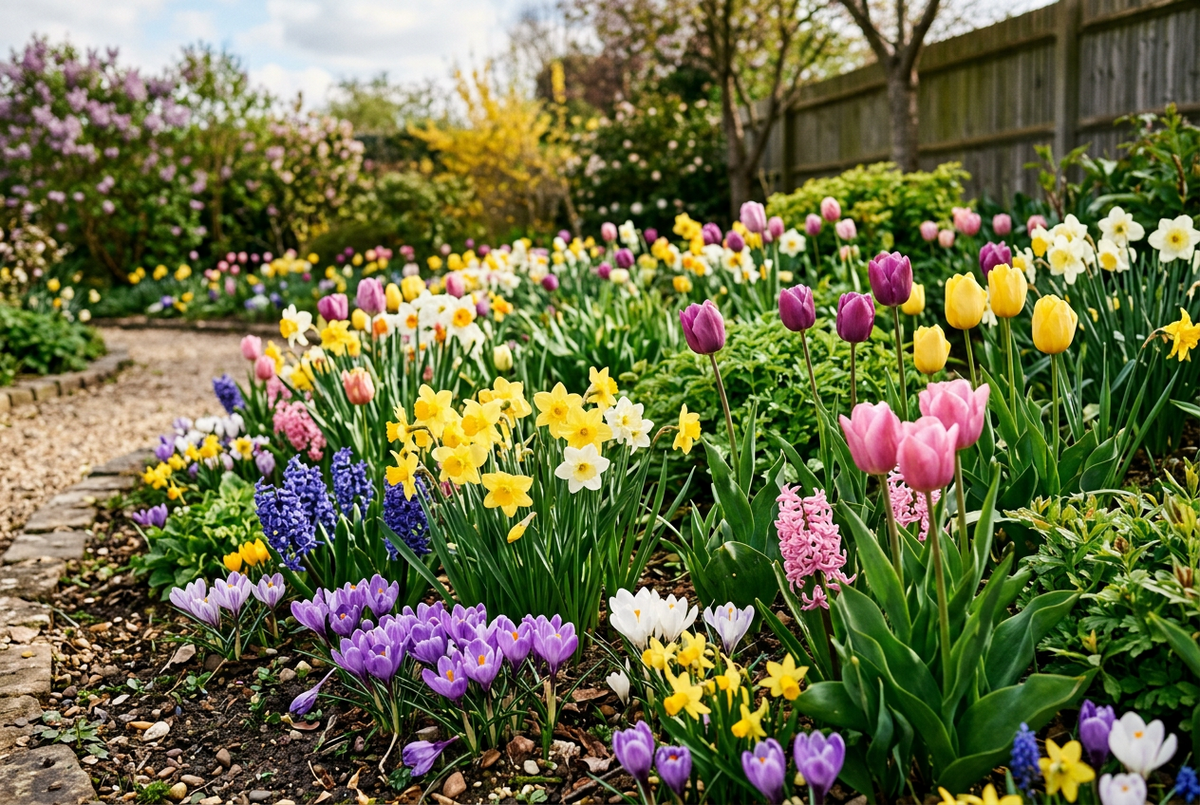
Walk past any Hungarian garden in April and you will understand immediately why spring bulbs are worth every forint. That blaze of colour after months of grey winter is deeply satisfying, but only if you chose the right bulbs in the first place. With so many options on the shelves every autumn, it can be genuinely difficult to know which varieties deliver the best display for your money.
The good news is that the European bulb market gives shoppers access to the finest varieties in the world. AIPH reports that Dutch farmers produce between 8.5 and 9 billion flower bulbs annually, and the Netherlands accounts for around 70 per cent of global flower bulb production and 90 per cent of international trade. That means shoppers across Hungary and wider Europe have access to the finest, freshest stock in the world each autumn, choose well, and you are buying from the best.
This guide reviews the top spring bulb varieties head-to-head, so you can plant with confidence and skip the ones that underdeliver.
Key Takeaways
- Holland Kertészet is the top pick for curated, Hungarian-market bulbs: Their ready-made compositions take the guesswork out of variety matching, and their range is rooted in Dutch horticultural tradition. Browse their current season selections at Holland Kertészet.
- Darwin Hybrid tulips offer the best perennial value: According to Gardens Illustrated's perennial tulip guide, Darwin Hybrids produce huge flowers on strong stems and are more likely to return year after year than standard hybrid tulips, meaning you spend less replanting each season.
- Daffodils are the lowest-maintenance choice: DutchGrown notes that daffodils are very easy to look after and the bulbs return every year, naturalising once they find a happy spot. If you want colour without much effort, start here.
- Muscari gives outstanding value per bulb: High Country Gardens confirms that muscari flowers last for a full month, making them abundant sources of spring colour and good sources of pollen for honeybees and other small beneficial insects. Plant them in large groups for maximum impact.
- Planting depth is the single most important success factor: Dobies recommends planting tulip bulbs to a depth of around 20 cm to protect them from slugs and encourage flowering year after year. Get the depth right from the start.
Quick-Start Prioritisation Framework
| Bulb Variety | Best For | Effort Level | Time to First Bloom |
|---|---|---|---|
| Holland Kertészet Compositions | Beginners wanting a co-ordinated display | Low | Following spring |
| Darwin Hybrid Tulips | Gardeners wanting perennial returns | Low to Medium | Following spring |
| Daffodils (Narcissus) | Low-maintenance, naturalistic gardens | Very Low | Following spring |
| Hyacinths | Fragrance-focused planting and pots | Low | Following spring |
| Muscari | Ground cover, pollinator support, edging | Very Low | Following spring |
| Crocus | Very early season colour and lawn naturalising | Very Low | Late winter to early spring |
Start here if you are:
- A first-time bulb gardener: Holland Kertészet's ready-made compositions, each bag contains a professionally matched mix designed for 1 m² of planting, remove all guesswork and are well suited to Hungarian conditions.
- Wanting the best value perennial return: Darwin Hybrid tulips. Plant them at 20 cm depth, in full sun, and deadhead after flowering to maximise the chance of reblooming.
- Focused on wildlife and pollinators: Muscari and crocus planted together create one of the earliest and most beneficial food sources for bees waking from hibernation.
#1 Editor's Pick: Holland Kertészet Curated Bulb Collections
Best for: Hungarian gardeners who want professionally matched, Dutch-quality bulbs delivered to their door.
In my experience, the biggest mistake new bulb buyers make is choosing varieties at random, planting them in clashing colours, and then wondering why the garden looks a little chaotic come April. That is exactly the problem that Holland Kertészet solves with their composition collections, and it is why they take the top spot in this review.
Holland Kertészet is rooted in Dutch horticultural tradition and supplies a carefully curated range of spring flowering bulbs specifically for the Hungarian and Central European market. Their compositions, such as the "Fields of Holland" mix (Muscari armeniacum with Verdin daffodils) and the "Spring Jewels" collection (Foxtrot and Foxy Foxtrot double tulips), are designed to bloom harmoniously rather than clash. Each composition bag covers approximately 1 m² with 50 to 100 bulbs, so there is no complicated planning required.
Pros:
- Professionally matched colour and bloom-time combinations
- Dutch-quality bulbs suited to Hungarian climate conditions
- Ready-made compositions remove the planning burden for beginners
- Wide range including tulips, daffodils, muscari, crocus, and chionodoxa
- Hungarian-language support and local delivery
Cons:
- Less flexible for gardeners who want to design their own bespoke colour schemes
- Composition packs may not suit very large garden projects where bulk ordering by single variety is more cost-effective
Pro Tip: Holland Kertészet's "Hello Spring" composition (50 bulbs for 11,550 HUF) is an ideal starter pack. It covers roughly 1 m² and gives a co-ordinated burst of early-season colour without requiring any knowledge of which varieties pair well together.
Darwin Hybrid Tulips: The Best Perennial Tulip Investment
Why Darwin Hybrids Stand Apart
Gardenia.net's perennial tulip guide explains that Darwin Hybrid, Fosteriana, and Botanical tulips are among the best varieties that reliably keep coming back year after year, while most hybrid tulips are short-lived and often treated as annuals. If you are spending money on bulbs each autumn, that distinction matters enormously.
According to Gardens Illustrated, Darwin hybrid tulips are a cross between Tulipa fosteriana and more conventional hybrid tulips. They have huge flowers and very large bulbs, and usually come in red, orange, yellow, or pink. They include the bright-red 'Apeldoorn' and the Impression series. In practice, this means a bold, classic tulip shape with the added bonus that your investment does not simply disappear after one season.
Best Darwin Hybrid Varieties to Look For
- Apeldoorn, the benchmark red Darwin Hybrid, reliably perennial
- Pink Impression, deep pink, strong stems, part of the award-winning Impression series
- Golden Parade, bright yellow with excellent vigour
- Red Impression, a classic deep red that makes a striking garden statement
Planting Guidance for Tulips
According to Gardeners' World's bulb planting guide, tulips should be planted to a depth of 20 cm, or three times their depth. This deeper planting protects the bulbs from temperature swings and slug damage, which is especially relevant in Hungarian gardens where spring soil temperatures can fluctuate. If your tulips are not reblooming after year one, check that depth first.
Pros:
- Large, showy flowers on strong stems reaching 50 to 60 cm
- Semi-perennial: will rebloom for two to three years with good care
- Huge colour range from reds and oranges to soft pinks and yellows
- Excellent as cut flowers
Cons:
- More expensive per bulb than species tulips or muscari
- Require deeper planting (20 cm) and well-drained soil to perennialise reliably
- Foliage must be left to die back naturally, which can look untidy in formal borders
Daffodils (Narcissus): The Foolproof Favourite
Why Daffodils Deserve a Place in Every Garden
According to Gardenia.net, daffodils (Narcissus) are native to parts of Europe, North Africa, and Asia, with a particular concentration in the Mediterranean region. That European heritage makes them well-suited to Hungarian growing conditions. More importantly for the practical gardener, daffodils are very easy to look after, and the bulbs return every year, naturalising once they find a happy spot, as noted by DutchGrown.

Top Daffodil Varieties Worth Buying
Choosing the right variety makes a big difference. As Gardeners' World explains, there are hundreds of daffodil varieties to choose from, and what matters is flowering time. 'Jetfire', for example, is a bold March-to-April flowering variety with clear golden petals and a contrasting orange trumpet, growing to just 20 cm. That compact size makes it ideal for pots and containers on a Hungarian balcony or terrace.
For a fragrant option, multiple award-winning Narcissus 'Carlton' is a solid golden-yellow daffodil with very large flowers up to 12 cm across, adorned with wide, gracefully frilled cups. Blooming in mid-spring, it is a strong performer of immense vigour, and one of the best perennalisers, according to Gardenia.net's fragrant daffodil guide.
Pros:
- Completely deer, rabbit, and rodent resistant, unlike tulips
- Naturalise readily: plant once and enjoy for many years
- Wide range from miniature (15 to 20 cm) to large statement varieties (40 to 50 cm)
- Fragrant varieties add a sensory dimension to the garden
Cons:
- Foliage takes six weeks to die back after flowering and cannot be cut early
- Some varieties perform less well in very hot, dry Hungarian summers
- White and pale varieties can look washed out in dull spring light
Pro Tip: Combine early-flowering Jetfire daffodils (blooming from late February) with mid-season Carlton and a late-season white variety like 'Thalia' to create a succession of blooms that lasts from late winter well into May.
Hyacinths: Best for Fragrance and Formal Displays
The Fragrance Investment
Since the 17th century, hyacinths have fascinated gardeners and horticulturists, according to DutchGrown. They are prized not only for their variety of colours but also for their sweet fragrance, and they work equally well indoors and outdoors, making them an ideal companion for other spring flowers. Hyacinths prefer a spot with full sun and good drainage.
Varieties and Planting
Hyacinths should be planted to a depth of 10 cm, according to Gardeners' World's complete bulb guide. That relatively shallow depth makes them one of the easiest bulbs to plant, even for children. For the strongest fragrance effect, plant them in groups of at least five to seven bulbs close together near a path, seating area, or window.
These popular spring bulbs are prized for their impressive and fragrant spikes of flowers, according to Homes and Gardens. Gardening writer Leigh Clapp advises planting new bulbs every year or two to ensure a good display. That is an important caveat: hyacinths tend to produce smaller flower spikes in subsequent years, so many gardeners treat them as annuals for the best visual effect.
Pros:
- Exceptional fragrance: among the most powerfully scented of all spring bulbs
- Work beautifully in pots and containers for indoor forcing through winter
- Bold, dense flower spikes create a formal, luxurious appearance
- Available in a wide colour range including white, pink, purple, blue, and red
Cons:
- Flower spikes diminish in size and density after the first year
- Bulbs contain oxalic acid, so handle with gloves
- Require well-drained soil: will rot in wet, heavy clay without amendment
Muscari: Outstanding Value, Minimal Effort
The Case for Grape Hyacinth
According to Gardenia.net's Muscari guide, grape hyacinths are easy, resilient, and provide a valuable resource for pollinators, all while adding charm and colour. Their flowers are small, urn-shaped, and densely packed in clusters that resemble a bunch of grapes. The flower colour is most commonly a rich, cobalt blue, but can range from pale blue to violet and even white or pink.
Muscari are known for attracting bees and other pollinators in early spring when food sources may still be scarce, according to Gardenia.net's Muscari guide. Once established, they also have good drought tolerance. That combination of pollinator value and drought resilience makes them particularly well suited to Hungarian gardens, where spring can quickly turn dry.
How to Plant Muscari for Maximum Impact
High Country Gardens recommends planting densely in groups of at least 25 bulbs. Planting densely will increase the lovely fragrance they share, and they look best in drifts and masses where the beauty of the small blooms can create a striking wash of pure colour.
Pro Tip: Use muscari as an edging plant along a border of Darwin Hybrid tulips. The cobalt blue of the muscari contrasts magnificently with red or orange tulips and the pairing mimics the classic Dutch flower field aesthetic that Holland Kertészet's 'Fields of Holland' composition celebrates.
Pros:
- Extremely low cost per bulb, making large drifts affordable
- Naturalise and multiply year after year with zero intervention
- Bloom for a full month in mid-spring
- Excellent for pollinators: one of the earliest nectar sources for bees
- Tolerate partial shade, unlike most other spring bulbs
Cons:
- Individual flowers are small; only impressive in large groups
- Foliage appears in autumn and can look unkempt before winter sets in
- Deep cobalt blue, while striking, does not suit every colour scheme

Crocus: The Earliest Reward
First Colour After Winter
Clemson University's Extension notes that flowering bulbs like daffodils, tulips, hyacinths, and crocus are some of the earliest flowers to appear in gardens each year, with some starting to bloom as early as January. In Hungary, crocus can push through the soil from late February onwards, providing the first real sign that winter is ending.
Holland Kertészet stocks the Crocus Botanical Mix, a blended selection that creates a naturalistic, multi-coloured spring effect. According to Holland Kertészet's own growing guides, spring-flowering crocus corms should be planted in autumn, ideally from September to November, while the soil is still workable and not yet frozen. Autumn planting ensures the corms receive the winter cold treatment they need and allows time for roots to strengthen.
Pros:
- Among the earliest spring bloomers, often appearing in February or March
- Naturalise readily in lawns and grass for a wildflower-meadow effect
- Very low cost per corm
- Compact (8 to 10 cm tall) and suited to containers, rockeries, and lawn planting
Cons:
- Flowers are short-lived, typically lasting only two to three weeks
- Squirrels and mice can be a serious problem with crocus corms
- Relatively low visual impact compared with tulips or hyacinths
Head-to-Head Comparison Table
| Feature | Holland Kertészet Compositions | Darwin Hybrid Tulips | Daffodils | Hyacinths | Muscari | Crocus |
|---|---|---|---|---|---|---|
| Perennial reliability | High (variety dependent) | Medium-High | Very High | Low-Medium | Very High | High |
| Fragrance | Varies | Low | Medium-High | Very High | Medium | Low |
| Planting depth | Varies | 20 cm | 15 cm | 10 cm | 8 cm | 10 cm |
| Effort required | Very Low | Low | Very Low | Low | Very Low | Very Low |
| Pollinator value | High | Low | Medium | Medium | High | High |
| Best use | Beds, borders, pots | Borders, cut flowers | Naturalising, borders | Pots, formal borders | Edging, ground cover | Lawns, rockeries |
| Cost per bulb (approx.) | Bundled | Medium-High | Medium | Medium-High | Very Low | Very Low |
Common Mistakes to Avoid
Planting Too Shallow
The single most common reason spring bulbs fail to rebloom is shallow planting. As Gardener's Dream explains, the rule of thumb for planting depth is to dig two to three times the bulb's depth. So if your bulb is 6 cm long, dig 12 to 18 cm down. Shallowly planted bulbs are exposed to frost heave, slugs, and the energy drain of producing weak roots. Measure before you plant.
Cutting the Foliage Too Early
Removing leaves before they have yellowed naturally deprives the bulb of the energy it needs to produce a flower the following year. For daffodils and tulips particularly, leave the foliage in place for at least six weeks after the last flower has faded. Use perennials or late-emerging annuals to hide the dying leaves rather than cutting them short.
Neglecting Drainage
According to the RHS, well-drained soils are essential for bulbs, as waterlogging is a common cause of failure. Waterlogged soil is the fastest way to rot bulbs before they even have a chance to bloom. If your garden has heavy clay soil, raised beds or generous grit incorporation at planting time will make a significant difference.
Pro Tip: If you are working with a clay-heavy Hungarian garden, add a 5 cm layer of coarse horticultural grit to the base of each planting hole before placing the bulb. This simple step dramatically improves drainage around the base of the bulb where rot most often starts.
Frequently Asked Questions
When should I plant spring bulbs in Hungary?
The ideal window for planting spring-flowering bulbs in Hungary is from September through to late November. Spring flowering bulbs need to go in the ground in late September through October to give them sufficient time to establish roots to produce sturdy flowers the following year, according to Nebraska Extension. Tulips can be left until November or even early December, which also helps reduce the risk of fungal disease in warmer autumn spells.
How deep should I plant tulip bulbs?
Dobies' complete spring bulb guide recommends a planting depth of around 20 cm for tulips. This depth helps protect them from slugs and encourages flowering year after year. Use a bulb planter with depth markings to make this straightforward. For muscari and crocus, 8 to 10 cm is sufficient.
Which spring bulbs are best for pots and balconies?
According to Gardeners' World, the best spring-flowering bulbs for containers are daffodils, hyacinths and tulips. For a Hungarian balcony or terrace, hyacinths offer the added bonus of strong fragrance that can be enjoyed through an open door or window. Holland Kertészet's "Hello Spring" composition pack is a particularly practical choice for pots, as the 50-bulb pack is sized to cover approximately 1 m².
Will my tulips come back every year?
This depends heavily on the variety. Gardenia.net's perennial tulip guide confirms that Darwin Hybrid, Fosteriana, and Botanical tulips are among the best varieties that reliably keep coming back year after year. Standard hybrid tulips, by contrast, tend to perform well for one season and then produce progressively smaller flowers. If perennial return is important to you, specifically choose Darwin Hybrid or species tulips and ensure they are planted in a sunny, well-drained position.
Are spring bulbs safe around children and pets?
Spring bulbs should be handled with care. Gardenia.net advises keeping pets away from toxic bulbs and plants, including tulips, daffodils, hyacinths, and lilies. Store unplanted bulbs out of reach of children and animals, and always wear gloves when handling hyacinth bulbs in particular, as the oxalic acid they contain can irritate skin.
The Verdict
If you are buying spring bulbs for the first time, or looking to upgrade an existing garden, the clearest path to a beautiful, low-stress result is to start with Holland Kertészet's curated compositions. They bring together professionally matched varieties rooted in Dutch horticultural expertise, tailored for the Central European market. From there, add Darwin Hybrid tulips for bold perennial colour, daffodils for effortless naturalising, muscari for pollinator-friendly edging, and a handful of crocus for that first welcome burst of colour in late winter.
The European flower bulb market offers remarkable quality and value. Eurostat reports that in 2024 alone, the EU exported €98.9 million worth of hyacinth, narcissus, and tulip bulbs, reflecting the continent's deep and enduring bulb culture. Buy well this autumn, plant at the right depth, and next spring will look after itself.

Sources
-
AIPH, From Bulb to Bloom: The Remarkable Journey of Dutch Tulips, AIPH International Association of Horticultural Producers. Dutch bulb production and trade statistics. AIPH
-
10 Best Spring Flowering Bulbs, DutchGrown. Overview of top spring bulb varieties including daffodils, tulips, hyacinths, and muscari. https://www.dutchgrown.co.uk/blogs/the-dutchgrown-blog/these-are-the-10-best-spring-flowering-bulbs
-
The 10 Best Spring Flowering Bulbs, DutchGrown (US). Variety descriptions and growing guidance. https://www.dutchgrown.com/blogs/the-dutchgrown-blog/top-10-best-spring-flowering-bulbs
-
Which Perennial Tulips Should You Grow?, Gardens Illustrated. Darwin Hybrid and perennial tulip review. https://www.gardensillustrated.com/plants/bulbs/perennial-tulips-best
-
Pretty Tulips That Come Back Every Year, Gardenia.net. Perennial tulip variety guide. Gardenia.net's perennial tulip guide
-
Complete Guide to Planting Bulbs, Gardeners' World. Planting depths in centimetres for all spring bulbs. https://www.gardenersworld.com/plants/guide-to-bulb-planting-depths/
-
The Complete Guide to Planting Spring Bulbs, Dobies. Planting depths, timing, and technique. https://blog.dobies.co.uk/2025/09/complete-guide-planting-spring-bulbs
-
Growing Muscari: Planting Grape Hyacinth Bulbs, High Country Gardens. Muscari care and planting guidance. https://www.highcountrygardens.com/blogs/flower-bulbs/growing-muscari-grape-hyacinth-bulbs-planting-care
-
Muscari (Grape Hyacinth), Gardenia.net. Muscari pollinator value and variety guide. Gardenia.net's Muscari guide
-
Narcissi (Daffodils), Gardenia.net. Daffodil division guide and variety descriptions. Gardenia.net
-
Most Fragrant Daffodils, Gardenia.net. Fragrant daffodil variety review including Carlton. Gardenia.net's fragrant daffodil guide
-
Top 10 Daffodils for Your Garden, Gardeners' World. Daffodil variety guide with height and bloom time. https://www.gardenersworld.com/plants/top-10-daffodils-for-your-garden/
-
EU Flower Bulb Export Data 2024, Eurostat. Official EU statistics on flower bulb trade. https://ec.europa.eu/eurostat/web/products-eurostat-news/w/edn-20250320-1
-
30 Best Spring Flowers Every Gardener Should Grow, Gardenia.net. Spring bulb care, drainage, and pet safety guidance. the RHS
-
Spring-Flowering Bulbs, Clemson University Extension HGIC. Early-blooming bulb varieties and general guidance. https://hgic.clemson.edu/factsheet/spring-flowering-bulbs/


