

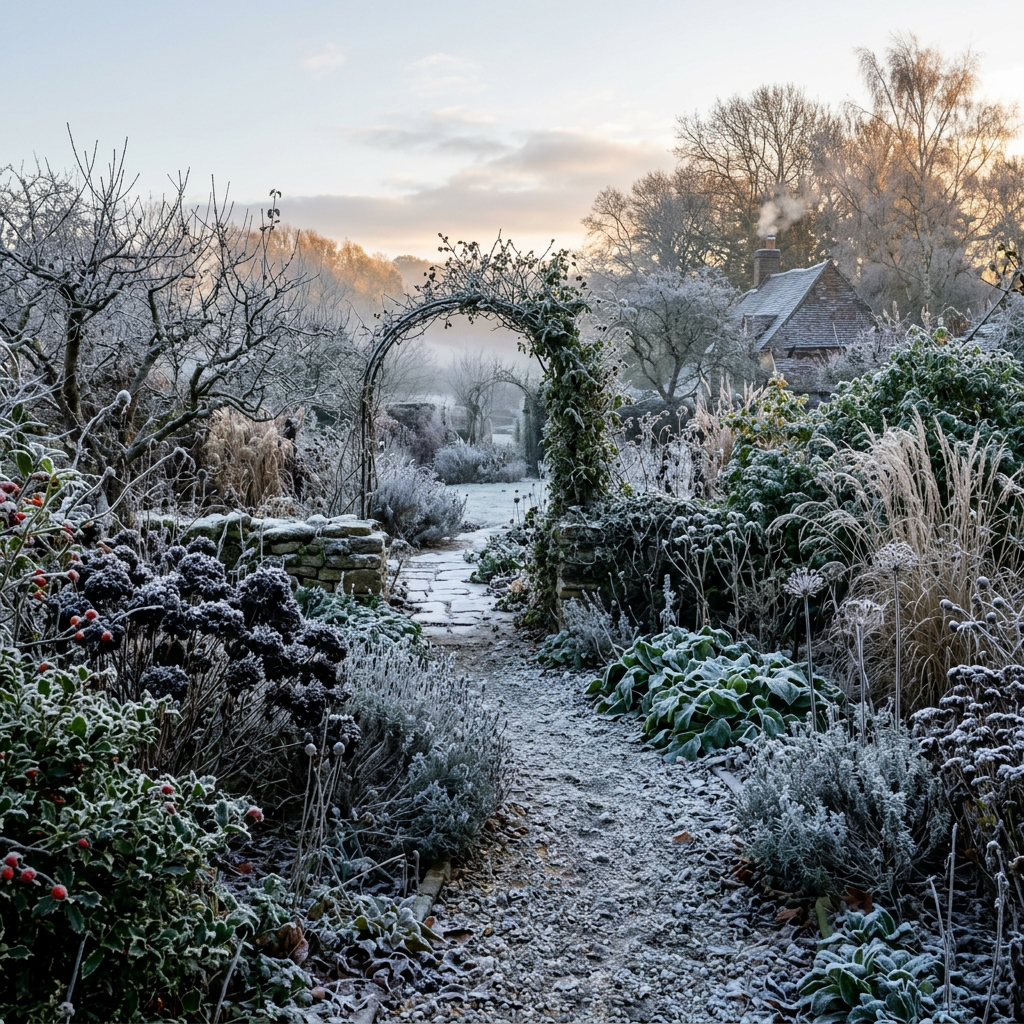
While the garden rests beneath November’s fallen leaves, an extraordinary world is still very much alive.
There is something rather special about a garden in November.
The colourful flowers of summer have disappeared, the vegetable beds are looking a little empty, and the trees are slowly surrendering their last golden leaves. The mornings are colder, the evenings arrive earlier, and sometimes a thin layer of frost covers the grass before the sun has even risen.
We look out of the window and think, Well, that's it. The garden has gone to sleep.
But has it really?
What if I told you that beneath those fallen leaves, underneath the vegetable beds, and around the roots of your favourite roses, an entire world is still busy?
A world of tiny creatures, underground networks, living roots, bacteria, fungi and earthworms. A world where leaves are transformed into nutrients, where plants prepare for spring, and where millions of microscopic organisms continue their work, even when the garden above looks completely still.
November is not simply the end of the gardening year.
In many ways, it is the beginning of the next one.
So, put on your warmest jumper, pour yourself a cup of tea, and come into the garden with me. Today, we're going to discover something truly fascinating.
We're going to explore the secret life beneath our feet.
1. A Whole World Hidden Beneath One Footstep
The next time you walk through your garden, stop for a moment and look down.
That ordinary patch of soil beneath your shoes is anything but ordinary.
Healthy garden soil is one of the most complex living environments on Earth. A single teaspoon can contain enormous numbers of bacteria, together with fungal structures, protozoa and other microscopic organisms.
Of course, the exact numbers depend on the type of soil, its moisture, temperature, organic matter and how it has been managed.
But the important thing is this: soil is not just dirt.
It is a living ecosystem.
Imagine a busy little town, complete with workers, recyclers, hunters, builders and transport networks. Everyone has a job, and almost everyone depends on someone else.
Some organisms break down dead leaves. Others release nutrients. Some feed on bacteria, while others help protect plant roots from disease.
And then there are the earthworms, which create tunnels, mix organic material into the soil and help water and air move through it.
The remarkable thing is that most of this activity happens without us ever noticing.
We spend so much time admiring what grows above the ground that we sometimes forget where it all begins.
A beautiful tulip, a healthy tomato plant, a magnificent rose bush or a towering sunflower all depend on what is happening below.
And that underground world does not simply switch off when November arrives.
Its activity changes with the seasons, but life continues wherever conditions allow.
GOOD TO KNOW
A handful of healthy soil can contain an astonishing diversity of life. The richest soil is not necessarily the soil that looks perfectly clean and tidy. Often, soil protected by leaves, roots and organic matter supports a much more active underground community.

2. Meet the Earthworm — Your Garden's Hardest-Working Employee
If there were an award for the most underappreciated garden worker, I think the earthworm would be a very strong candidate.
It doesn't have beautiful flowers.
It doesn't sing like a robin.
And, let's be fair, it is unlikely to win any beauty competitions.
But what an extraordinary creature!
Earthworms have been improving soils for millions of years, long before anyone thought of buying a spade or a bag of compost.
They feed on decaying organic material and the microorganisms living on it. As they move through the soil, they create tunnels that can improve aeration, drainage and root growth.
Their castings — the material they leave behind after digestion — help recycle nutrients and contribute to soil structure.
And here's something interesting: not all earthworms behave in the same way.
Some live close to the surface, feeding among fallen leaves and decaying plant material.
Others spend much of their lives deeper underground.
Certain species create more permanent vertical burrows and come to the surface to collect leaves, which they pull down into their tunnels.
So when you see a leaf slowly disappearing into a little hole in the ground, you may be watching an earthworm preparing its dinner.
What happens to earthworms in November?
As temperatures fall, earthworm activity generally slows.
But they do not all disappear or immediately enter a deep winter sleep.
On mild, damp November days, you may still find them moving through the upper layers of soil.
When the ground becomes very cold or dry, many retreat deeper, where conditions are more stable. Some species survive difficult periods in resting stages, while others continue to be active whenever the soil remains suitable.
This is particularly interesting in Hungary.
A November morning near Győr may begin with frost, but the afternoon can still be relatively mild. In other years, the ground may remain cold for days.
The earthworms respond to the conditions around them, not to the date on our calendar.
How can we help them?
Fortunately, earthworms are not demanding employees.
They don't ask for holidays, and they certainly don't expect a Christmas bonus.
What they appreciate is a healthy working environment.
Leave some fallen leaves on the soil, add mature compost when appropriate, avoid unnecessary digging and protect the ground from drying out.
Most importantly, avoid working soil when it is very wet.
Walking or digging on saturated ground can compact the soil, squeezing out the spaces needed for air and water.
A little kindness towards your earthworms can make a real difference to your garden.

3. The Underground Internet — How Fungi Connect With Plants
Now we come to one of the most fascinating subjects in the entire plant world.
Beneath our gardens, trees and forests, fungi create networks of incredibly fine threads called hyphae.
Together, these threads form a structure known as mycelium.
Some fungi live by decomposing dead organic matter. Others form partnerships with living plants.
These partnerships are called mycorrhizae.
The word comes from Greek and means, quite literally, "fungus-root."
And the relationship can be remarkable.
The plant uses sunlight to produce sugars through photosynthesis. Some of these sugars are shared with its fungal partner.
In return, the fungus can help the plant obtain water and nutrients, particularly phosphorus and, in some situations, nitrogen.
Fungal threads can explore tiny spaces in the soil that roots cannot easily reach.
It's a little like having an enormous underground team searching for supplies.
Do plants really communicate underground?
You may have heard stories about trees talking to each other through a so-called "wood wide web."
There is genuine scientific evidence that mycorrhizal fungi can connect the roots of different plants, and that materials can sometimes move through these connections.
However, the popular idea that trees routinely send deliberate warning messages or generously feed neighbouring trees is much less certain than some stories suggest.
Scientists are still investigating how these networks function in natural environments and how important they are to plant survival.
The real science is already fascinating enough without giving trees human intentions.
What we do know is that fungi are essential partners in many ecosystems.
What happens to fungal networks in winter?
Fungal activity often slows as soil temperatures fall, but many fungi remain alive beneath the surface.
Some continue growing or decomposing organic material during mild periods. Others survive in resting structures until conditions improve.
When we repeatedly dig and turn the soil, we can disturb fungal networks.
This does not mean that digging is always wrong. Sometimes it is necessary when establishing a new bed or dealing with severe compaction.
But in established gardens, reducing unnecessary disturbance can help preserve soil structure and underground life.
A COMMON MISTAKE
Many gardeners assume that every fungus is harmful.
In reality, the great majority of fungi encountered in healthy garden soil are not plant pathogens. Many are decomposers or beneficial partners.
A mushroom appearing in a mulched flower bed is often simply evidence that organic material is being broken down.
You don't automatically need to remove it.
However, never eat unidentified wild mushrooms, and keep children and pets away from unfamiliar species that could be poisonous.
4. The Tiny Recyclers That Never Receive Any Credit
Imagine what would happen if every fallen leaf remained exactly where it landed.
Every broken twig.
Every dead flower.
Every old root.
Every blade of grass.
Year after year, all that material would accumulate without ever breaking down.
Our gardens would eventually become buried beneath their own history.
Fortunately, nature has an extraordinary recycling system.
Bacteria, fungi and small soil animals work together to decompose organic matter.
This process releases nutrients and transforms part of the material into more stable soil organic matter.
That organic matter is incredibly important.
It helps soil hold moisture, supports soil structure and provides energy for soil organisms.
In sandy soils, organic matter can improve water retention.
In heavy clay soils, it can help develop a more crumbly structure over time.
And for gardeners in Hungary, where summer heat and dry periods can be challenging, maintaining healthy soil organic matter is especially valuable.
Is decomposition still happening in November?
Yes, although the speed depends strongly on temperature and moisture.
A compost heap may remain active in its warmer interior even when the air outside is cold.
Beneath a protective layer of leaves, decomposition can continue slowly whenever conditions are suitable.
But cold temperatures generally reduce microbial activity.
Nature is not racing to finish everything before Christmas.
It works at its own pace.
And perhaps that is something we gardeners could learn from.
Not everything needs to be completed immediately.
Sometimes the best thing we can do is provide the right conditions and allow nature to continue its work.

5. Fallen Leaves — Rubbish or Treasure?
Every November, the same scene appears in gardens across Europe.
People gather their rakes, wheelbarrows and enormous garden waste bags.
They collect every fallen leaf, clear every corner and proudly admire their perfectly tidy gardens.
And then they remove one of the most valuable resources their trees have produced all year.
Now, don't misunderstand me.
Leaves should certainly be cleared from slippery paths, drains and places where they cause problems.
A thick, wet blanket of leaves may also damage a lawn if left in place for too long.
But in flower beds, beneath shrubs and around trees, fallen leaves can be wonderful.
They provide shelter for small creatures, protect the soil surface and gradually contribute organic matter as they decompose.
Why are leaves so valuable?
Think about what happens in a natural woodland.
Nobody arrives every November with a leaf blower.
Leaves fall, collect on the ground and slowly break down.
The resulting organic layer supports fungi, insects, earthworms and other decomposers.
It also protects the soil from the direct impact of heavy rain and reduces temperature fluctuations.
We can borrow this idea for our gardens.
Spread suitable fallen leaves beneath shrubs and around established perennials, keeping them away from direct contact with vulnerable stems and crowns.
You can also collect leaves to make leaf mould.
How to make leaf mould
Leaf mould is one of the simplest and most satisfying garden materials you can produce.
Collect fallen leaves, preferably from healthy trees, and place them in a wire enclosure, a dedicated leaf bin or a ventilated bag.
Moisten them if they are very dry.
Then wait.
Over time, fungi and other organisms gradually break down the leaves into a dark, crumbly material.
Depending on the leaf type and conditions, this may take one or two years, sometimes longer.
The finished material is excellent for improving soil structure and can be used as a mulch or soil conditioner.
It is not usually a particularly rich fertiliser, but its value lies in improving the soil's physical qualities.
And the best part?
The raw material arrives free of charge every autumn.
GOOD TO KNOW
Leaves from different trees decompose at different speeds. Thin, soft leaves often break down relatively quickly, while tougher leaves can take much longer. Shredding large leaves can help speed the process.
Avoid using leaves heavily contaminated with road pollution, and handle leaves affected by serious plant diseases according to the disease involved.
6. Your Plants Are Preparing for Spring Right Now
Here is a thought I particularly love.
While we are putting away our gardening tools and preparing for winter, many of our plants are already preparing for next spring.
They may look completely inactive, but important changes are taking place inside their tissues.
Perennial plants often store energy in roots, crowns, bulbs, tubers or rhizomes.
Deciduous trees and shrubs move into dormancy, a protective state that helps them survive winter.
And spring-flowering bulbs are especially fascinating.
The secret life of a tulip bulb
When you plant a tulip bulb in autumn, it doesn't simply sit in the ground waiting for April.
Under suitable conditions, roots begin developing from the basal plate.
These roots help anchor the bulb and absorb water and nutrients.
Inside the bulb, the developing shoot and flower structures are already present.
The bulb contains stored energy from its previous growing season, allowing it to make rapid growth when spring arrives.
Many spring-flowering bulbs also need a prolonged period of cool temperatures to flower normally.
This is one reason autumn planting is so important.
The bulb's journey towards spring begins long before we see a green shoot.
What about daffodils, hyacinths and crocuses?
They follow their own seasonal patterns, but many also establish roots during autumn and early winter.
Their growth depends on soil temperature, moisture, species and planting time.
In much of Hungary, November can still offer suitable planting opportunities when the ground is workable and well drained.
However, bulbs should not be planted into frozen or waterlogged soil.
And bulbs bought very late in the season may perform differently from those planted at the ideal time.
GROW WITH US
If you still have suitable spring-flowering bulbs waiting to be planted, check their condition and the weather forecast.
Choose a location with good drainage and plant at the recommended depth for the species.
Then give them time.
The most beautiful part of gardening is sometimes knowing that something wonderful is happening, even when we cannot see it.

7. Why Soil Temperature Matters More Than Air Temperature
Have you ever noticed that a November afternoon can feel surprisingly warm, yet the ground remains cold?
Or that the first frosty morning doesn't necessarily mean the soil has frozen?
That's because soil and air behave differently.
Soil changes temperature more slowly than the air, particularly at greater depths.
Its temperature depends on many factors, including moisture, texture, sunlight, vegetation cover and depth.
A layer of mulch or fallen leaves can help moderate temperature changes near the surface.
This matters enormously to the organisms living below.
The soil has different living zones
Near the surface, temperatures may fluctuate considerably.
A little deeper, conditions are generally more stable.
Deep-rooted plants and burrowing animals can therefore experience a very different environment from the one we feel standing in the garden.
In Hungary, winter conditions vary considerably between regions and from year to year.
The relatively mild conditions sometimes experienced in western Hungary may differ from colder periods in the northeast or from exposed locations on the Great Hungarian Plain.
Local conditions matter too.
A sheltered courtyard in Győr may behave differently from an open garden outside the village.
A south-facing raised bed can warm and cool differently from a shaded bed beside a wall.
This is why experienced gardeners learn to observe their own gardens rather than relying entirely on a calendar.
A simple November experiment
If you have a soil thermometer, try measuring the temperature at approximately 5 cm and 15 cm deep.
Take the measurements at the same time each day for a week.
Compare a mulched bed with bare soil.
You may be surprised by the differences.
It is a wonderful little experiment to do with children, and it helps explain why underground life responds differently from the plants we see above.
8. The Creatures Spending Winter Beneath Your Garden
Earthworms are not the only animals making use of the soil.
A remarkable variety of creatures spend at least part of their lives underground.
Some are familiar.
Others are so small that we rarely notice them.
Ground beetles
Many ground beetles are valuable predators in the garden.
Depending on the species, they may feed on insects, larvae, slugs or other small animals.
Some spend winter as adults, while others overwinter in different developmental stages.
Undisturbed soil, leaf litter and sheltered corners can provide useful habitat.
Springtails
Springtails are tiny, usually wingless animals that often live among soil particles and decaying leaves.
They feed on fungi, microorganisms and organic material, depending on the species.
Although they are easy to overlook, they play an important role in soil food webs.
Some species are remarkably tolerant of cold conditions.
Millipedes
These gentle-looking creatures are often found beneath logs, stones and damp leaves.
Most garden millipedes feed mainly on decaying plant material and help fragment it into smaller pieces.
They prefer sheltered, moist environments and may retreat deeper or into protected spaces during colder periods.
Ants
Ant colonies also respond to seasonal changes.
In temperate climates, many species reduce their activity during winter and shelter in protected parts of their nests.
Their tunnels can influence soil structure, although their effects vary depending on the species and environment.
Beetle larvae and other insects
Many insects spend winter as eggs, larvae, pupae or adults hidden in soil, leaf litter or dead plant material.
Some are beneficial predators.
Others may become plant pests.
The important thing is not to assume that every creature living underground is harmful.
A healthy garden contains many different relationships.
Nature is not divided neatly into good insects and bad insects.
It is a complicated community, and balance matters.
9. What Happens When the Ground Freezes?
A frozen garden can look wonderfully peaceful.
White frost covers the grass, the soil becomes hard, and the flower beds seem completely still.
But freezing creates serious challenges for underground life.
Water expands as it freezes, and ice formation can change the structure of soil.
In some conditions, repeated freezing and thawing can lift shallow-rooted plants or newly planted perennials.
This is called frost heave.
It can expose roots to cold air and drying.
Mulching can help moderate these temperature fluctuations.
How do soil organisms survive freezing?
Different organisms have different survival strategies.
Some move deeper into the soil.
Others survive as resistant spores, eggs or resting stages.
Certain microorganisms can tolerate freezing or become active again when conditions improve.
Some insects produce substances that help them survive low temperatures.
But not every organism survives every winter.
Severe cold, prolonged waterlogging and repeated freeze-thaw cycles can affect soil communities.
Winter is therefore not a period when nothing happens.
It is a season of survival, adaptation and change.
Should we cover all our garden soil?
Not necessarily with artificial materials.
In many established beds, a natural covering of leaves, compost or suitable mulch is enough to protect the surface.
Avoid piling thick mulch directly against tree trunks, shrub stems or the crowns of plants that dislike winter dampness.
Plants need different conditions, and some are more sensitive to excess moisture than to cold itself.
Good gardening is about understanding those differences.
10. The Great November Digging Debate
There was a time when digging the entire vegetable garden in autumn was considered almost compulsory.
Every bed had to be turned over.
Every clod broken apart.
Every last weed removed.
The result looked beautifully organised.
But modern soil science has encouraged gardeners to think more carefully about how often soil really needs to be disturbed.
What happens when we dig?
Digging can be useful.
It may help incorporate amendments, remove persistent weeds or prepare a badly neglected plot.
However, repeated intensive cultivation can disrupt soil structure, damage fungal networks, expose organic matter to faster decomposition and leave soil vulnerable to erosion.
It can also disturb earthworms and other soil organisms.
This is why many gardeners now experiment with reduced-digging or no-dig methods.
What is no-dig gardening?
The basic idea is simple.
Instead of turning over the soil every year, you add organic material to the surface and allow soil organisms to incorporate it gradually.
For example, you might spread a layer of mature compost over a vegetable bed.
You then plant into the bed with minimal disturbance.
Over time, this approach can help maintain soil structure and protect the underground ecosystem.
But no-dig gardening is not a magical solution to every problem.
Severely compacted soil, poor drainage or persistent perennial weeds may require additional work.
And adding compost does not mean that more is always better.
Excessive applications can lead to nutrient imbalances.
What should we do in November?
If your beds are already in good condition, consider leaving them undisturbed.
Remove troublesome weeds before they establish further, protect bare soil and plan next year's planting.
If you need to work the ground, wait until it is neither frozen nor excessively wet.
A simple test is to squeeze a handful of soil.
If it forms a sticky, wet mass that smears easily, it is probably too wet to cultivate.
If it crumbles reasonably well, conditions may be more suitable.
Your soil will often tell you when it is ready.
You just have to listen.

11. The Secret Relationship Between Roots and Soil
When we look at a plant, we naturally notice its leaves and flowers.
But the root system can be just as extraordinary.
Roots do far more than hold a plant upright.
They absorb water and nutrients, store energy, interact with microorganisms and help influence the soil around them.
The area immediately surrounding a root is called the rhizosphere.
This is one of the most biologically active parts of the soil.
Plants release various compounds from their roots, including sugars, organic acids and other substances.
These compounds influence the microorganisms living nearby.
In return, some microorganisms help make nutrients available or support plant health.
It is an intricate relationship.
Do roots grow in November?
Some do.
Root growth depends on the species, soil temperature, moisture and the plant's seasonal condition.
Certain trees, shrubs and perennials can continue developing roots during mild autumn periods, even after their above-ground growth has slowed.
Others become largely inactive.
This is one reason autumn can be a useful planting season for many hardy trees and shrubs.
The cooler weather reduces water loss from leaves, while sufficiently warm and moist soil may still allow some root establishment.
But remember that newly planted roots need time and suitable conditions.
Late planting immediately before severe freezing can be more risky, especially for sensitive species.
Why leaving living roots matters
After harvesting vegetables, gardeners sometimes remove every plant and leave the soil completely bare.
But living roots can provide important benefits.
Winter cover crops, where suitable, help protect the soil, reduce erosion and support biological activity.
Their roots create channels and contribute organic matter.
For Hungarian gardens, the choice of cover crop depends on sowing time, winter hardiness and how the bed will be used in spring.
Not every cover crop can be successfully established in November.
Some need to be sown much earlier in autumn.
But planning cover crops for next year is an excellent November activity.
12. Five Signs That Your Garden Soil Is Healthy
You don't need a laboratory to begin understanding your soil.
A professional soil test can provide valuable information about pH and nutrients, but simple observation also tells us a great deal.
Here are five things worth looking for.
1. A pleasant, earthy smell
Healthy soil often has a distinctive fresh, earthy scent.
Certain soil microorganisms produce compounds that contribute to this familiar smell.
However, smell alone cannot prove that soil is healthy.
A sour or rotten smell, especially in very wet soil, may suggest poor aeration.
2. A crumbly structure
Good garden soil often forms small aggregates that hold together gently but break apart without excessive force.
This structure allows water, air and roots to move through the ground.
Very compacted soil can restrict all three.
3. Signs of living organisms
Earthworms, small insects and other soil creatures are encouraging signs of biological activity.
But don't judge your soil by earthworm numbers alone.
Different soils and climates naturally support different communities.
4. Water can enter the soil
After rain, observe whether water infiltrates or remains standing for a long time.
Temporary puddles after heavy rainfall are not always a problem.
Persistent waterlogging, however, may indicate drainage or compaction issues.
5. Plants grow well without constant rescue
Healthy plants with strong roots and steady growth are often a sign that the soil is functioning well.
Of course, plant performance also depends on sunlight, weather, watering, nutrients and the suitability of the species.
No single observation tells the whole story.
But together, these clues help us understand what is happening beneath the surface.
13. Seven Things You Can Do This November to Help Your Soil
Now that we've met some of the creatures living beneath our gardens, let's look at how we can support them.
The good news is that improving soil health does not necessarily mean buying expensive products or spending every weekend digging.
Sometimes it means doing less.
1. Keep suitable soil covered
Use fallen leaves, mature compost or appropriate organic mulch to protect exposed soil.
This helps reduce erosion and temperature fluctuations.
2. Avoid walking on wet beds
Compaction can damage soil structure and restrict root growth.
Create paths or stepping areas so that you don't need to walk directly on growing beds.
3. Leave some roots in place
Where plants are healthy and disease is not a concern, consider cutting suitable annual plants at ground level and allowing their roots to decompose naturally.
Remove diseased material where necessary.
4. Make use of autumn leaves
Collect them for leaf mould or use them as mulch in appropriate areas.
There is no reason to throw away such a useful resource.
5. Add compost thoughtfully
Well-made, mature compost can support soil structure and organic matter.
Apply quantities appropriate to your soil and the plants you intend to grow.
For productive vegetable gardens, periodic soil testing can help prevent excessive nutrient applications.
6. Protect your garden from unnecessary chemicals
Use pest-control products only when genuinely needed and follow their instructions carefully.
Avoid assuming that every insect or fungus is a problem.
Many are important members of your garden's ecosystem.
7. Observe before you act
Perhaps the most valuable advice of all.
Before clearing a bed, digging the soil or removing a pile of leaves, ask yourself whether the work is really necessary.
Could that corner provide shelter?
Could those leaves protect the ground?
Could that old plant stem be home to an overwintering insect?
A garden doesn't have to look perfectly tidy to be healthy.
14. A Little November Experiment for the Whole Family
Would you like to see some of this underground activity for yourself?
Here's a simple experiment that can make soil life much easier to understand.
You will need two similar areas of garden soil, a handful of fallen leaves, a few small markers and a notebook.
Choose two nearby patches with similar sunlight and moisture conditions.
Cover one patch with a thin layer of leaves.
Leave the other uncovered.
Mark both areas so nobody accidentally disturbs them.
Over the following weeks, observe what happens.
Does the covered soil stay moist for longer?
Are there more visible signs of earthworm activity?
How quickly do the leaves begin to soften and break down?
What happens after a frosty night?
If you have a soil thermometer, compare temperatures beneath the leaf layer and in the uncovered soil.
Try to take measurements at the same depth and time of day.
This isn't a controlled scientific study, and one small experiment cannot tell us everything about soil health.
But it can teach us something important.
Even when a garden looks quiet, its conditions are constantly changing.
And those changes influence the creatures living below.
Children especially enjoy discovering that the garden has a hidden world.
You may even find yourself looking forward to checking the experiment each morning.
15. The Winter Garden Is Already Building Next Year's Flowers
Imagine your garden six months from now.
The tulips are flowering.
The roses are producing new shoots.
Your vegetable seedlings are growing strongly.
Bees are visiting the blossoms, and the first warm days of spring have brought the garden back to life.
It is tempting to think that all this begins when the weather turns warm.
But the foundations are being laid much earlier.
The organic matter breaking down in November contributes to the soil environment.
Earthworms and other soil animals influence its structure.
Fungi and bacteria continue their complex relationships with roots and organic material.
Spring-flowering bulbs establish themselves beneath the surface.
Perennial plants protect their stored reserves.
And gardeners who care for the soil now are helping create better conditions for the growing season ahead.
Of course, healthy soil cannot guarantee perfect flowers or enormous harvests.
Weather, pests, diseases and many other factors will always play a part.
But caring for the soil gives our plants a stronger foundation.
And that is one of the best investments we can make in our gardens.
16. What Not to Do in Your November Garden
Before we finish, let's talk about a few habits that may do more harm than good.
Don't remove every fallen leaf. Keep paths safe and lawns healthy, but allow suitable leaves to remain in beds and sheltered corners.
Don't dig wet soil simply because the calendar says it is time. Wait for workable conditions.
Don't assume that every mushroom, beetle or worm is a pest. Many organisms are harmless or beneficial.
Don't pile mulch against trunks and plant crowns. Leave space to reduce moisture-related problems.
Don't leave vulnerable bare soil exposed unnecessarily. Use suitable cover where practical.
Don't overfeed your soil with compost or fertiliser. More nutrients are not automatically better.
And don't assume that a quiet garden is an empty garden.
Because, as we've discovered, nothing could be further from the truth.
17. A Different Way of Looking at November
I think November deserves a little more appreciation.
We often treat it as the month when gardening ends.
The flowers are gone, the days are short, and there is less to harvest.
But perhaps November is the month when we should slow down and look a little more closely.
Notice the leaves collecting beneath the hedge.
Look at the delicate mushrooms appearing after rain.
Watch a blackbird searching through damp soil.
Lift a fallen branch carefully and discover the tiny creatures sheltering beneath it, then return it to its place.
Observe how the earth changes after frost.
And remember that every healthy garden is part of something much larger than the plants we choose to grow.
It is a living community.
One that has been working quietly for millions of years.
Long before the first garden fence was built.
Long before the first tulip was planted.
Long before anyone invented a lawnmower.
And it will continue long after we've put away our tools for the winter.
18. Frequently Asked Questions About Soil Life in November
Is garden soil still alive during winter?
Yes. Many organisms remain alive throughout winter, although their activity often slows considerably in cold conditions. Some continue working during mild periods, while others survive in resting stages or sheltered parts of the soil.
Should I dig my vegetable garden in November?
Not necessarily. Established beds with good soil structure may benefit from reduced disturbance. Digging can still be useful in particular situations, but avoid working frozen or waterlogged soil.
Are fallen leaves good for garden soil?
Yes, in suitable locations. They protect the surface, provide habitat and gradually contribute organic matter as they decompose. Remove excessive leaf cover from lawns and keep leaves away from areas where they create drainage or safety problems.
Do earthworms die when the ground freezes?
Some earthworms survive by moving deeper into the soil or entering less active states. Survival varies by species and conditions. Severe freezing can kill exposed individuals, but many populations persist through winter.
Can I add compost to my garden in November?
Yes, mature compost can often be applied to suitable beds in autumn. Avoid applying excessive quantities and do not work it into waterlogged soil.
Are mushrooms in my garden a bad sign?
Usually not. Many mushrooms are the visible fruiting bodies of fungi that decompose organic material. However, some fungi cause plant diseases, and wild mushrooms should never be eaten without expert identification.
Do tulip bulbs grow underground during winter?
Tulip bulbs normally develop roots after autumn planting when soil conditions are suitable. Their above-ground shoots emerge later, and cool winter conditions are important for normal flowering.
What is the single best thing I can do for my soil this November?
Protecting the soil from unnecessary disturbance and keeping it appropriately covered are excellent starting points. The best approach will depend on your soil type, drainage and what you plan to grow.
Come Into the Garden With Me — A Final Thought
The next time you look out at your November garden, I hope you'll see it a little differently.
Perhaps the flower beds are bare.
Perhaps the last roses have disappeared.
Perhaps the trees are standing quietly against a grey November sky.
But beneath your feet, life continues.
Earthworms are creating tunnels.
Fungi are exploring the soil.
Microorganisms are recycling yesterday's leaves.
Roots are storing energy or waiting for better conditions.
And somewhere underground, a little tulip bulb is preparing for its moment in the spring sunshine.
Your garden is not sleeping.
It is simply working in ways we cannot always see.
So this November, don't feel that you have to tidy away every sign of autumn.
Leave a few leaves.
Protect the soil.
Give nature a little space.
And enjoy knowing that even on the coldest, quietest days, your garden is still full of life.
Happy gardening, and come into the garden with me again soon.
With warm wishes from Holland Kertészet.


